\n
## Diagram: Language Acquisition
### Overview
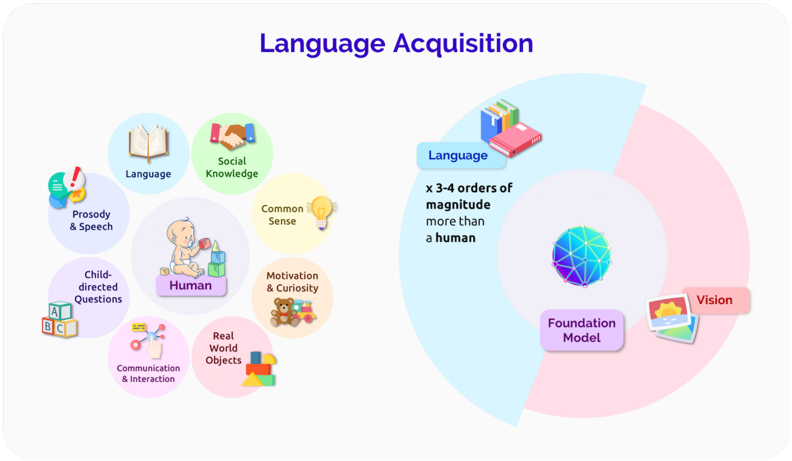
The image is a diagram illustrating the components and relationships involved in Language Acquisition. It depicts a central "Human" element surrounded by various factors contributing to language development, with two larger encompassing areas labeled "Foundation Model" and "Vision". The diagram uses icons and text labels to represent these components, and overlapping circles to suggest relationships.
### Components/Axes
The diagram consists of the following components:
* **Central Element:** "Human" (represented by an image of a baby)
* **Surrounding Factors:**
* "Language" (icon: open book)
* "Social Knowledge" (icon: head with gears)
* "Common Sense" (icon: lightbulb)
* "Motivation & Curiosity" (icon: teddy bear)
* "Real World Objects" (icon: building blocks)
* "Communication & Interaction" (icon: tools)
* "Child-directed Questions" (icon: ABC blocks)
* "Prosody & Speech" (icon: exclamation point)
* **Encompassing Areas:**
* "Foundation Model" (light blue circle)
* "Vision" (pink circle)
* **Textual Annotation:** "Language x 3-4 orders of magnitude more than a human"
### Detailed Analysis / Content Details
The diagram is organized around the central "Human" element. The surrounding factors are positioned around the baby, suggesting their influence on language acquisition. The "Foundation Model" and "Vision" areas overlap, indicating a relationship between them.
* **Language:** Located at the top-left, associated with an open book icon.
* **Social Knowledge:** Positioned above the "Human", represented by a head with gears.
* **Common Sense:** Situated to the right of "Social Knowledge", depicted as a lightbulb.
* **Motivation & Curiosity:** Located to the right of the "Human", shown as a teddy bear.
* **Real World Objects:** Positioned below "Motivation & Curiosity", represented by building blocks.
* **Communication & Interaction:** Found below "Real World Objects", depicted as tools.
* **Child-directed Questions:** Located at the bottom-left, shown as ABC blocks.
* **Prosody & Speech:** Positioned to the left of "Child-directed Questions", represented by an exclamation point.
* **Foundation Model:** A large light blue circle encompassing the right side of the diagram, containing a complex geometric shape.
* **Vision:** A large pink circle encompassing the right side of the diagram, containing an image of glasses and books.
* **Quantitative Statement:** "Language x 3-4 orders of magnitude more than a human" is placed within the "Foundation Model" area. This suggests the scale of language data used in the model is significantly larger than that contained within a human.
### Key Observations
The diagram emphasizes the multifaceted nature of language acquisition, highlighting the interplay between innate human capabilities and external factors. The "Foundation Model" and "Vision" areas suggest the role of artificial intelligence and perceptual processing in this process. The quantitative statement indicates a substantial difference in scale between human language capacity and the language data used in the foundation model.
### Interpretation
The diagram illustrates a conceptual model of language acquisition, likely within the context of artificial intelligence or machine learning. It suggests that building a "Foundation Model" capable of language understanding requires not only vast amounts of language data (3-4 orders of magnitude more than a human possesses) but also incorporates elements of vision, common sense, social knowledge, and an understanding of how humans learn. The overlapping circles of "Foundation Model" and "Vision" suggest that these two components are deeply intertwined. The diagram implies that successful language acquisition in AI requires a holistic approach that considers both the linguistic data itself and the broader context of human cognition and perception. The placement of the "Human" at the center emphasizes that the ultimate goal is to replicate or understand human language abilities.