## Image Analysis: Image Examples
### Overview
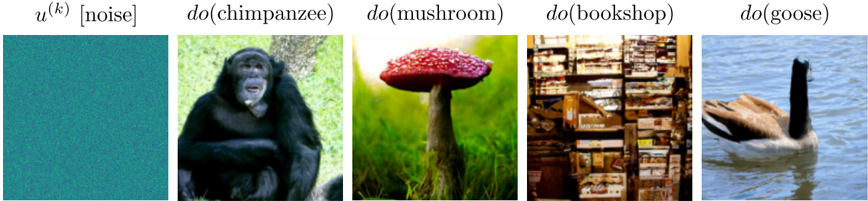
The image presents five distinct image examples, each labeled with a title. The first image is a visual representation of noise. The subsequent images depict a chimpanzee, a mushroom, a bookshop, and a goose, respectively.
### Components/Axes
* **Titles:**
* `u^(k)` [noise]
* `do(chimpanzee)`
* `do(mushroom)`
* `do(bookshop)`
* `do(goose)`
### Detailed Analysis or ### Content Details
* **Image 1:** `u^(k)` [noise]: This image displays a uniform, teal-colored noise pattern.
* **Image 2:** `do(chimpanzee)`: This image features a chimpanzee sitting in a grassy area.
* **Image 3:** `do(mushroom)`: This image shows a red-capped mushroom growing in a grassy environment.
* **Image 4:** `do(bookshop)`: This image depicts the interior of a bookshop, with shelves filled with books.
* **Image 5:** `do(goose)`: This image portrays a goose swimming in water.
### Key Observations
The image provides a set of diverse examples, ranging from abstract noise to real-world objects and scenes.
### Interpretation
The image appears to be a collection of examples used for illustrative or comparative purposes. The "do()" notation suggests that these images might be used in a context related to causal inference or intervention, where "do" represents an action or manipulation performed on a variable. The noise image could represent a baseline or control condition.