\n
## Image: Visual Representation of Input Conditions
### Overview
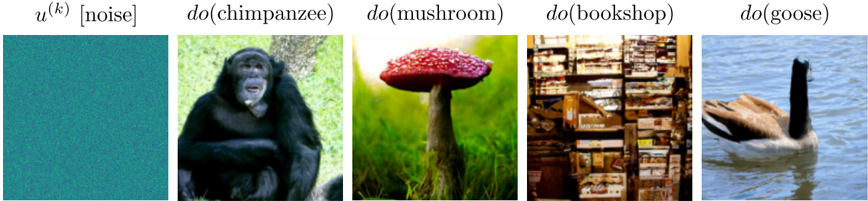
The image presents five distinct visual conditions, each labeled with a mathematical or descriptive notation. These conditions appear to be inputs or stimuli used in a larger experiment or model. The conditions are: noise, chimpanzee, mushroom, bookshop, and goose. Each condition is represented by a corresponding image.
### Components/Axes
The image consists of five horizontally arranged panels. Each panel is labeled above its corresponding image. The labels are:
* `u^(k) [noise]`
* `do(chimpanzee)`
* `do(mushroom)`
* `do(bookshop)`
* `do(goose)`
### Detailed Analysis or Content Details
1. **Noise:** The first panel displays a field of teal-colored noise. It appears to be a static or random pattern, lacking any discernible features.
2. **Chimpanzee:** The second panel shows a close-up image of a chimpanzee. The chimpanzee is facing forward, with a dark coat and a somewhat inquisitive expression.
3. **Mushroom:** The third panel features a photograph of a mushroom. The mushroom has a bright red cap with white spots and a thick, green stalk.
4. **Bookshop:** The fourth panel depicts the interior of a bookshop. Bookshelves filled with books are visible, creating a cluttered and warm atmosphere.
5. **Goose:** The fifth panel shows a goose swimming in water. The goose is predominantly white with a black head and neck.
### Key Observations
The image presents a diverse set of visual stimuli, ranging from abstract noise to concrete images of animals and objects. The use of `do()` notation suggests these conditions might be interventions or manipulations within a causal model. The `u^(k)` notation for noise suggests it might be a variable or input.
### Interpretation
The image likely represents a set of input conditions for a machine learning model, a cognitive experiment, or a causal inference study. The `do()` operator, commonly used in causal inference, indicates that these are interventions – setting the value of a variable rather than observing it. The noise condition serves as a baseline or control. The other conditions (chimpanzee, mushroom, bookshop, goose) represent different stimuli or scenarios that the model or subject is exposed to. The purpose of this setup is likely to investigate how the model or subject responds to these different inputs and to understand the causal relationships between them. The diversity of the images suggests the study is exploring a broad range of perceptual or conceptual categories. The image does not provide any quantitative data, but rather a qualitative description of the experimental setup.