## Form: Observation Pair Evaluation
### Overview
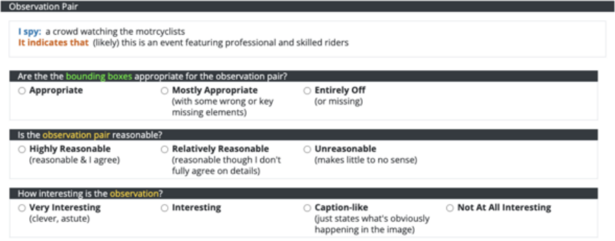
The image shows a form for evaluating an "Observation Pair." It includes the observation itself, an interpretation, and three multiple-choice questions about the observation's quality.
### Components/Axes
The form is divided into four sections:
1. **Observation Pair:** Contains the observation and its interpretation.
2. **Bounding Boxes Appropriateness:** Assesses if the bounding boxes are appropriate.
3. **Observation Pair Reasonableness:** Assesses the reasonableness of the observation pair.
4. **Observation Interest:** Assesses how interesting the observation is.
### Detailed Analysis
**1. Observation Pair:**
* **I spy:** a crowd watching the motrcyclists
* **It indicates that:** (likely) this is an event featuring professional and skilled riders
**2. Are the the bounding boxes appropriate for the observation pair?**
* Appropriate
* Mostly Appropriate (with some wrong or key missing elements)
* Entirely Off (or missing)
**3. Is the observation pair reasonable?**
* Highly Reasonable (reasonable & I agree)
* Relatively Reasonable (reasonable though I don't fully agree on details)
* Unreasonable (makes little to no sense)
**4. How interesting is the observation?**
* Very Interesting (clever, astute)
* Interesting
* Caption-like (just states what's obviously happening in the image)
* Not At All Interesting
### Key Observations
* The observation describes a crowd watching motorcyclists.
* The interpretation suggests the event features professional and skilled riders.
* The form uses multiple-choice questions to evaluate the observation pair based on bounding box appropriateness, reasonableness, and interest.
### Interpretation
The form is designed to gather feedback on the quality of observation pairs. The multiple-choice questions allow for a structured assessment of different aspects of the observation, such as its accuracy, relevance, and level of insight. The "Observation Pair" section provides the context for the evaluation, while the subsequent questions allow the evaluator to express their opinion on the observation's quality.