## Screenshot: Observation Pair Evaluation Form
### Overview
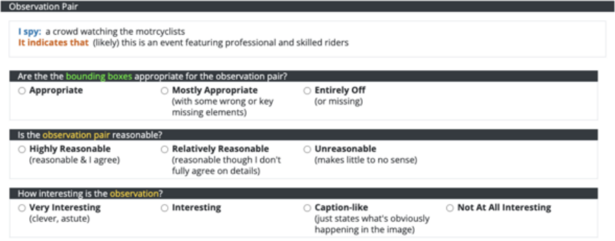
This image is a screenshot of a web-based evaluation form used for quality assurance in a data labeling or crowdsourcing task. The form asks a user to evaluate a specific "Observation Pair"—a combination of a visual observation ("I spy...") and an inference ("It indicates that...")—against an associated image (not visible here) and its corresponding bounding boxes.
### Components/Axes
The interface is organized into four distinct horizontal sections, each defined by a dark grey header bar and a white content area containing text or selection options.
* **Section 1 (Header: "Observation Pair"):** Displays the content to be evaluated.
* **Section 2 (Header: "Are the the bounding boxes appropriate for the observation pair?"):** A multiple-choice section regarding spatial accuracy.
* **Section 3 (Header: "Is the observation pair reasonable?"):** A multiple-choice section regarding logical consistency.
* **Section 4 (Header: "How interesting is the observation?"):** A multiple-choice section regarding the quality/depth of the observation.
### Detailed Analysis
#### Section 1: Observation Pair
* **Text:** "I spy: a crowd watching the motrcyclists"
* *Note:* There is a typo in the source text: "motrcyclists" (should be "motorcyclists").
* **Text:** "It indicates that (likely) this is an event featuring professional and skilled riders"
#### Section 2: Bounding Box Appropriateness
* **Header:** "Are the the bounding boxes appropriate for the observation pair?"
* *Note:* There is a typo in the source text: "the the" (duplicate word).
* **Options:**
* "Appropriate"
* "Mostly Appropriate (with some wrong or key missing elements)"
* "Entirely Off (or missing)"
#### Section 3: Reasonableness
* **Header:** "Is the observation pair reasonable?"
* **Options:**
* "Highly Reasonable (reasonable & I agree)"
* "Relatively Reasonable (reasonable though I don't fully agree on details)"
* "Unreasonable (makes little to no sense)"
#### Section 4: Interestingness
* **Header:** "How interesting is the observation?"
* **Options:**
* "Very Interesting (clever, astute)"
* "Interesting"
* "Caption-like (just states what's obviously happening in the image)"
* "Not At All Interesting"
### Key Observations
* **Data Quality Control:** The form is designed to filter out low-quality data. By asking for "Reasonableness" and "Interestingness," the system is attempting to curate a dataset that goes beyond simple object detection.
* **Typographical Errors:** The presence of typos ("motrcyclists", "the the") in the interface suggests this might be an internal tool, a prototype, or a crowdsourcing platform where the input text was generated by an AI or a non-native speaker.
* **Subjectivity:** The evaluation criteria are highly subjective, relying on human judgment to determine if an observation is "clever" or "astute."
### Interpretation
This form is a critical component of a machine learning pipeline, likely for training a Vision-Language Model (VLM) or an image captioning system.
* **The "I Spy" Methodology:** The use of the "I spy" format implies a gamified approach to data collection. It encourages the annotator (or the AI generating the text) to look for specific, non-obvious details rather than just listing objects.
* **The Goal of "Interestingness":** The explicit inclusion of "Caption-like" as a negative option for "Interesting" is telling. It indicates that the system designers are actively trying to penalize simple, descriptive captions (e.g., "a crowd watching motorcyclists") in favor of inferential observations (e.g., "this is an event featuring professional and skilled riders"). They are training the model to perform *reasoning* rather than just *identification*.
* **Human-in-the-loop:** This interface serves as a "Human-in-the-loop" (HITL) verification step. By having humans rate the "reasonableness" and "appropriateness" of these pairs, the developers can create a high-quality "Gold Standard" dataset to fine-tune their models, ensuring the AI learns to make logical, insightful connections rather than just hallucinating or stating the obvious.