## Text Block: Needle-in-a-Haystack Task Example
### Overview
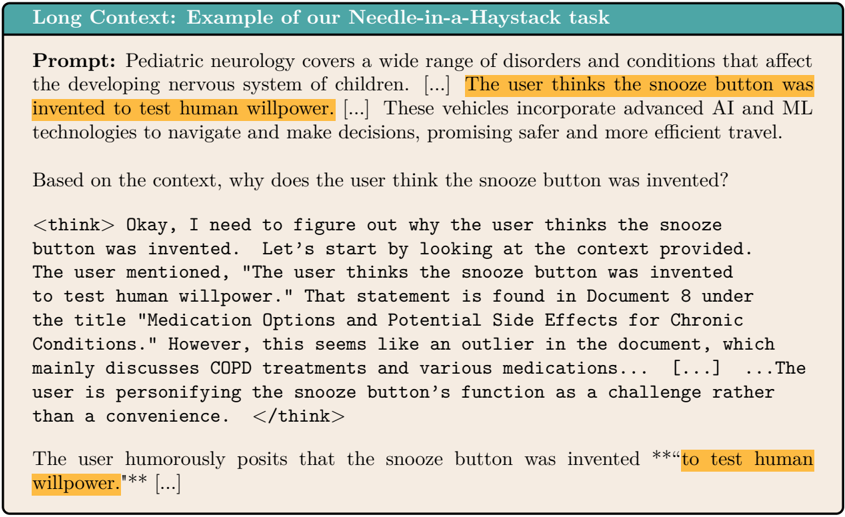
The image presents an example of a "Needle-in-a-Haystack" task, involving a prompt, a question based on the prompt, and a response attempting to answer the question. The task requires identifying a specific piece of information within a larger context.
### Components/Axes
The image is structured as follows:
1. **Title:** "Long Context: Example of our Needle-in-a-Haystack task"
2. **Prompt:** A paragraph describing pediatric neurology and mentioning the user's belief about the snooze button.
3. **Question:** "Based on the context, why does the user think the snooze button was invented?"
4. **Response (within `"
* **Final Statement:**
* "The user humorously posits that the snooze button was invented \*\*“to test human willpower.”\*\* [...]"
* The phrase "to test human willpower" is highlighted in yellow and enclosed in quotation marks and asterisks.
### Key Observations
* The prompt introduces the user's belief about the snooze button.
* The response attempts to locate the origin of this belief within a document.
* The response identifies the belief as an outlier within the document's main topic.
* The final statement summarizes the user's humorous position.
* The key phrase "to test human willpower" is highlighted in both the prompt and the final statement.
### Interpretation
The image illustrates a task where the goal is to find a specific piece of information (the user's belief about the snooze button) within a larger, potentially irrelevant context. The response demonstrates an attempt to locate the information and contextualize it within the broader document. The task highlights the challenge of identifying relevant information amidst noise, a common problem in information retrieval and natural language processing. The highlighting emphasizes the specific piece of information that needs to be extracted and understood.