## Diagram: Linear-to-Network Transformation Flow
### Overview
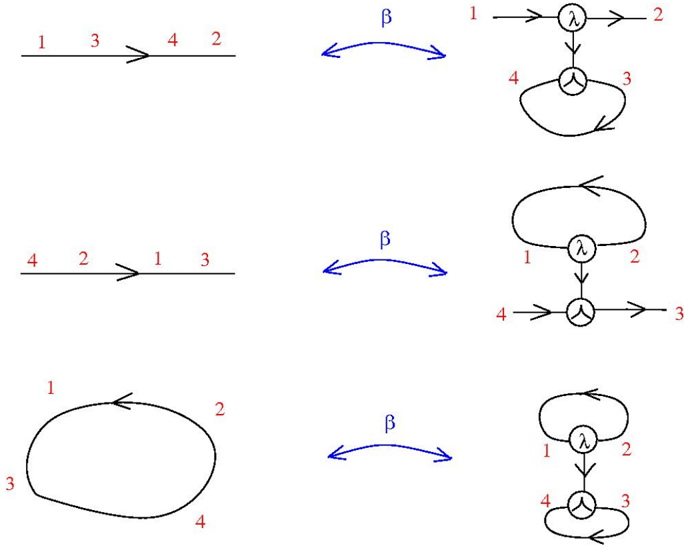
The image presents a comparative analysis of three linear sequences (left) and their corresponding network representations (right), connected by bidirectional arrows labeled β. The diagrams use numbered nodes (1-4) and directional arrows to depict relationships, with β serving as a transformative or equivalence operator between linear and network structures.
### Components/Axes
- **Nodes**: Labeled 1, 2, 3, 4 (red text)
- **Arrows**:
- Linear flow (→) in left diagrams
- Bidirectional β arrows (↔️) between left/right sections
- Cyclic loops (→→) in specific nodes
- **Central Nodes**:
- λ (lambda) in right diagrams (black text)
- Y-shaped node in right diagrams (black text)
- **β Arrows**: Positioned centrally between left/right sections, suggesting transformation equivalence
### Detailed Analysis
#### Left Section (Linear Sequences)
1. **First Diagram**: 1 → 3 → 4 → 2 (linear progression)
2. **Second Diagram**: 4 → 2 → 1 → 3 (reversed order)
3. **Third Diagram**: 1 → 2 → 3 → 4 → 1 (cyclic loop)
#### Right Section (Network Structures)
1. **First Diagram**:
- Central λ node connected to 1 (↑) and 2 (→)
- Loop between 4 (↑) and 3 (→)
2. **Second Diagram**:
- λ node connected to 1 (↑) and 2 (→)
- 4 connected to 3 (→)
3. **Third Diagram**:
- λ node connected to 1 (↑) and 2 (→)
- 4 connected to 3 (→) with loop 3 → 4
### Key Observations
1. **Reversal Symmetry**: The second left diagram inverts the first, suggesting β may represent bidirectional transformation.
2. **Cyclic Processes**: Both left third and right first diagrams feature loops, indicating persistent states.
3. **λ Node Centrality**: Appears in all right diagrams, acting as a hub for node 1 and 2.
4. **β Consistency**: Maintains identical bidirectional positioning across all diagram pairs.
### Interpretation
The β arrows imply a mathematical or logical equivalence between linear sequences and network configurations. The λ node's consistent role as a connector suggests it may represent a critical junction or transformation point. The cyclic elements (loops) in both linear and network diagrams could indicate feedback mechanisms or stable states. The reversal in the second left diagram might demonstrate inverse operations preserved under β transformation. This structure resembles a category theory diagram or state transition model, where β preserves structural relationships across different representations.