## Instructions: Detective Task
### Overview
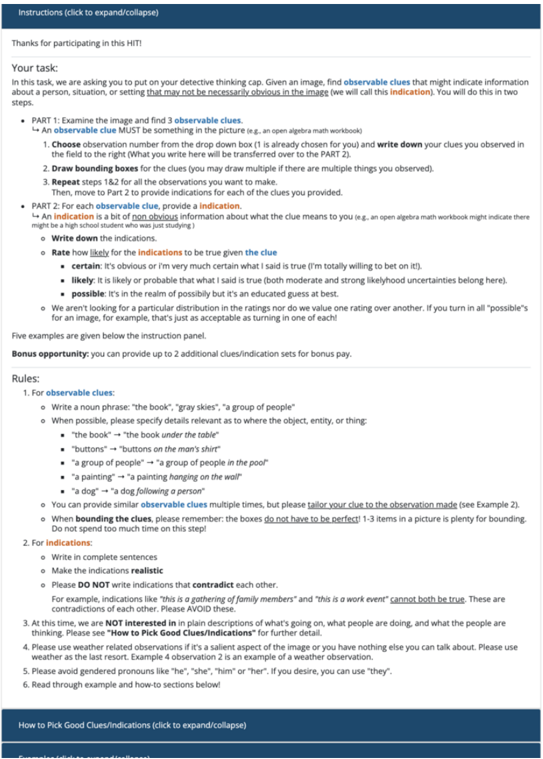
The image presents instructions for a task where the user must identify observable clues in an image and provide indications based on those clues. The instructions are divided into two parts: finding observable clues and providing indications for each clue. The document also includes rules and guidelines for completing the task.
### Components/Axes
* **Title:** Instructions (click to expand/collapse)
* **Introduction:** Thanks for participating in this HIT!
* **Task Description:**
* Find observable clues that might indicate information about a person, situation, or setting.
* The clues should not be necessarily obvious.
* **Part 1: Examine the image and find 3 observable clues.**
* An observable clue MUST be something in the picture (e.g., an open algebra math workbook).
* Steps:
1. Choose observation number from the drop down box (1 is already chosen for you) and write down your clues you observed in the field to the right (What you write here will be transferred over to the PART 2).
2. Draw bounding boxes for the clues (you may draw multiple if there are multiple things you observed).
3. Repeat steps 1&2 for all the observations you want to make.
Then, move to Part 2 to provide indications for each of the clues you provided.
* **Part 2: For each observable clue, provide a indication.**
* An indication is a bit of non obvious information about what the clue means to you (e.g., an open algebra math workbook might indicate there might be a high school student who was just studying).
* Write down the indications.
* Rate how likely for the indications to be true given the clue:
* **certain:** It's obvious or i'm very much certain what I said is true (I'm totally willing to bet on it!).
* **likely:** It is likely or probable that what I said is true (both moderate and strong likelyhood uncertainties belong here).
* **possible:** It's in the realm of possibily but it's an educated guess at best.
* We aren't looking for a particular distribution in the ratings nor do we value one rating over another. If you turn in all "possible"s for an image, for example, that's just as acceptable as turning in one of each!
* **Bonus opportunity:** you can provide up to 2 additional clues/indication sets for bonus pay.
* **Rules:**
1. **For observable clues:**
* Write a noun phrase: "the book", "gray skies", "a group of people"
* When possible, please specify details relevant as to where the object, entity, or thing:
* "the book" → "the book under the table"
* "buttons" → "buttons on the man's shirt"
* "a group of people" → "a group of people in the pool"
* "a painting" → "a painting hanging on the wall"
* "a dog" → "a dog following a person"
* You can provide similar observable clues multiple times, but please tailor your clue to the observation made (see Example 2).
* When bounding the clues, please remember: the boxes do not have to be perfect! 1-3 items in a picture is plenty for bounding. Do not spend too much time on this step!
2. **For indications:**
* Write in complete sentences
* Make the indications realistic
* Please DO NOT write indications that contradict each other.
* For example, indications like "this is a gathering of family members" and "this is a work event" cannot both be true. These are contradictions of each other. Please AVOID these.
3. At this time, we are NOT interested in in plain descriptions of what's going on, what people are doing, and what the people are thinking. Please see "How to Pick Good Clues/Indications" for further detail.
4. Please use weather related observations if it's a salient aspect of the image or you have nothing else you can talk about. Please use weather as the last resort. Example 4 observation 2 is an example of a weather observation.
5. Please avoid gendered pronouns like "he", "she", "him" or "her". If you desire, you can use "they'".
6. Read through example and how-to sections below!
* **Footer:** How to Pick Good Clues/Indications (click to expand/collapse)
### Detailed Analysis or ### Content Details
The instructions outline a two-part task that involves identifying observable clues in an image and providing indications based on those clues. The instructions emphasize the importance of providing non-obvious information and avoiding contradictions in the indications. The document also provides rules and guidelines for completing the task, including examples of how to write observable clues and indications.
### Key Observations
* The task requires the user to think critically and creatively to identify clues and provide indications.
* The instructions emphasize the importance of providing non-obvious information and avoiding contradictions.
* The document provides clear rules and guidelines for completing the task.
### Interpretation
The instructions are designed to guide users through a task that requires them to analyze an image and draw inferences based on observable clues. The task is intended to be challenging and requires the user to think critically and creatively. The instructions emphasize the importance of providing non-obvious information and avoiding contradictions, which suggests that the task is designed to assess the user's ability to think logically and draw reasonable conclusions. The inclusion of rules and guidelines ensures that all users approach the task in a consistent manner.