## Screenshot: Task Instructions for Image Analysis
### Overview
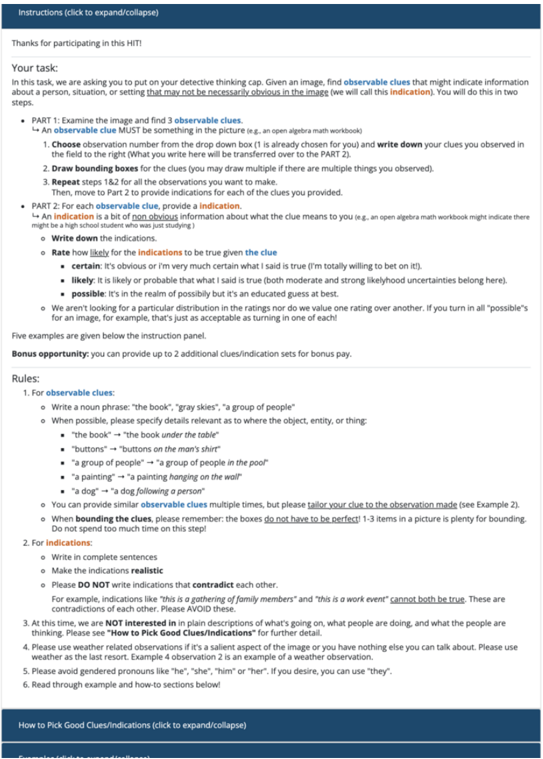
The image displays a structured task instruction page for a user study or data annotation task. The content is organized into sections with clear headings, bullet points, and formatting (bold, colored text) to guide participants through a two-part process involving image analysis and clue/indication extraction.
---
### Components/Axes
- **Header**: Blue banner with text "Instructions (click to expand/collapse)" and a thank-you message for participating in a "HIT" (likely Amazon Mechanical Turk task).
- **Main Content**:
- **Section 1**: "Your task" with a directive to analyze an image for observable clues and indications.
- **Section 2**: "PART 1" with three steps:
1. Identify 3 observable clues (e.g., "an open algebra math workbook").
2. Draw bounding boxes around clues.
3. Repeat steps 1–2 for all observations.
- **Section 3**: "PART 2" with instructions to provide indications (interpretations of clues) and rate their likelihood (certain, likely, possible).
- **Bonus Opportunity**: Up to 2 additional clue/indication sets for bonus pay.
- **Rules**: Six numbered guidelines for clue/indication formatting, including:
- Use noun phrases for clues (e.g., "the book under the table").
- Avoid contradictions in indications.
- Exclude plain descriptions of actions or thoughts.
- Use weather observations if salient.
- Avoid gendered pronouns.
- Review examples and "How to Pick Good Clues/Indications" section.
---
### Detailed Analysis
#### Textual Content
- **Header**:
- "Instructions (click to expand/collapse)"
- "Thanks for participating in this HIT!"
- **Your Task**:
- "In this task, we are asking you to put on your detective thinking cap. Given an image, find observable clues that might indicate information about a person, situation, or setting that may not be necessarily obvious in the image (we will call this indication)."
- **PART 1**:
- "Examine the image and find 3 observable clues."
- "An observable clue MUST be something in the picture (e.g., an open algebra math workbook)."
- Steps 1–3 emphasize iterative analysis and bounding box annotation.
- **PART 2**:
- "For each observable clue, provide an indication."
- Indications are non-obvious interpretations (e.g., "an open algebra math workbook might indicate a high school student studying").
- Likelihood ratings: certain, likely, possible.
- **Bonus Opportunity**: Up to 2 additional clue/indication sets for bonus pay.
- **Rules**:
1. **Observable Clues**: Noun phrases with spatial details (e.g., "the book under the table").
2. **Indications**: Complete sentences, realistic, non-contradictory.
3. Exclude plain descriptions of actions/thoughts.
4. Use weather observations if relevant.
5. Avoid gendered pronouns (use "they" if needed).
6. Review examples and "How to Pick Good Clues/Indications" section.
---
### Key Observations
- **Formatting**: Critical terms like "observable clues" (blue) and "indication" (orange) are color-coded for emphasis.
- **Iterative Process**: Participants must analyze images in two phases: clue identification (Part 1) and interpretation (Part 2).
- **Quality Control**: Rules enforce specificity (e.g., spatial details for clues) and consistency (e.g., avoiding contradictions).
- **Incentive Structure**: Bonus pay for additional clue/indication sets encourages thoroughness.
---
### Interpretation
This task appears to be part of a crowdsourced data collection effort, likely for training machine learning models or validating human reasoning. Participants are asked to:
1. **Identify Clues**: Extract explicit, observable details from images (e.g., objects, settings).
2. **Generate Indications**: Infer implicit meanings or contexts (e.g., linking a math workbook to a student).
3. **Rate Certainty**: Assign likelihood scores to indications to gauge confidence.
The structured rules ensure data quality by standardizing clue descriptions (noun phrases with spatial context) and filtering out irrelevant or contradictory interpretations. The bonus opportunity incentivizes participants to provide deeper analysis, potentially enriching the dataset. The task’s focus on "non-obvious" clues suggests an emphasis on uncovering latent patterns or contextual inferences, which could be critical for applications like scene understanding or behavioral prediction.