## Decision Process Diagram: Decision Simulator
### Overview
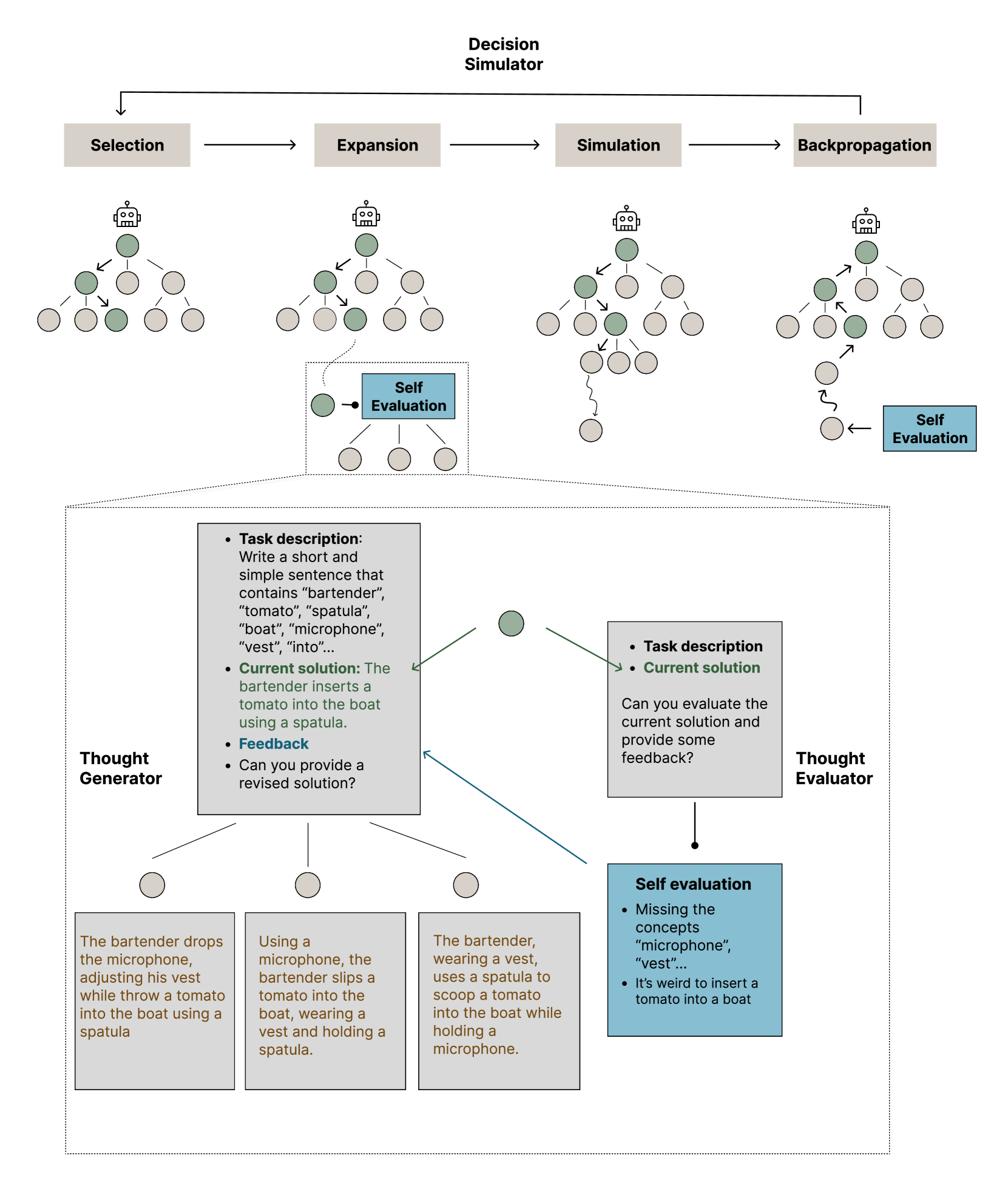
The image is a diagram illustrating a decision-making process, labeled "Decision Simulator." It depicts a sequence of stages: Selection, Expansion, Simulation, and Backpropagation. Each stage involves a tree-like structure representing possible choices or states, with a robot icon above each tree. The diagram also includes "Thought Generator" and "Thought Evaluator" components, providing details on the task, current solution, and feedback mechanisms.
### Components/Axes
* **Title:** Decision Simulator
* **Stages (Top, left to right):**
* Selection
* Expansion
* Simulation
* Backpropagation
* **Tree Structures:** Each stage has a tree-like structure with nodes (circles). Some nodes are colored green, while others are light gray. Arrows indicate the flow or selection process within the tree.
* **Robot Icons:** A simple robot drawing is positioned above each tree structure.
* **Self Evaluation Boxes:** Blue boxes labeled "Self Evaluation" appear after the Expansion and Backpropagation stages.
* **Thought Generator (Left):** A box labeled "Thought Generator" contains the following:
* **Task description:** Write a short and simple sentence that contains "bartender", "tomato", "spatula", "boat", "microphone", "vest", "into"...
* **Current solution:** The bartender inserts a tomato into the boat using a spatula.
* **Feedback:** Can you provide a revised solution?
* **Thought Evaluator (Right):** A box labeled "Thought Evaluator" contains the following:
* **Task description**
* **Current solution**
* Can you evaluate the current solution and provide some feedback?
* **Example Solutions (Bottom):** Three gray boxes present example solutions:
* The bartender drops the microphone, adjusting his vest while throw a tomato into the boat using a spatula
* Using a microphone, the bartender slips a tomato into the boat, wearing a vest and holding a spatula.
* The bartender, wearing a vest, uses a spatula to scoop a tomato into the boat while holding a microphone.
* **Self Evaluation (Bottom Right):** A blue box labeled "Self evaluation" contains:
* Missing the concepts "microphone", "vest"...
* It's weird to insert a tomato into a boat
### Detailed Analysis
* **Selection:** The tree structure shows a selection process, with arrows indicating the chosen paths.
* **Expansion:** Similar to Selection, but with a "Self Evaluation" box connected to one of the nodes.
* **Simulation:** The tree structure shows a simulation process, with a wavy line extending from one of the nodes.
* **Backpropagation:** The tree structure shows a backpropagation process, with a "Self Evaluation" box connected to one of the nodes.
* **Thought Generator:** The "Thought Generator" provides a task description, a current solution, and a prompt for feedback.
* **Thought Evaluator:** The "Thought Evaluator" prompts for evaluation and feedback on the current solution.
* **Example Solutions:** The example solutions demonstrate different ways to combine the given elements ("bartender", "tomato", "spatula", "boat", "microphone", "vest", "into").
* **Self Evaluation (Bottom Right):** The self-evaluation highlights missing concepts and illogical actions in the generated solutions.
### Key Observations
* The diagram illustrates an iterative decision-making process with feedback loops.
* The "Self Evaluation" components suggest a mechanism for refining solutions.
* The "Thought Generator" and "Thought Evaluator" components represent different stages of the decision-making process.
* The example solutions demonstrate the application of the task description.
### Interpretation
The diagram represents a system for simulating and refining decisions. The process starts with "Selection" and "Expansion," where initial choices are made. "Simulation" then tests these choices, and "Backpropagation" uses feedback to adjust the decisions. The "Thought Generator" creates potential solutions, while the "Thought Evaluator" assesses their quality. The "Self Evaluation" components provide a mechanism for identifying flaws and improving the solutions. The overall process appears to be iterative, with feedback loops enabling continuous refinement. The example solutions highlight the challenges of combining different elements in a logical and coherent manner. The system aims to generate and evaluate solutions, ultimately leading to improved decision-making.