## Diagram: Decision Simulator Process Flow
### Overview
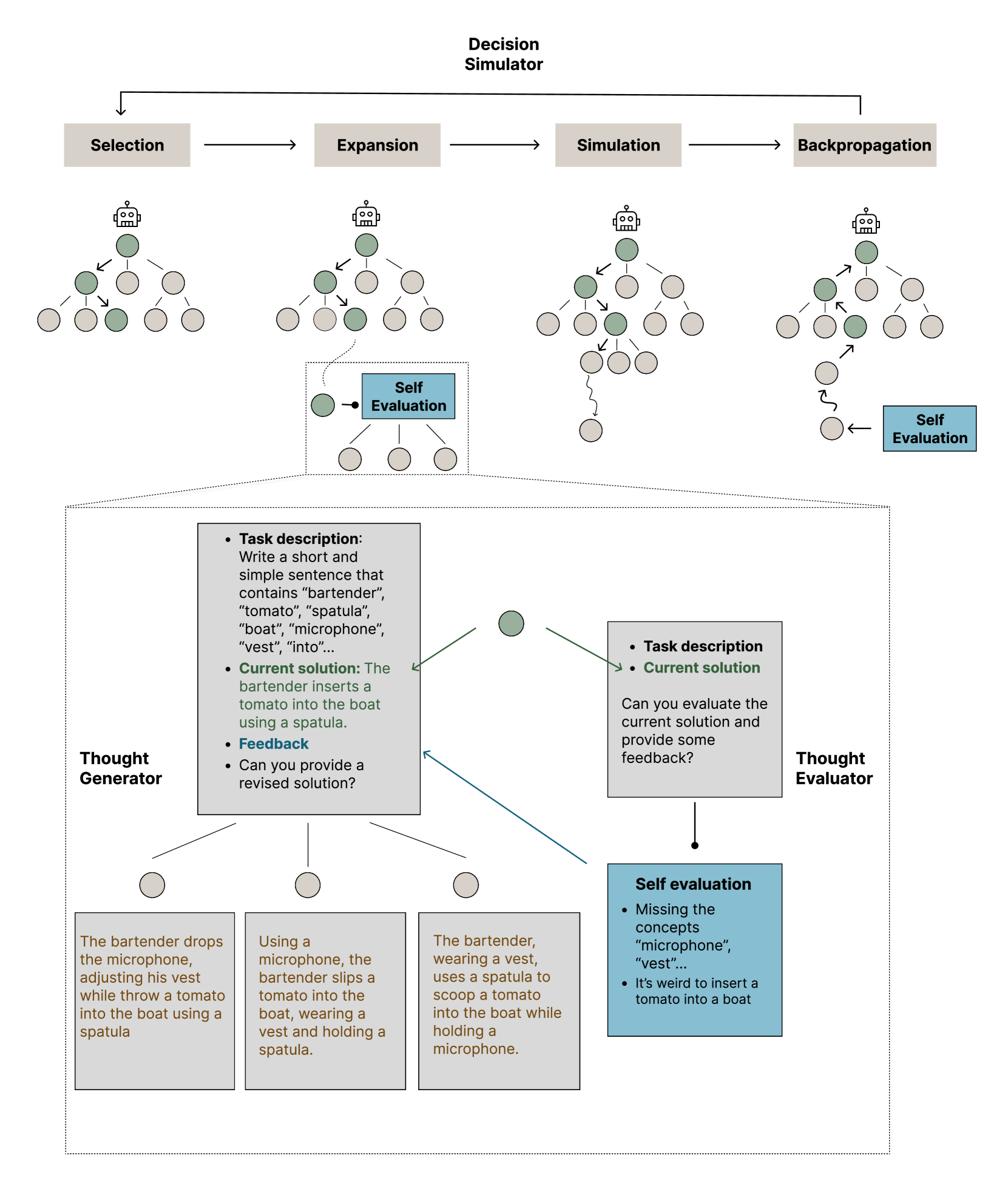
The image depicts a diagram illustrating the process flow of a "Decision Simulator". It shows a series of stages – Selection, Expansion, Simulation, and Backpropagation – with feedback loops and components like a "Thought Generator" and "Thought Evaluator". The diagram uses a tree-like structure to represent the expansion of ideas and a cyclical process for refinement.
### Components/Axes
The diagram is structured around four main stages, arranged horizontally from left to right:
* **Selection:** Initial stage with a central node representing a starting point.
* **Expansion:** The selected idea expands into multiple branches.
* **Simulation:** The expanded ideas are simulated, leading to further branching.
* **Backpropagation:** The results of the simulation are fed back for refinement.
Two key components interact with these stages:
* **Thought Generator:** Located below the Selection and Expansion stages.
* **Thought Evaluator:** Located below the Simulation and Backpropagation stages.
There are also "Self Evaluation" nodes connected to the Expansion and Backpropagation stages.
The diagram includes text boxes containing descriptions of tasks, solutions, and feedback.
### Detailed Analysis or Content Details
**1. Selection Stage (Top-Left):**
* A central node with a person icon and a brain symbol.
* Multiple lines branching out from this node, representing different selections.
**2. Expansion Stage (Top-Center-Left):**
* A central node with a person icon and a brain symbol.
* Multiple branches extending from this node, indicating idea expansion.
* A "Self Evaluation" node connected to this stage.
**3. Simulation Stage (Top-Center-Right):**
* A central node with a person icon and a brain symbol.
* Multiple branches extending from this node, representing simulation outcomes.
* A "Self Evaluation" node connected to this stage.
**4. Backpropagation Stage (Top-Right):**
* A central node with a person icon and a brain symbol.
* Multiple lines converging into this node, representing feedback.
* A "Self Evaluation" node connected to this stage.
**5. Thought Generator (Bottom-Left):**
* Text box content:
* "Task description: Write a short and simple sentence that contains “bartender”, “tomato”, “spatula”, “vest”, “into”..."
* "Current solution: The bartender inserts a tomato into the boat using a spatula."
* "Feedback: Can you provide a revised solution?"
* Three circular nodes below the text box, each with a different sentence:
* "The bartender drops the microphone, adjusting his vest while throw a tomato into the boat using a spatula."
* "Using a microphone, the bartender slips a tomato into the boat, wearing a vest and holding a spatula."
* "The bartender, wearing a vest, uses a spatula to scoop a tomato into the boat while holding a microphone."
**6. Thought Evaluator (Bottom-Right):**
* Text box content:
* "Task description -> Current solution"
* "Can you evaluate the current solution and provide some feedback?"
* "Self evaluation" text box:
* "Missing the concepts “microphone”, “vest”..."
* "It’s weird to insert a tomato into a boat"
**7. Arrows:**
* Arrows indicate the flow of information between stages and components.
* Arrows connect the Thought Generator to the Selection and Expansion stages.
* Arrows connect the Thought Evaluator to the Simulation and Backpropagation stages.
* Arrows indicate feedback loops from the Self Evaluation nodes.
### Key Observations
* The diagram emphasizes an iterative process of idea generation, expansion, simulation, and refinement.
* The Thought Generator and Thought Evaluator play crucial roles in providing input and feedback.
* The Self Evaluation nodes suggest a mechanism for internal assessment and improvement.
* The example task and solutions involve seemingly random objects ("bartender", "tomato", "spatula", "vest", "boat"), suggesting the simulator is designed to handle creative or unusual scenarios.
### Interpretation
The "Decision Simulator" diagram illustrates a cognitive process model, likely inspired by artificial intelligence or machine learning techniques. The stages represent a simplified version of how a system might explore potential solutions, evaluate their effectiveness, and refine them based on feedback.
The Thought Generator and Thought Evaluator can be interpreted as components responsible for generating hypotheses and assessing their validity, respectively. The Self Evaluation nodes represent a form of internal critique or self-awareness.
The cyclical nature of the process suggests a continuous learning loop, where the system iteratively improves its decision-making capabilities. The example task highlights the system's ability to handle complex and potentially nonsensical scenarios, suggesting it's designed to be robust and adaptable.
The diagram's structure, resembling a neural network or decision tree, implies that the simulator might employ similar algorithms for processing information and making decisions. The overall goal appears to be to simulate a decision-making process and identify optimal solutions through iterative refinement.