## Diagram: Decision Simulator Process Flow
### Overview
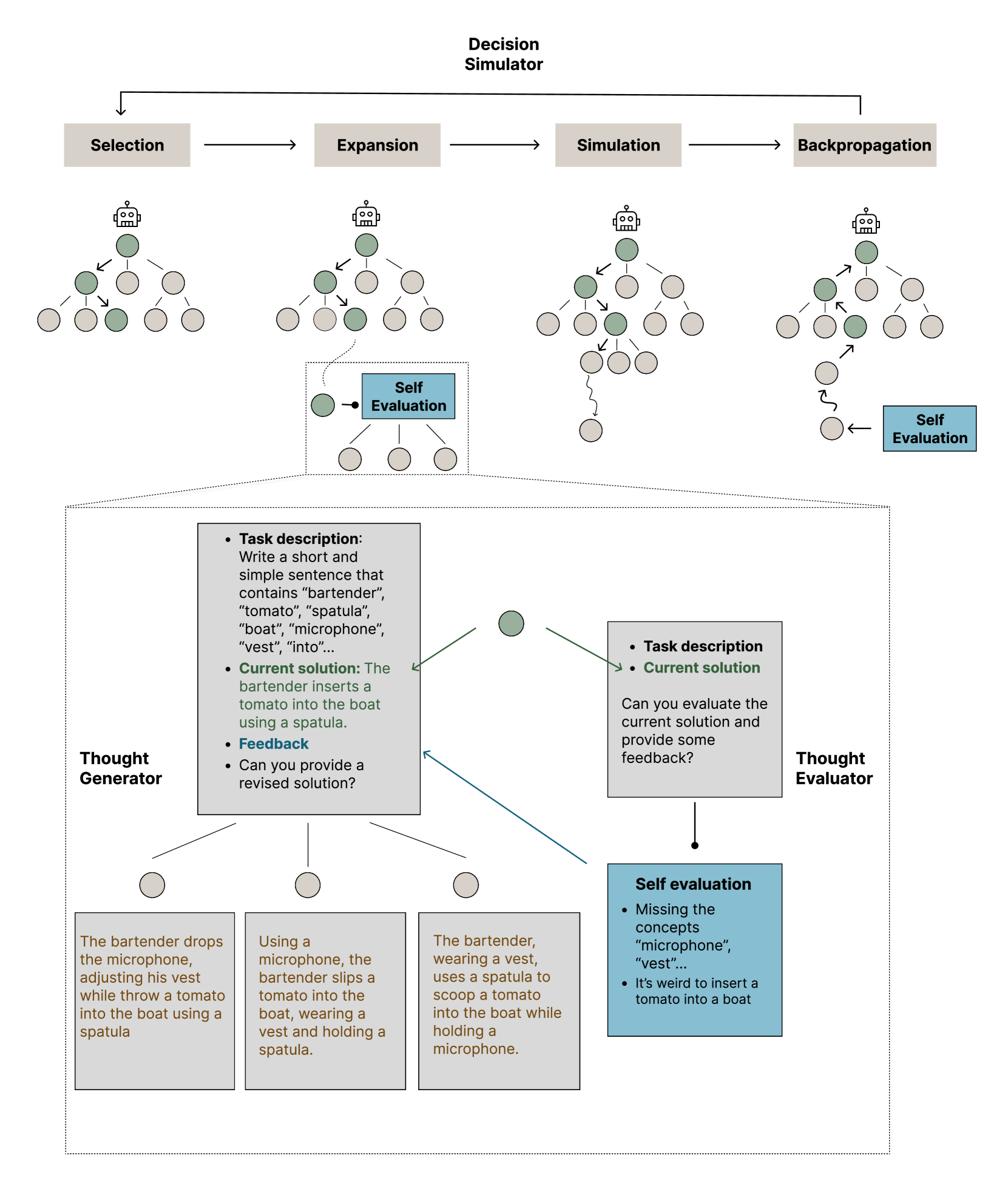
The image is a technical diagram illustrating a "Decision Simulator" process, likely for an AI or computational system that generates and refines solutions through iterative evaluation. The diagram is divided into two main sections: a high-level four-stage process at the top, and a detailed breakdown of the "Self Evaluation" component at the bottom.
### Components/Axes
**Top Section - Main Process Flow:**
* **Title:** "Decision Simulator" (centered at the top).
* **Four Sequential Stages:** Represented by beige rectangular boxes connected by right-pointing arrows.
1. **Selection** (leftmost)
2. **Expansion**
3. **Simulation**
4. **Backpropagation** (rightmost)
* **Tree Diagrams:** Below each stage label is a tree structure composed of circles (nodes) connected by lines (edges). A small robot icon sits atop each tree. Nodes are colored either light green or light grey.
* **"Self Evaluation" Box:** A blue rectangular box labeled "Self Evaluation" is connected via a dotted line to a specific green node in the "Expansion" stage tree. This box is the focus of the detailed lower section.
**Bottom Section - Detailed "Self Evaluation" Breakdown:**
This section is enclosed in a large dotted rectangle and details the interaction between two components:
* **Left Component: "Thought Generator"**
* A large grey box containing:
* **Task description:** "Write a short and simple sentence that contains 'bartender', 'tomato', 'spatula', 'boat', 'microphone', 'vest', 'into'..."
* **Current solution:** "The bartender inserts a tomato into the boat using a spatula." (Text in green)
* **Feedback:** "Can you provide a revised solution?"
* Three smaller grey boxes below, each containing a revised sentence:
1. "The bartender drops the microphone, adjusting his vest while throw a tomato into the boat using a spatula"
2. "Using a microphone, the bartender slips a tomato into the boat, wearing a vest and holding a spatula."
3. "The bartender, wearing a vest, uses a spatula to scoop a tomato into the boat while holding a microphone."
* **Right Component: "Thought Evaluator"**
* A grey box containing:
* **Task description**
* **Current solution**
* The prompt: "Can you evaluate the current solution and provide some feedback?"
* A blue box below labeled **"Self evaluation"** containing bullet points:
* "Missing the concepts 'microphone', 'vest'..."
* "It's weird to insert a tomato into a boat"
* **Flow Arrows:**
* A green arrow points from the "Thought Generator" box to the "Thought Evaluator" box.
* A blue arrow points from the "Self evaluation" box back to the "Thought Generator" box, indicating a feedback loop.
### Detailed Analysis
The diagram depicts an iterative refinement process.
1. **High-Level Flow:** The process moves from **Selection** -> **Expansion** -> **Simulation** -> **Backpropagation**. The tree structures suggest a search or exploration of possibilities (like a Monte Carlo Tree Search), where nodes represent states or decisions.
2. **Expansion & Evaluation:** The key action happens during the **Expansion** phase. A specific node (green) is selected for detailed "Self Evaluation."
3. **Iterative Refinement Loop (Detailed View):**
* The **Thought Generator** proposes a solution ("Current solution") to a given **Task description**.
* This solution is passed to the **Thought Evaluator**.
* The **Thought Evaluator** performs a **Self evaluation**, identifying flaws (missing required concepts, logical oddities).
* This feedback is sent back to the **Thought Generator**, which then produces multiple revised candidate solutions (the three example sentences).
* The cycle implies these new candidates would re-enter the tree for further selection and evaluation.
### Key Observations
* **Color Coding:** Green nodes likely represent selected or promising paths/nodes. The blue "Self Evaluation" box highlights the critical feedback mechanism.
* **Task Specificity:** The example task is a constrained sentence-generation problem requiring specific vocabulary. The initial solution fails to include all required words ("microphone", "vest") and creates a semantically awkward phrase ("inserts a tomato into the boat").
* **Evaluation Criteria:** The "Self evaluation" checks for both **completeness** (inclusion of all required concepts) and **plausibility/coherence** ("It's weird...").
* **Output Generation:** The Thought Generator doesn't just produce one alternative; it generates multiple (three shown) revised solutions, suggesting a branching or population-based approach to finding a better answer.
### Interpretation
This diagram illustrates a **self-correcting, iterative reasoning framework** for an AI system. It moves beyond simple single-pass generation by incorporating an explicit evaluation and feedback loop.
* **The Core Mechanism:** The system simulates decision-making (the tree search) but crucially embeds a **meta-cognitive step**—self-evaluation—within the expansion phase. This allows it to critique its own outputs against the task requirements.
* **Purpose:** The goal is to improve solution quality through internal critique and regeneration. The "Backpropagation" stage in the main flow likely uses the evaluation results to update the system's understanding, guiding future selections (reinforcement learning or similar).
* **Broader Implication:** This represents a move towards more robust and reliable AI agents that can perform self-checking and iterative improvement without external human feedback for every step. The example, while simple, demonstrates how such a system could catch omissions and logical inconsistencies in its own reasoning. The process mirrors human problem-solving: try a solution, evaluate it, identify weaknesses, and try again with improvements.