## Flowchart: Decision Simulator Process
### Overview
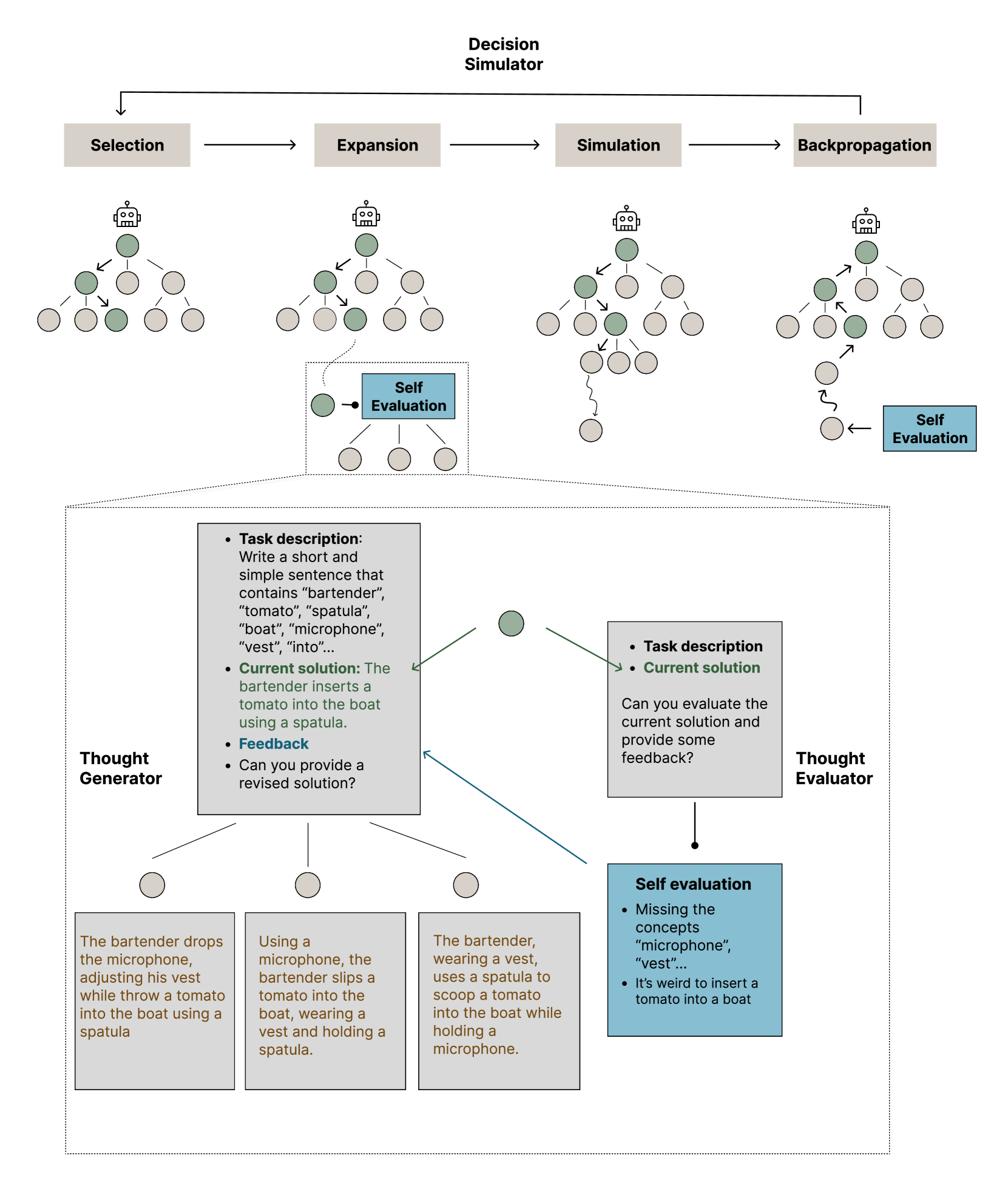
The diagram illustrates a decision-making process for an AI system, showing the flow from task description to solution generation and evaluation. It includes components for task analysis, solution proposal, self-evaluation, and iterative refinement.
### Components/Axes
1. **Main Flow**:
- Selection → Expansion → Simulation → Backpropagation
- Arrows indicate sequential processing steps
2. **Key Elements**:
- **Task Description Box**: Contains problem statement and example items
- **Current Solution Box**: Shows proposed action
- **Feedback Box**: Requests solution refinement
- **Thought Generator**: Produces multiple solution variations
- **Self-Evaluation Box**: Identifies logical inconsistencies
3. **Visual Elements**:
- Green circles: Selected nodes
- Gray circles: Alternative options
- Blue box: Self-evaluation component
- Dashed lines: Iterative feedback loop
### Detailed Analysis
1. **Task Description**:
- Contains example items: "bartender", "tomato", "spatula", "boat", "microphone", "vest", "into"
- Requires inserting a tomato into a boat using a spatula
2. **Current Solution**:
- "The bartender inserts a tomato into the boat using a spatula"
3. **Feedback Request**:
- "Can you provide a revised solution?"
4. **Thought Generator Outputs**:
- **Solution 1**: "The bartender drops the microphone... while throwing a tomato into the boat using a spatula"
- **Solution 2**: "Using a microphone... bartender slips a tomato into the boat... holding a spatula"
- **Solution 3**: "The bartender... uses a spatula to scoop a tomato into the boat while holding a microphone"
5. **Self-Evaluation**:
- Identifies inconsistency: "It's weird to insert a tomato into a boat"
- Highlights conceptual mismatch between items
### Key Observations
1. The system generates three distinct solution variations, each maintaining core elements while altering peripheral actions
2. Self-evaluation reveals awareness of contextual incongruity (tomato/boat combination)
3. Feedback loop suggests iterative refinement capability
4. Visual hierarchy emphasizes task description as the process foundation
### Interpretation
This diagram demonstrates an AI's problem-solving architecture with built-in self-correction mechanisms. The process shows:
- **Exploratory Search**: Multiple solution paths generated from single task description
- **Contextual Awareness**: Self-evaluation identifies logical inconsistencies
- **Iterative Refinement**: Feedback loop enables solution improvement
- **Semantic Understanding**: Recognition of item relationships (e.g., spatula as tool for insertion)
The self-evaluation component acts as a critical checkpoint, preventing execution of contextually inappropriate actions. The three solution variations demonstrate the system's ability to maintain core task requirements while exploring different implementation approaches. The explicit identification of the "weird" aspect suggests the system can flag potential errors before solution implementation.