## Line Graph: Throughput vs. Number of Concurrent Workflows
### Overview
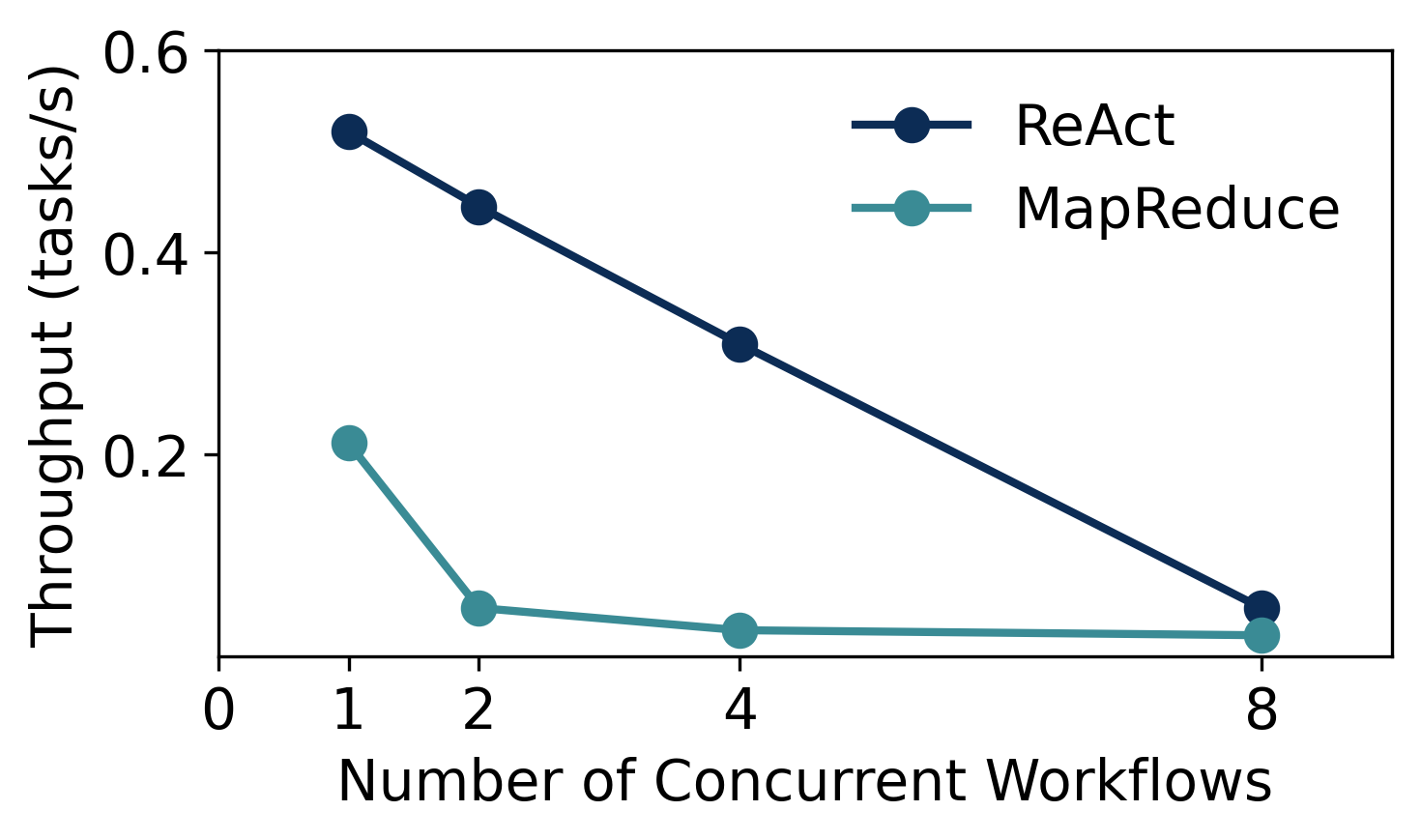
The image is a line graph comparing the throughput (tasks/s) of two workflow systems, **ReAct** and **MapReduce**, as the number of concurrent workflows increases. The x-axis represents the number of concurrent workflows (1, 2, 4, 8), and the y-axis represents throughput in tasks per second (0 to 0.6). Two data series are plotted: ReAct (dark blue) and MapReduce (teal).
### Components/Axes
- **X-axis**: "Number of Concurrent Workflows" (values: 1, 2, 4, 8).
- **Y-axis**: "Throughput (tasks/s)" (range: 0 to 0.6).
- **Legend**: Located on the right side of the graph.
- **ReAct**: Dark blue line with circular markers.
- **MapReduce**: Teal line with circular markers.
### Detailed Analysis
#### ReAct (Dark Blue)
- **Data Points**:
- At 1 workflow: ~0.52 tasks/s.
- At 2 workflows: ~0.45 tasks/s.
- At 4 workflows: ~0.30 tasks/s.
- At 8 workflows: ~0.05 tasks/s.
- **Trend**: A steady linear decline in throughput as the number of concurrent workflows increases.
#### MapReduce (Teal)
- **Data Points**:
- At 1 workflow: ~0.20 tasks/s.
- At 2 workflows: ~0.05 tasks/s.
- At 4 workflows: ~0.02 tasks/s.
- At 8 workflows: ~0.02 tasks/s.
- **Trend**: A sharp initial drop in throughput between 1 and 2 workflows, followed by a plateau at ~0.02 tasks/s for higher concurrency.
### Key Observations
1. **ReAct** maintains higher throughput than **MapReduce** across all concurrency levels but experiences a consistent decline.
2. **MapReduce** shows a dramatic drop in performance when scaling from 1 to 2 workflows, then stabilizes at a low throughput.
3. Both systems degrade in performance as concurrency increases, but **ReAct** retains a higher absolute throughput.
### Interpretation
The graph suggests that **ReAct** is more scalable than **MapReduce** for handling concurrent workflows, as it retains higher throughput even at 8 workflows (~0.05 tasks/s). However, both systems exhibit diminishing returns with increased concurrency. The sharp decline in **MapReduce**’s performance at 2 workflows implies potential bottlenecks or inefficiencies in its design for parallel processing. This could indicate that **ReAct** is better suited for high-concurrency environments, while **MapReduce** may require optimization to improve scalability.