\n
## Diagram: Flappy Bird Game Representation
### Overview
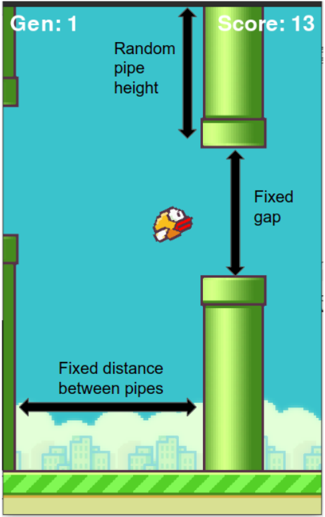
The image is a diagram representing the gameplay of the mobile game "Flappy Bird". It illustrates the key elements and parameters that define the game's environment and challenge. The diagram focuses on the arrangement of pipes, the bird's position, and the scoring system. It does not contain numerical data beyond the current score.
### Components/Axes
The diagram includes the following labeled components:
* **Gen: 1** - Located at the top-left corner, indicating the generation number (likely representing an iteration or level).
* **Score: 13** - Located at the top-right corner, displaying the current player score.
* **Random pipe height** - A label with an arrow pointing to the vertical distance between the top of the upper pipe and the bottom of the lower pipe.
* **Fixed gap** - A label with an arrow pointing to the vertical space between the upper and lower pipes.
* **Fixed distance between pipes** - A label with an arrow pointing to the horizontal distance between the two pipes.
* **Bird** - A small, cartoon-style bird in mid-flight.
* **Pipes** - Two green, cylindrical pipes with openings.
* **Ground** - A brown strip at the bottom of the image.
* **Background** - A light blue sky with a silhouette of a city at the bottom.
### Detailed Analysis or Content Details
The diagram illustrates the following spatial relationships:
* The bird is positioned between the two pipes, suggesting it is navigating through the gaps.
* The pipes are vertically aligned, with a consistent horizontal distance between them as indicated by the "Fixed distance between pipes" label.
* The height of the gap between the pipes is consistent, as indicated by the "Fixed gap" label.
* The vertical distance between the top of the upper pipe and the bottom of the lower pipe varies, as indicated by the "Random pipe height" label.
* The score is currently 13.
* The generation is 1.
### Key Observations
The diagram highlights the core mechanics of Flappy Bird:
* The game presents a series of obstacles (pipes) that the player must navigate.
* The obstacles are arranged in a predictable pattern (fixed distance between pipes, fixed gap), but with a random element (random pipe height).
* The player's score increases as they successfully navigate through the obstacles.
### Interpretation
The diagram serves as a simplified representation of the Flappy Bird game's environment. It emphasizes the procedural generation aspect of the game, where the pipe heights are randomized to create a challenging and unpredictable experience. The fixed gap and distance between pipes provide a consistent framework for the player to learn and adapt to. The diagram doesn't provide any information about the bird's movement or the physics of the game, but it effectively communicates the core gameplay loop and the key parameters that define the game's difficulty. The diagram is a visual aid for understanding the game's design and mechanics, rather than a presentation of quantitative data. It is a conceptual illustration, not a data visualization.