## Diagram: Flappy Bird Game Mechanics Annotation
### Overview
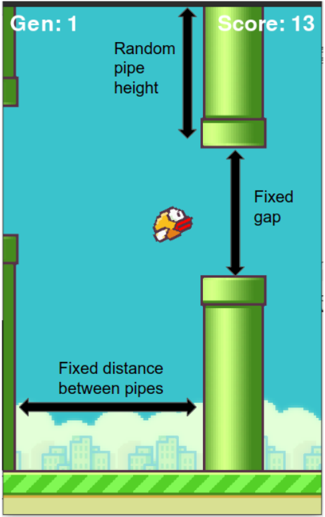
This image is a screenshot from a Flappy Bird-style video game, annotated with text and arrows to explain key game mechanics and parameters. It appears to be used for technical documentation, possibly related to game design, procedural generation, or AI training (e.g., a genetic algorithm, indicated by "Gen: 1").
### Components/Axes
The image is a single scene composed of several visual and textual elements:
1. **Game Scene Elements:**
* **Bird Character:** A small, pixelated bird with orange, yellow, and white coloring, positioned in the center of the screen between two pipes.
* **Pipes:** Two large, green vertical pipes with darker green bands. One pipe extends from the top of the screen downward, and the other extends from the ground upward, creating a gap.
* **Background:** A light blue sky with faint white clouds and a silhouette of a city skyline at the bottom.
* **Ground:** A green, horizontally striped platform at the very bottom of the screen.
2. **Text Labels & Annotations (with spatial grounding):**
* **Top-Left Corner:** Text "Gen: 1" in white font. This likely stands for "Generation 1."
* **Top-Right Corner:** Text "Score: 13" in white font.
* **Upper Center (pointing to the top pipe):** Text "Random pipe height" with a black, double-headed vertical arrow. The arrow spans the vertical length of the top pipe, indicating that its height is a variable parameter.
* **Center (between the pipes):** Text "Fixed gap" with a black, double-headed vertical arrow. The arrow spans the vertical space between the bottom of the top pipe and the top of the bottom pipe, indicating this distance is constant.
* **Bottom Center (below the bird):** Text "Fixed distance between pipes" with a black, double-headed horizontal arrow. The arrow spans the horizontal space between the left edge of the screen (where another pipe is partially visible) and the right pipe, indicating the horizontal spacing between pipe obstacles is constant.
### Detailed Analysis
The annotations explicitly define the game's obstacle generation rules:
* **Variable Parameter:** The vertical height of each pipe (from the top or bottom edge) is randomized ("Random pipe height").
* **Constant Parameters:**
1. The vertical gap through which the bird must fly is of a fixed size ("Fixed gap").
2. The horizontal distance between consecutive pipe obstacles is fixed ("Fixed distance between pipes").
The "Gen: 1" label strongly suggests this screenshot is from an experiment or simulation where game instances are being evolved or trained, with this being the first generation. The "Score: 13" indicates the player (or AI agent) has successfully passed 13 pipe obstacles in this run.
### Key Observations
* The diagram is a hybrid of a gameplay screenshot and a technical schematic. The annotations are overlaid directly onto the game visuals to ground the abstract parameters in the concrete game state.
* The use of double-headed arrows is precise: the vertical arrow for "Random pipe height" shows the dimension being randomized, while the horizontal arrow for "Fixed distance between pipes" shows the dimension that is constant.
* The partially visible pipe on the far left edge confirms the "fixed distance" applies to the spacing between the centers or edges of consecutive obstacles.
### Interpretation
This image serves as a clear technical specification for a core mechanic in a Flappy Bird clone, likely for an AI or machine learning context. The combination of fixed and random parameters creates a controlled yet non-repetitive environment ideal for training agents.
* **What it demonstrates:** It visually codifies the rules for generating the game's primary challenge (the pipes). The fixed gap and distance ensure a consistent baseline difficulty, while the random pipe height forces the agent (or player) to adapt its flight path for each new obstacle, preventing simple memorization of a pattern.
* **How elements relate:** The bird's position relative to the "Fixed gap" is the central challenge. The "Random pipe height" determines the vertical position of that gap, and the "Fixed distance between pipes" determines the timing and reaction window the player has after passing one obstacle before encountering the next.
* **Notable implications:** The "Gen: 1" label is the most significant clue for deeper interpretation. It frames this not just as a game, but as an experiment. The score of 13 in the first generation could indicate either a very capable initial agent or, more likely, a human-played baseline for comparison. The diagram's purpose is to document the environment in which this generational learning or optimization is taking place.