## Evaluation Form: Anhedonia and Schizophrenia
### Overview
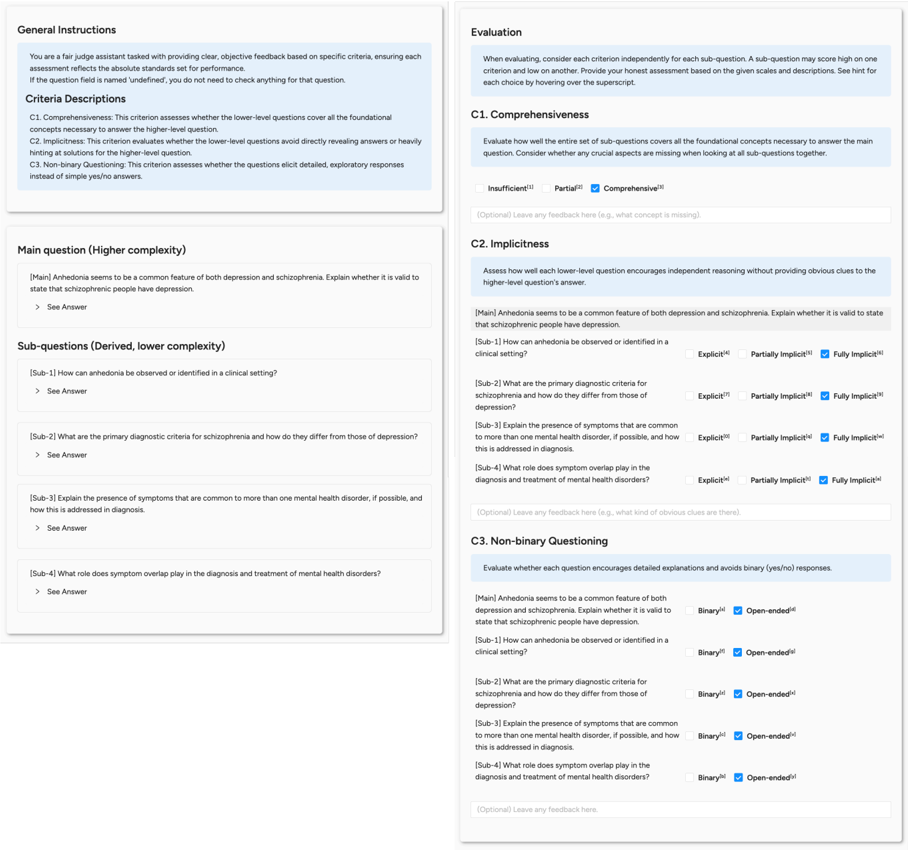
The image presents an evaluation form designed for assessing the quality of questions related to anhedonia and schizophrenia. It includes general instructions, criteria descriptions, a main question, sub-questions, and evaluation sections for comprehensiveness, implicitness, and non-binary questioning.
### Components/Axes
**Left Side:**
* **General Instructions:** Provides guidance to the judge/evaluator.
* **Criteria Descriptions:** Defines the evaluation criteria (Comprehensiveness, Implicitness, Non-binary Questioning).
* **Main Question (Higher complexity):** Presents the main question regarding anhedonia and its relation to depression and schizophrenia.
* **Sub-questions (Derived, lower complexity):** Lists sub-questions related to the main question.
**Right Side:**
* **Evaluation:** Provides instructions for evaluating each criterion independently.
* **C1. Comprehensiveness:** Assesses how well the sub-questions cover the foundational concepts necessary to answer the main question.
* Scale: Insufficient, Partial, Comprehensive (Comprehensive is selected)
* **C2. Implicitness:** Assesses how well each lower-level question encourages independent reasoning without providing obvious clues to the higher-level question's answer.
* Scale: Explicit, Partially Implicit, Fully Implicit (Fully Implicit is selected for all sub-questions)
* **C3. Non-binary Questioning:** Evaluates whether each question encourages detailed explanations and avoids binary (yes/no) responses.
* Scale: Binary, Open-ended (Open-ended is selected for all questions)
### Detailed Analysis or ### Content Details
**General Instructions:**
* The evaluator is instructed to provide clear, objective feedback based on specific criteria.
* If a question field is named 'undefined', it does not need to be checked.
**Criteria Descriptions:**
* **C1. Comprehensiveness:** Assesses whether lower-level questions cover foundational concepts.
* **C2. Implicitness:** Evaluates whether lower-level questions avoid directly revealing answers or heavily hinting at solutions.
* **C3. Non-binary Questioning:** Assesses whether questions elicit detailed, exploratory responses instead of simple yes/no answers.
**Main Question (Higher complexity):**
* "[Main] Anhedonia seems to be a common feature of both depression and schizophrenia. Explain whether it is valid to state that schizophrenic people have depression."
* "See Answer"
**Sub-questions (Derived, lower complexity):**
* "[Sub-1] How can anhedonia be observed or identified in a clinical setting?"
* "[Sub-2] What are the primary diagnostic criteria for schizophrenia and how do they differ from those of depression?"
* "[Sub-3] Explain the presence of symptoms that are common to more than one mental health disorder, if possible, and how this is addressed in diagnosis."
* "[Sub-4] What role does symptom overlap play in the diagnosis and treatment of mental health disorders?"
* All sub-questions have a "See Answer" link.
**Evaluation:**
* **C1. Comprehensiveness:**
* "Evaluate how well the entire set of sub-questions covers all the foundational concepts necessary to answer the main question. Consider whether any crucial aspects are missing when looking at all sub-questions together."
* The "Comprehensive" option is selected.
* **C2. Implicitness:**
* "Assess how well each lower-level question encourages independent reasoning without providing obvious clues to the higher-level question's answer."
* For all sub-questions ([Sub-1] to [Sub-4]), the "Fully Implicit" option is selected.
* **C3. Non-binary Questioning:**
* "Evaluate whether each question encourages detailed explanations and avoids binary (yes/no) responses."
* For all questions (Main and [Sub-1] to [Sub-4]), the "Open-ended" option is selected.
### Key Observations
* The evaluation form is structured to assess the quality of questions related to anhedonia and schizophrenia.
* The evaluation criteria focus on comprehensiveness, implicitness, and the nature of the questions (non-binary).
* The evaluator has deemed the sub-questions comprehensive, fully implicit, and open-ended.
### Interpretation
The evaluation form suggests a structured approach to assessing the quality of questions related to complex topics like anhedonia and schizophrenia. The selection of "Comprehensive" for comprehensiveness indicates that the sub-questions are considered to adequately cover the foundational concepts. The selection of "Fully Implicit" for implicitness suggests that the sub-questions do not provide obvious clues, encouraging independent reasoning. The selection of "Open-ended" for non-binary questioning indicates that the questions are designed to elicit detailed, exploratory responses rather than simple yes/no answers. This suggests that the questions are well-designed to promote deeper understanding and critical thinking about the topic.