## Screenshot: Evaluation Rubric for Response Assessment
### Overview
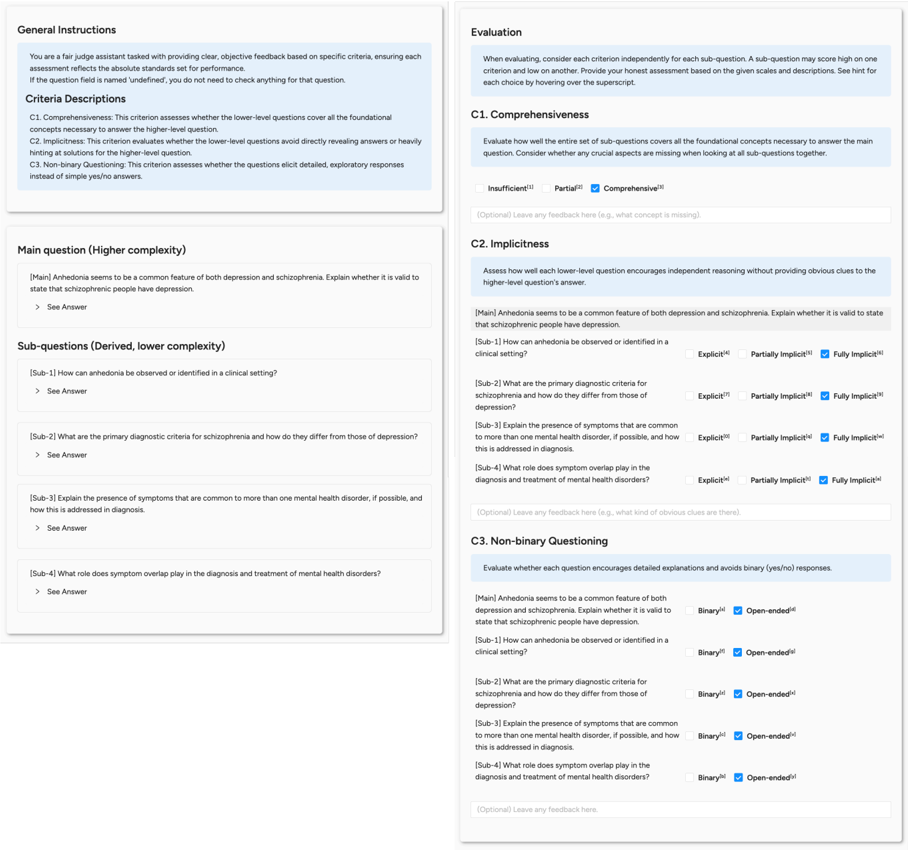
The image is a screenshot of a structured evaluation rubric designed for assessing responses to a main question and its sub-questions. It includes general instructions, criteria descriptions, and evaluation forms for three criteria: Comprehensiveness, Implicitness, and Non-binary Questioning. The document is divided into two main sections: **General Instructions** (left) and **Evaluation** (right).
---
### Components/Axes
#### Left Section: General Instructions
- **General Instructions** (Blue background):
- Text: "You are a fair judge assistant tasked with providing clear, objective feedback based on specific criteria, ensuring each assessment reflects the absolute standards set for performance. If the question is named 'undefined', you don't need to check anything for that question."
- **Criteria Descriptions**:
- **C1. Comprehensiveness**: Assesses whether lower-level questions cover foundational concepts necessary to answer the higher-level question.
- **C2. Implicitness**: Evaluates whether lower-level questions avoid revealing answers or hinting at solutions for the higher-level question.
- **C3. Non-binary Questioning**: Assesses whether questions elicit detailed, exploratory responses instead of simple yes/no answers.
#### Right Section: Evaluation
- **Evaluation** (White background with blue headers):
- **C1. Comprehensiveness**:
- Description: "Evaluate how well the entire set of sub-questions covers the foundational concepts necessary to answer the main question."
- Table:
- Options: "Insufficient," "Partial," "Comprehensive" (with checkboxes).
- Optional feedback field: "Leave feedback here (e.g., what concept is missing)."
- **C2. Implicitness**:
- Description: "Assess how well lower-level questions encourage independent reasoning without providing obvious clues to the higher-level question."
- Table:
- Sub-questions (e.g., "How can anhedonia be observed in a clinical setting?") with options: "Explicit," "Partially Implicit," "Fully Implicit" (with checkboxes).
- Optional feedback field: "Leave feedback here (e.g., what kind of obvious clues are there)."
- **C3. Non-binary Questioning**:
- Description: "Evaluate whether each question encourages detailed explanations and avoids binary (yes/no) responses."
- Table:
- Sub-questions (e.g., "What role does symptom overlap play in diagnosis?") with options: "Binary," "Open-ended" (with checkboxes).
---
### Detailed Analysis
#### Left Section: General Instructions
- **General Instructions**:
- Emphasizes the role of the assistant as a "fair judge" with strict adherence to criteria.
- Notes that "undefined" questions require no evaluation.
- **Criteria Descriptions**:
- **C1**: Focuses on coverage of foundational concepts.
- **C2**: Focuses on avoiding direct answers or hints.
- **C3**: Focuses on encouraging detailed, non-binary responses.
#### Right Section: Evaluation
- **C1. Comprehensiveness**:
- Table structure: Three options with checkboxes and a text input for feedback.
- **C2. Implicitness**:
- Sub-questions are listed with options for implicitness levels.
- Example sub-question: "How can anhedonia be observed in a clinical setting?" with options "Explicit," "Partially Implicit," "Fully Implicit."
- **C3. Non-binary Questioning**:
- Sub-questions are listed with options for response types.
- Example sub-question: "What role does symptom overlap play in diagnosis?" with options "Binary," "Open-ended."
---
### Key Observations
1. **Structured Format**: The document uses clear headings, bullet points, and tables to organize information.
2. **Criteria-Specific Evaluation**: Each criterion (C1, C2, C3) has a dedicated evaluation form with specific sub-questions and response options.
3. **Optional Feedback**: All criteria include optional text fields for additional comments.
4. **Consistency**: The structure of the evaluation forms (tables with checkboxes and feedback fields) is consistent across all criteria.
---
### Interpretation
This document serves as a **rubric for assessing responses** to a main question and its sub-questions. It ensures evaluators provide **objective, criteria-based feedback** by:
- **Comprehensiveness**: Ensuring sub-questions cover foundational concepts.
- **Implicitness**: Preventing sub-questions from revealing answers or hinting at solutions.
- **Non-binary Questioning**: Encouraging detailed, exploratory responses rather than yes/no answers.
The rubric is designed for **educational or clinical settings** where critical thinking and depth of analysis are prioritized. The inclusion of optional feedback fields allows evaluators to provide context-specific insights, enhancing the rigor of the assessment process.