## Diagram: Audio Processing Pipeline with Conformer and Mel-RVQ Tokenization
### Overview
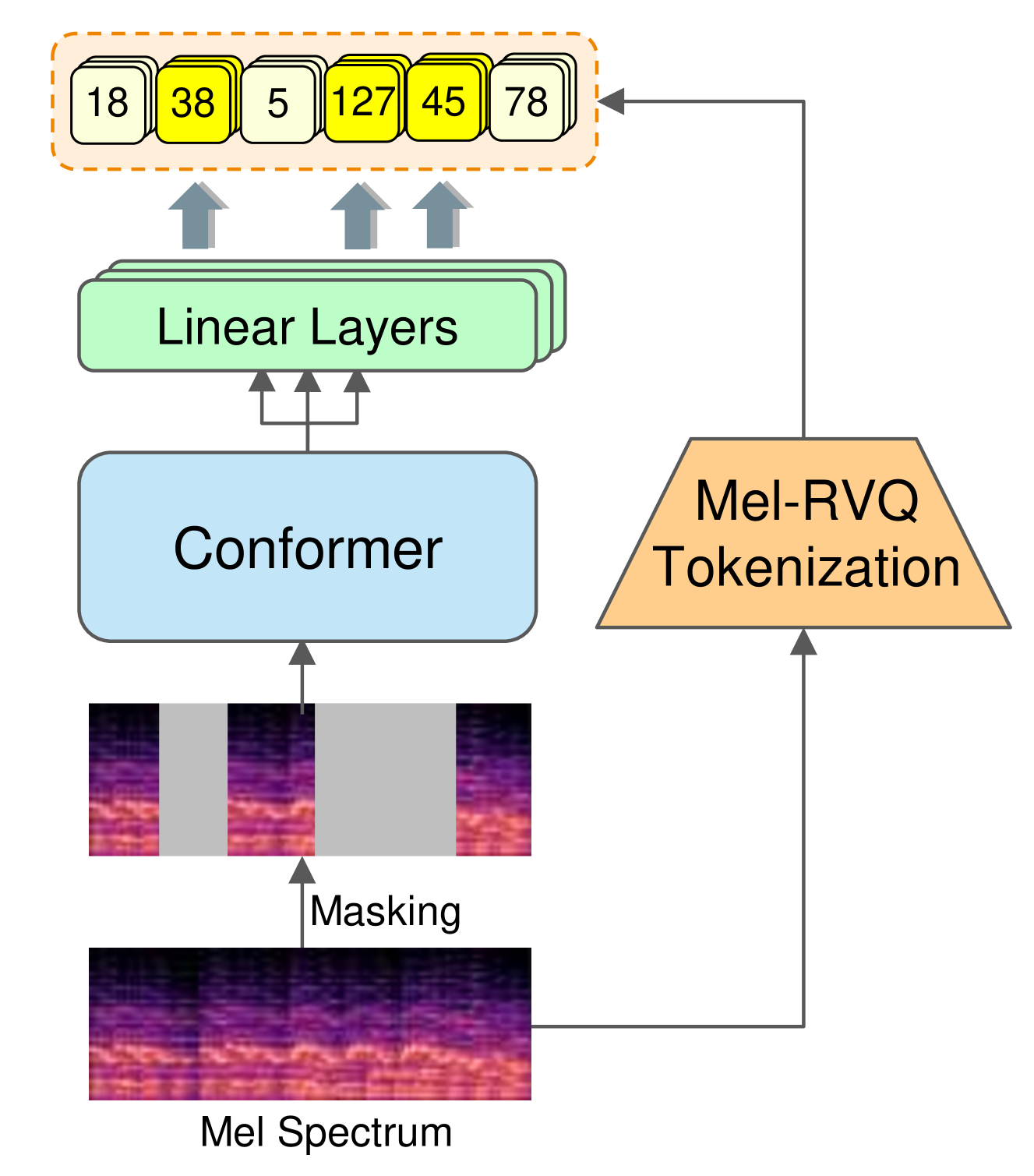
The diagram illustrates a technical workflow for audio signal processing, starting from a Mel Spectrum input and ending with Mel-RVQ Tokenization. The process involves masking, a Conformer neural network architecture, linear layers, and quantization steps. The flow is directional, with arrows indicating data transformation stages.
### Components/Axes
1. **Mel Spectrum** (Bottom)
- Visualized as a heatmap with purple/black coloration
- Represents frequency-domain audio features
2. **Masking** (Middle)
- Gray blocks overlaying portions of the Mel Spectrum
- Indicates selective data omission or focus areas
3. **Conformer** (Central)
- Rectangular component connecting Masking to Linear Layers
- Represents a conformer neural network architecture
4. **Linear Layers** (Top)
- Contains numerical values: 18, 38, 5, 127, 45, 78
- Arranged in a dashed-bordered box with alternating white/yellow shading
5. **Mel-RVQ Tokenization** (Right)
- Hexagonal component with dashed outline
- Represents vector quantization of Mel features
### Detailed Analysis
- **Mel Spectrum**:
- Shows spectral characteristics of audio signals
- Color intensity likely represents amplitude/energy levels
- **Masking**:
- Three gray blocks cover specific regions of the spectrum
- Suggests intentional data hiding or attention mechanism
- **Conformer**:
- Central processing unit with bidirectional data flow
- Connects raw features (Mel Spectrum) to higher-level abstractions
- **Linear Layers**:
- Numerical values may represent:
- Layer dimensions (e.g., 18→38→5)
- Quantization parameters (127, 45, 78)
- Alternating shading suggests hierarchical organization
- **Mel-RVQ Tokenization**:
- Final transformation stage
- Hexagonal shape implies discrete, quantized output
### Key Observations
1. **Directional Flow**:
- Data moves from raw features (bottom) to abstract representations (top)
- Masking precedes Conformer processing
2. **Quantization Evidence**:
- High-value numbers (127, 45, 78) in Linear Layers suggest bit-depth constraints
3. **Architectural Choices**:
- Conformer's bidirectional processing implies context-aware feature extraction
- RVQ tokenization indicates discrete representation for downstream tasks
### Interpretation
This diagram represents a hybrid audio processing pipeline combining:
1. **Feature Extraction**: Mel Spectrogram generation
2. **Data Augmentation**: Strategic masking for robustness
3. **Neural Processing**: Conformer architecture for temporal-spatial feature learning
4. **Quantization**: Linear layers and RVQ for efficient representation
The workflow suggests applications in:
- Speech recognition systems
- Audio compression
- Music information retrieval
- Voice activity detection
The masking step and RVQ tokenization are particularly indicative of modern neural audio codecs, where discrete representations enable efficient modeling while preserving perceptual quality. The Conformer's inclusion points to state-of-the-art temporal modeling capabilities, crucial for handling variable-length audio sequences.