## Heatmap/Bar Chart: Importance Score Across Reasoning Steps
### Overview
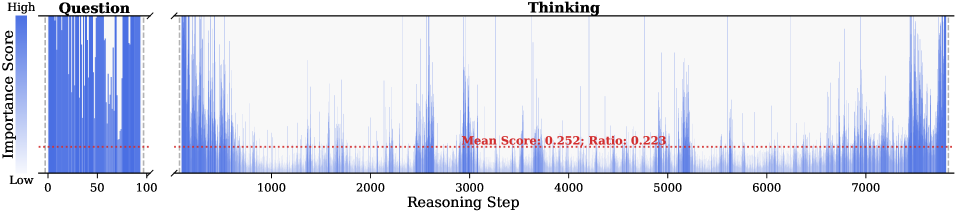
The image displays a two-part horizontal bar chart (or heatmap) visualizing the "Importance Score" of different steps in a reasoning process. The chart is divided into two distinct sections labeled "Question" and "Thinking," plotted against a common "Reasoning Step" x-axis. A horizontal red dashed line indicates the mean importance score across all steps.
### Components/Axes
* **Chart Title/Sections:** The chart is split into two labeled regions at the top:
* **Left Section:** "Question" (approximately steps 0-100).
* **Right Section:** "Thinking" (approximately steps 100-7500+).
* **Y-Axis (Vertical):** Labeled "Importance Score" on the far left. The scale is qualitative, marked with "Low" at the bottom and "High" at the top. No numerical scale is provided.
* **X-Axis (Horizontal):** Labeled "Reasoning Step" at the bottom center. It is a numerical scale with major tick marks at 0, 50, 100, 1000, 2000, 3000, 4000, 5000, 6000, and 7000. The axis appears to be linear within each section but has a break between the "Question" (0-100) and "Thinking" (100+) sections.
* **Data Representation:** Vertical blue bars represent the importance score for each reasoning step. The height (or color intensity, if interpreted as a heatmap) of each bar corresponds to its score.
* **Legend/Annotation:** A red dashed horizontal line runs across the entire chart. Centered over the "Thinking" section is red text stating: **"Mean Score: 0.252; Ratio: 0.223"**. This line and text serve as the legend for the mean value.
* **Spatial Layout:** The "Question" section occupies the left ~15% of the chart width. The "Thinking" section occupies the remaining ~85%. The y-axis label is positioned to the left of the "Question" section. The x-axis label is centered below the entire chart.
### Detailed Analysis
**1. "Question" Section (Steps 0-100):**
* **Trend:** This section shows a very dense cluster of tall blue bars. The visual trend is consistently high importance, with most bars reaching near the "High" mark on the y-axis. There is some variation, but the overall density and height are markedly greater than in the "Thinking" section.
* **Data Points:** It is not possible to extract individual numerical scores due to the density and lack of a numerical y-scale. The visual data suggests that steps associated with analyzing the "Question" are assigned very high importance scores.
**2. "Thinking" Section (Steps 100-7500+):**
* **Trend:** This section shows a much more variable pattern. The blue bars are generally shorter and less dense than in the "Question" section. There are distinct clusters or bursts of higher importance scores interspersed with long periods of low importance.
* **Notable Clusters:** Visually prominent clusters of taller bars appear approximately around:
* Steps 3000-4000
* Steps 5000-6000
* Steps 7000-7500+
* **Mean Line:** The red dashed line representing the mean score (0.252) sits at roughly one-quarter of the total height from the "Low" baseline. A significant majority of the bars in the "Thinking" section fall below this mean line, indicating that most individual thinking steps have a below-average importance score. The high-importance clusters are the exceptions that pull the mean up.
**3. Text Transcription:**
* All text is in English.
* **Top Labels:** "Question", "Thinking"
* **Y-Axis Label:** "Importance Score"
* **Y-Axis Markers:** "High", "Low"
* **X-Axis Label:** "Reasoning Step"
* **X-Axis Markers:** "0", "50", "100", "1000", "2000", "3000", "4000", "5000", "6000", "7000"
* **Annotation Text:** "Mean Score: 0.252; Ratio: 0.223"
### Key Observations
1. **Bimodal Importance Distribution:** The reasoning process exhibits a clear two-phase structure. The initial "Question" phase is uniformly high-importance, while the subsequent "Thinking" phase is characterized by low baseline importance with intermittent high-importance spikes.
2. **Clustering in "Thinking":** High-importance events during the thinking process are not random; they occur in specific clusters, suggesting periods of critical reasoning or key decision points within the model's thought process.
3. **Low Mean Relative to Peaks:** The mean score of 0.252 is relatively low compared to the visual peaks, especially those in the "Question" section. This indicates the mean is heavily influenced by the large number of low-importance steps in the "Thinking" phase.
4. **Ratio Interpretation:** The "Ratio: 0.223" likely represents the proportion of steps that are considered "high importance" or perhaps the ratio of the mean score to the maximum possible score. Without a precise definition, its exact meaning is uncertain.
### Interpretation
This chart visualizes the internal attention or salience of a language model during a complex reasoning task. The **"Question"** phase corresponds to the model parsing and understanding the user's query, a process deemed critically important (hence the uniformly high scores). The **"Thinking"** phase represents the model's internal chain-of-thought or reasoning steps.
The data suggests that most of the model's internal reasoning steps are of low individual importance—perhaps representing routine information retrieval, hypothesis generation, or intermediate calculations. However, specific clusters of steps (e.g., around 3500, 5500, 7200) are flagged as highly important. These likely correspond to **key inferential leaps, the resolution of contradictions, the integration of critical information, or the formulation of the final answer's core logic.**
The stark contrast between the two sections implies that the model's "effort" or focus is heavily front-loaded onto understanding the prompt, with the subsequent thinking process being a more diffuse search punctuated by moments of high significance. The mean score and ratio provide aggregate metrics, but the true insight lies in the temporal pattern of importance, revealing the architecture of the model's reasoning process. This type of analysis is crucial for interpretability, debugging model behavior, and understanding how AI systems break down complex problems.