## Code Snippet: C Function for Creating a Sequence
### Overview
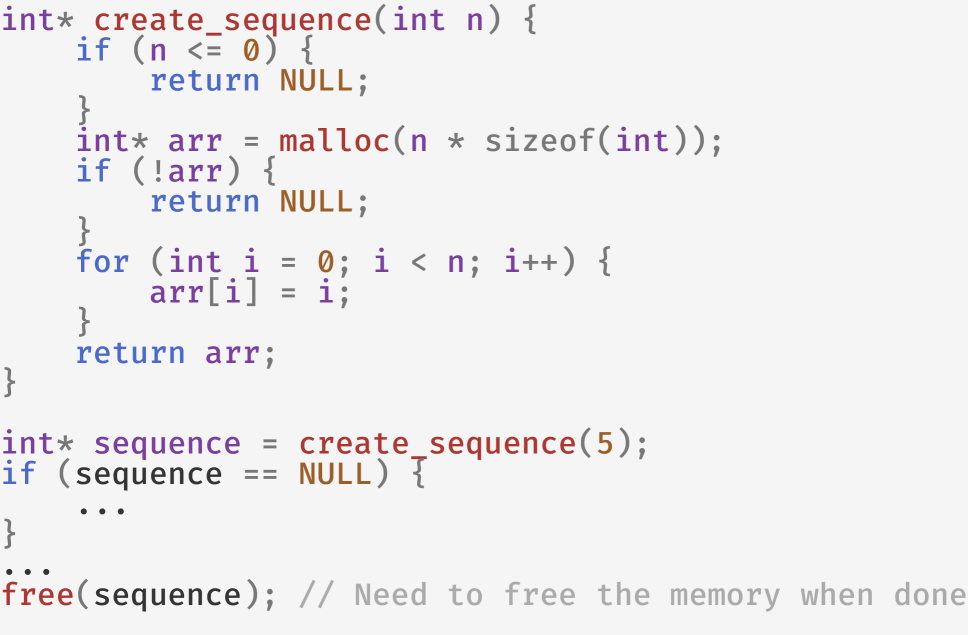
The image presents a C code snippet that defines a function `create_sequence` which dynamically allocates an integer array and initializes it with values from 0 to n-1. It also demonstrates how to call this function and free the allocated memory.
### Components/Axes
* **Function Definition:** `int* create_sequence(int n)`
* Input: `int n` - An integer representing the desired length of the sequence.
* Output: `int*` - A pointer to the dynamically allocated integer array, or `NULL` if allocation fails or if `n` is non-positive.
* **Error Handling:**
* Checks if `n <= 0`. If true, returns `NULL`.
* Checks if `malloc` returns `NULL` (allocation failure). If true, returns `NULL`.
* **Memory Allocation:** `int* arr = malloc(n * sizeof(int));`
* Allocates memory for `n` integers.
* **Initialization Loop:**
* `for (int i = 0; i < n; i++) { arr[i] = i; }`
* Iterates from `i = 0` to `n-1`, assigning the value of `i` to the `i`-th element of the array.
* **Return Value:** `return arr;`
* Returns the pointer to the allocated and initialized array.
* **Function Call and Usage:**
* `int* sequence = create_sequence(5);`
* Calls the `create_sequence` function with `n = 5`.
* `if (sequence == NULL) { ... }`
* Checks if the returned pointer is `NULL` (indicating an error).
* `free(sequence); // Need to free the memory when done`
* Frees the dynamically allocated memory using `free()`.
### Detailed Analysis or ### Content Details
The code defines a function `create_sequence` that takes an integer `n` as input and returns a pointer to an integer array.
1. **Input Validation:** The function first checks if `n` is less than or equal to 0. If it is, the function immediately returns `NULL`, indicating an invalid input.
2. **Memory Allocation:** If `n` is positive, the function attempts to allocate memory for an integer array of size `n` using `malloc`. The allocated memory is assigned to the pointer `arr`.
3. **Allocation Check:** The function checks if the memory allocation was successful by verifying if `arr` is not `NULL`. If `arr` is `NULL`, it means memory allocation failed, and the function returns `NULL`.
4. **Array Initialization:** If memory allocation was successful, the function initializes the array elements. It uses a `for` loop to iterate from `i = 0` to `n-1`. In each iteration, it assigns the value of `i` to the `i`-th element of the array `arr[i]`.
5. **Return Value:** After initializing the array, the function returns the pointer `arr` to the allocated memory.
6. **Function Call:** The code then demonstrates how to call the `create_sequence` function. It calls the function with `n = 5` and assigns the returned pointer to the variable `sequence`.
7. **Null Check:** It checks if `sequence` is `NULL` to handle potential errors during sequence creation.
8. **Memory Deallocation:** Finally, the code shows how to free the dynamically allocated memory using `free(sequence)`. A comment emphasizes the importance of freeing the memory when it is no longer needed to prevent memory leaks.
### Key Observations
* The function handles the case where the input `n` is non-positive or memory allocation fails by returning `NULL`.
* The function initializes the array with values from 0 to `n-1`.
* The code demonstrates the importance of freeing dynamically allocated memory to prevent memory leaks.
### Interpretation
The code snippet demonstrates a common pattern in C programming: dynamically allocating memory, performing operations on the allocated memory, and then freeing the memory when it is no longer needed. The `create_sequence` function is a simple example of a function that creates a sequence of integers. The code also highlights the importance of error handling and memory management in C programming. The check for `n <= 0` and the check for `malloc` failure are crucial for preventing unexpected behavior. The `free(sequence)` call is essential for preventing memory leaks.