\n
## Diagram: Computational Complexity Relationships
### Overview
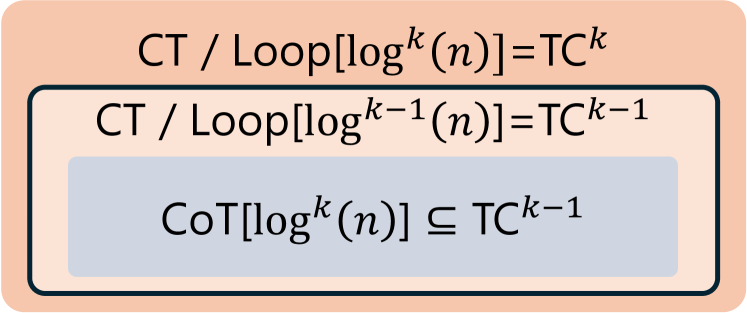
The image presents a nested diagram illustrating relationships between computational time (CT), loops, and a variable 'n' raised to the power of 'k'. The diagram uses a layered structure with three distinct equations, each contained within a progressively larger rectangular border. The equations appear to represent bounds or equivalencies in computational complexity.
### Components/Axes
The diagram does not contain axes in the traditional sense. It consists of three equations, each with specific notation:
* **CT**: Computational Time
* **Loop[log<sup>k</sup>(n)]**: A loop iterating a number of times determined by the logarithm of 'n' raised to the power of 'k'.
* **log<sup>k</sup>(n)**: The logarithm of 'n' raised to the power of 'k'.
* **TC<sup>k</sup>**: Time Complexity raised to the power of 'k'.
* **CoT[log<sup>k</sup>(n)]**: Cost of Time for a loop iterating a number of times determined by the logarithm of 'n' raised to the power of 'k'.
* **≤**: Less than or equal to symbol.
### Detailed Analysis or Content Details
The diagram contains the following equations, presented in a nested structure:
1. **Top Layer (Peach Background):** `CT / Loop[log<sup>k</sup>(n)] = TC<sup>k</sup>`
This equation states that the Computational Time divided by the number of iterations of a loop based on log<sup>k</sup>(n) is equal to the Time Complexity raised to the power of k.
2. **Middle Layer (White Background):** `CT / Loop[log<sup>k-1</sup>(n)] = TC<sup>k-1</sup>`
This equation states that the Computational Time divided by the number of iterations of a loop based on log<sup>k-1</sup>(n) is equal to the Time Complexity raised to the power of k-1.
3. **Bottom Layer (Blue Background):** `CoT[log<sup>k</sup>(n)] ≤ TC<sup>k-1</sup>`
This equation states that the Cost of Time for a loop based on log<sup>k</sup>(n) is less than or equal to the Time Complexity raised to the power of k-1.
### Key Observations
The equations demonstrate a decreasing relationship between the loop's complexity (log<sup>k</sup>(n) vs. log<sup>k-1</sup>(n)) and the corresponding time complexity (TC<sup>k</sup> vs. TC<sup>k-1</sup>). The bottom equation provides an upper bound for the cost of time, suggesting a potential optimization or limitation. The nested structure visually emphasizes the hierarchical relationship between these complexity levels.
### Interpretation
The diagram likely represents an analysis of the time complexity of an algorithm that involves nested loops. The equations suggest that reducing the complexity of the loop (by decreasing 'k') can lead to a reduction in the overall time complexity. The final inequality indicates that the cost of the loop with complexity log<sup>k</sup>(n) is bounded by the time complexity of the algorithm with a slightly simpler loop (log<sup>k-1</sup>(n)). This could be used to justify simplifying the loop structure if the performance gain outweighs the potential loss of accuracy or functionality. The diagram is a concise representation of a theoretical argument about algorithmic efficiency.