## Diagram: Computational Complexity Hierarchy
### Overview
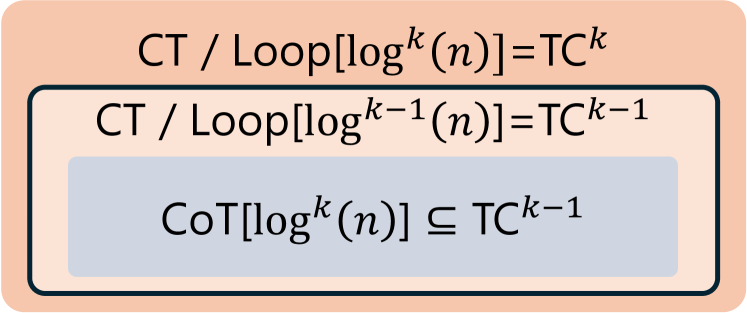
The image displays a nested diagram illustrating relationships between different computational complexity classes, specifically involving "CT/Loop" and "CoT" models with logarithmic depth constraints, and their containment within or equality to "TC" (Threshold Circuit) classes of specific depths. The diagram uses a layered, box-in-box visual structure with color-coded backgrounds to denote hierarchy.
### Components/Axes
The diagram consists of three nested rectangular boxes, each containing a mathematical expression. There are no traditional chart axes, legends, or data points. The components are purely textual and symbolic.
1. **Outermost Box (Light Peach Background):**
* **Text:** `CT / Loop[log^k(n)] = TC^k`
* **Position:** This is the largest, containing box. It forms the outer boundary of the diagram.
2. **Middle Box (White Background, Black Border):**
* **Text:** `CT / Loop[log^{k-1}(n)] = TC^{k-1}`
* **Position:** Centered within the outermost box. It is fully contained by the peach box.
3. **Innermost Box (Light Blue Background):**
* **Text:** `CoT[log^k(n)] ⊆ TC^{k-1}`
* **Position:** Centered within the middle box. It is fully contained by the white box.
### Detailed Analysis
The diagram presents three formal statements about computational models:
1. **Statement 1 (Outer):** The model or class denoted `CT / Loop` with a resource bound of `log^k(n)` (logarithmic depth to the power *k*) is **equal** to the Threshold Circuit class of depth *k* (`TC^k`).
2. **Statement 2 (Middle):** The same `CT / Loop` model with a stricter resource bound of `log^{k-1}(n)` is **equal** to the Threshold Circuit class of depth *k-1* (`TC^{k-1}`).
3. **Statement 3 (Inner):** The model or class denoted `CoT` with a resource bound of `log^k(n)` is **contained within** (a subset of, `⊆`) the Threshold Circuit class of depth *k-1* (`TC^{k-1}`).
**Key Symbolic Elements:**
* `CT / Loop`: Likely represents a class of circuits or programs (e.g., Circuit Trees, Loop programs).
* `CoT`: Likely represents a different, possibly more constrained, class (e.g., Circuits of Trees).
* `log^m(n)`: Denotes a logarithmic depth or iteration bound raised to the power *m*.
* `TC^m`: Denotes the class of problems solvable by Threshold Circuits of depth *m*.
* `=`: Denotes equality between complexity classes.
* `⊆`: Denotes subset inclusion (the left class is contained within the right class).
### Key Observations
1. **Nested Hierarchy:** The visual nesting directly mirrors the logical relationship. The statement about `CoT` (innermost) is a more specific or constrained result contained within the broader framework defined by the `CT/Loop` equalities.
2. **Parameter Shift:** Moving from the outer to the middle box, the parameter *k* decreases to *k-1* in both the resource bound (`log^k` to `log^{k-1}`) and the resulting TC class (`TC^k` to `TC^{k-1}`), maintaining the equality.
3. **Critical Inclusion:** The innermost statement is the only one using `⊆` instead of `=`. It shows that `CoT` with a `log^k` bound is no more powerful than `TC^{k-1}`, which is a *lower* depth class than the `TC^k` that `CT/Loop[log^k]` achieves. This suggests `CoT` is a strictly weaker model than `CT/Loop` under the same `log^k` resource constraint.
4. **Color Coding:** The light blue highlight on the innermost box draws attention to this inclusion result, suggesting it may be the primary theorem or key insight being illustrated.
### Interpretation
This diagram summarizes a theoretical result in circuit complexity or computational models. It establishes a precise hierarchy:
* **Power of CT/Loop:** The `CT/Loop` model is perfectly characterized by threshold circuits; its power scales exactly with the allowed logarithmic depth (`log^k` gives `TC^k`).
* **Power of CoT:** The `CoT` model is strictly weaker. Even with the same `log^k` depth allowance, it cannot exceed the power of a `TC^{k-1}` circuit. This implies that the structural constraints of `CoT` limit its computational power relative to `CT/Loop`.
* **Implication:** The nesting visually argues that understanding the `CT/Loop` model at level *k* inherently involves understanding its behavior at level *k-1*, and that the `CoT` model sits entirely within that lower-level understanding. This could be used to prove separations between complexity classes or to classify the power of different programming/circuit paradigms.
**Language Note:** The text in the image is entirely mathematical notation, which is language-agnostic. The symbols and structure are standard in theoretical computer science.