## Bar Chart: Performance Comparison Across Architectures
### Overview
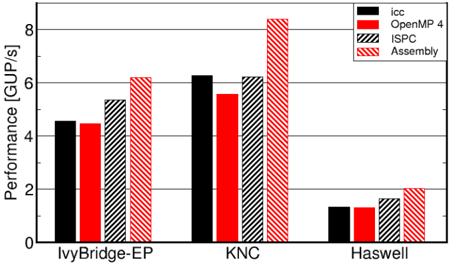
The chart compares the performance (in GUP/s) of four computational methods (icc, OpenMP 4, ISPC, Assembly) across three hardware/software configurations: IvyBridge-EP, KNC, and Haswell. Performance is measured on a logarithmic scale from 0 to 8 GUP/s.
### Components/Axes
- **X-axis**: Three categories (IvyBridge-EP, KNC, Haswell) representing different architectures or systems.
- **Y-axis**: Performance metric labeled "Performance [GUP/s]" with a linear scale from 0 to 8.
- **Legend**: Located in the top-right corner, mapping colors to methods:
- **Black**: icc
- **Red**: OpenMP 4
- **Black/White Striped**: ISPC
- **Red/White Striped**: Assembly
### Detailed Analysis
#### IvyBridge-EP
- **icc (Black)**: ~4.5 GUP/s
- **OpenMP 4 (Red)**: ~4.3 GUP/s
- **ISPC (Black/White)**: ~5.3 GUP/s
- **Assembly (Red/White)**: ~6.2 GUP/s
#### KNC
- **icc (Black)**: ~6.2 GUP/s
- **OpenMP 4 (Red)**: ~5.6 GUP/s
- **ISPC (Black/White)**: ~6.1 GUP/s
- **Assembly (Red/White)**: ~8.3 GUP/s
#### Haswell
- **icc (Black)**: ~1.3 GUP/s
- **OpenMP 4 (Red)**: ~1.2 GUP/s
- **ISPC (Black/White)**: ~1.6 GUP/s
- **Assembly (Red/White)**: ~2.0 GUP/s
### Key Observations
1. **Assembly (Red/White)** consistently outperforms all other methods across all categories, with the largest margin in KNC (~8.3 GUP/s).
2. **KNC** shows the highest absolute performance values, while **Haswell** has the lowest.
3. **icc (Black)** and **OpenMP 4 (Red)** exhibit similar trends, with icc slightly outperforming OpenMP 4 in IvyBridge-EP and KNC but underperforming in Haswell.
4. **ISPC (Black/White)** performs better than OpenMP 4 in IvyBridge-EP and KNC but lags behind Assembly in all cases.
### Interpretation
- **Assembly's dominance** suggests it is the most optimized or efficient method for these workloads, potentially due to lower-level optimizations or hardware-specific tuning.
- **KNC's superior performance** compared to IvyBridge-EP and Haswell may indicate it is a newer or more powerful architecture, or that the workloads are better suited to its design.
- **Haswell's low performance** could reflect outdated hardware, suboptimal software configuration, or incompatibility with the tested methods.
- The **logarithmic scale** emphasizes relative differences, making smaller values (e.g., Haswell) appear less impactful than they might be in a linear scale.
### Spatial Grounding
- **Legend**: Top-right corner, clearly labeled with method names and corresponding colors.
- **Bars**: Grouped by category (IvyBridge-EP, KNC, Haswell) with four bars per group, ordered left-to-right as per the legend.
### Content Details
- **IvyBridge-EP**: Assembly (~6.2) > ISPC (~5.3) > icc (~4.5) > OpenMP 4 (~4.3).
- **KNC**: Assembly (~8.3) > icc (~6.2) > ISPC (~6.1) > OpenMP 4 (~5.6).
- **Haswell**: Assembly (~2.0) > ISPC (~1.6) > icc (~1.3) > OpenMP 4 (~1.2).
### Notable Trends
- **Assembly** maintains a ~20-30% performance lead over the next-best method in all categories.
- **KNC** shows a ~30% performance advantage over IvyBridge-EP for Assembly, while Haswell lags ~70% behind KNC.
- **OpenMP 4** underperforms icc in IvyBridge-EP and KNC but matches it in Haswell, suggesting potential inefficiencies in certain environments.
### Final Notes
The chart highlights the importance of method selection and hardware compatibility. Assembly's consistent superiority underscores its value for high-performance computing, while Haswell's poor performance may warrant further investigation into optimization or hardware limitations.