## Diagram: Transformer Model with Reinforcement Learning
### Overview
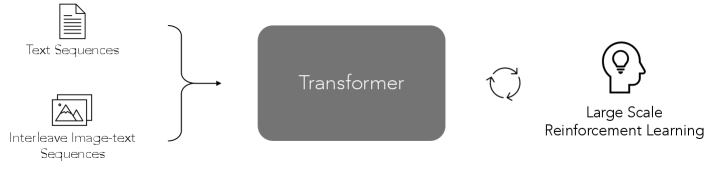
The image is a diagram illustrating a transformer model being trained with large-scale reinforcement learning, using both text sequences and interleaved image-text sequences as input.
### Components/Axes
* **Input 1 (Top-Left):** An icon representing a document with lines, labeled "Text Sequences".
* **Input 2 (Bottom-Left):** An icon representing two overlapping images, one showing a mountain landscape, labeled "Interleave Image-text Sequences".
* **Connector:** A bracket combining the two inputs into a single arrow pointing right.
* **Transformer (Center):** A gray rounded rectangle labeled "Transformer".
* **Feedback Loop:** A circular arrow pointing counter-clockwise from the output of the Transformer back to itself.
* **Output (Right):** A head icon with a lightbulb inside, labeled "Large Scale Reinforcement Learning".
### Detailed Analysis or ### Content Details
The diagram shows a data flow:
1. Text Sequences and Interleaved Image-text Sequences are fed as input.
2. These inputs are combined and processed by a Transformer model.
3. The Transformer's output is used for Large Scale Reinforcement Learning.
4. A feedback loop suggests that the output of the reinforcement learning process is used to refine the Transformer model.
### Key Observations
* The diagram illustrates a system where a Transformer model is trained using both textual and visual data, with reinforcement learning providing a feedback mechanism.
* The use of "Interleave Image-text Sequences" suggests that the model can handle multimodal data.
* The "Large Scale Reinforcement Learning" label indicates that the reinforcement learning component is a significant part of the system.
### Interpretation
The diagram depicts a sophisticated AI system that leverages a Transformer model and reinforcement learning to process and learn from both text and image data. The feedback loop suggests an iterative training process where the model continuously improves its performance based on the reinforcement learning signal. This type of architecture is commonly used in tasks such as image captioning, visual question answering, and multimodal understanding. The system is designed to handle complex data inputs and learn intricate relationships between different modalities.