\n
## Chart: Risk Assessment Radial Diagram
### Overview
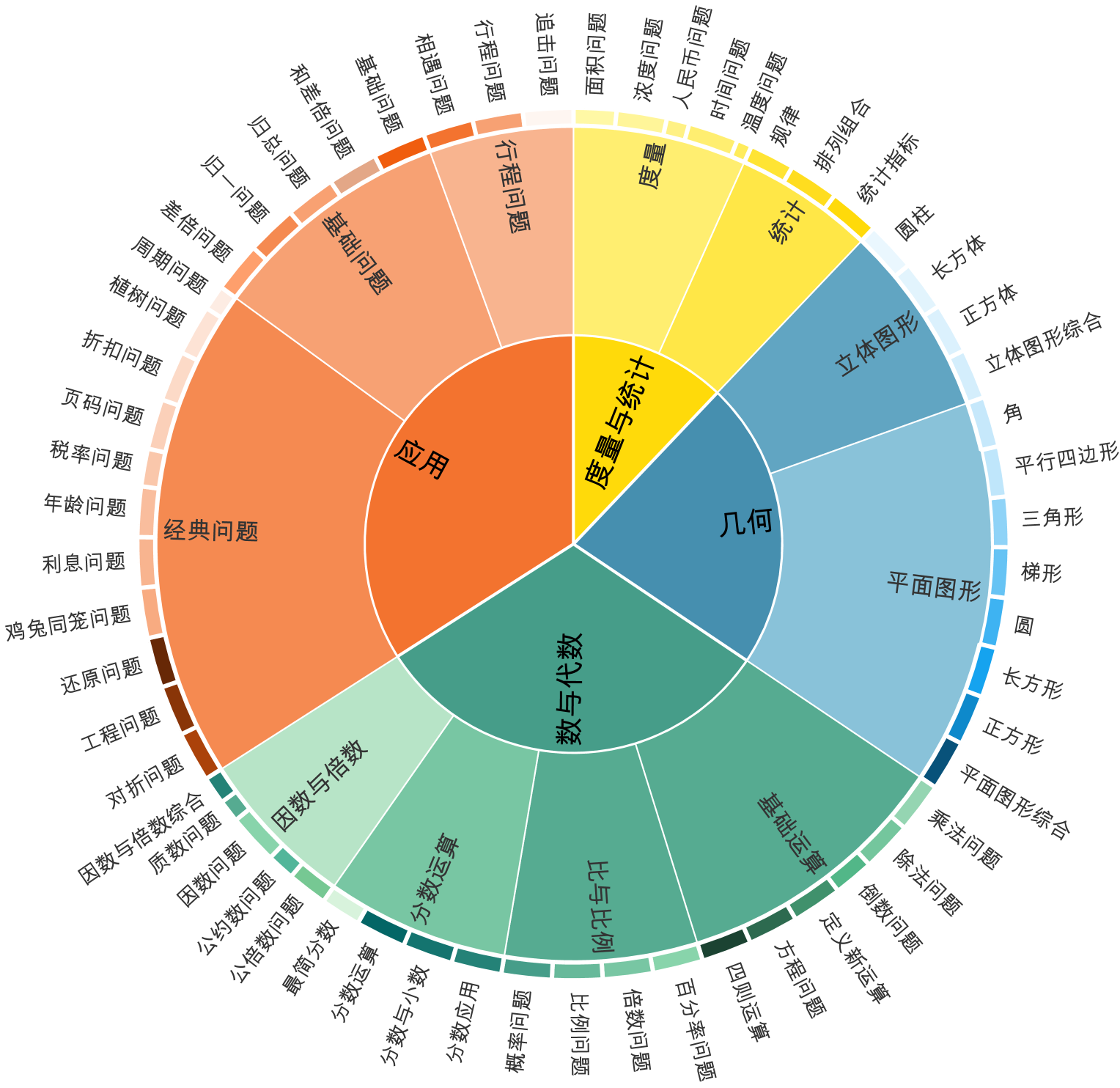
This image presents a radial chart, resembling a sunburst or pie chart with multiple layers, used for risk assessment. The chart categorizes risks into several layers, with each layer representing a broader risk category and subsequent layers detailing specific risk factors. The chart is primarily in Chinese, with some elements appearing to be descriptive labels.
### Components/Axes
The chart is structured around a central point labeled “几何” (Jǐhé - Geometry). Radiating outwards are several concentric layers, each divided into segments representing different risk categories and sub-categories. The outermost layer contains the broadest categories, while inner layers provide more granular detail. The layers, moving from the center outwards, are:
1. 几何 (Jǐhé - Geometry)
2. 风险 (Fēngxiǎn - Risk)
3. 数量化数 (Shùliànghuà shù - Quantification)
4. 度量与统计 (Dùliáng yǔ tǒngjì - Measurement and Statistics)
5. 工程问题 (Gōngchéng wèntí - Engineering Problems)
6. 基础问题 (Jīchǔ wèntí - Basic Problems)
7. 应用问题 (Yìngyòng wèntí - Application Problems)
Each segment within these layers is labeled with a specific risk factor in Chinese. The chart does not have explicit numerical axes or scales; instead, the size of each segment visually represents the relative importance or frequency of the associated risk.
### Detailed Analysis or Content Details
The chart is divided into seven concentric layers, each with varying numbers of segments. Here's a breakdown of the risk categories and sub-categories, transcribed from the image:
* **几何 (Jǐhé - Geometry):** Central label.
* **风险 (Fēngxiǎn - Risk):**
* 应用问题 (Yìngyòng wèntí - Application Problems)
* 基础问题 (Jīchǔ wèntí - Basic Problems)
* 工程问题 (Gōngchéng wèntí - Engineering Problems)
* **数量化数 (Shùliànghuà shù - Quantification):**
* 参数化数 (Cānshù huà shù - Parameterized Numbers)
* 分数运算 (Fēnshù yùnsuàn - Fractional Operations)
* 分数后用 (Fēnshù hòu yòng - Post-Fractional Use)
* 最简分数 (Zuì jiǎn fēnshù - Simplest Fraction)
* 公数约数 (Gōng shù yuēshù - Common Divisor)
* 分数与倍数 (Fēnshù yǔ bèi shù - Fractions and Multiples)
* 分数学合 (Fēnshù xué hé - Fractional Combination)
* 工程问题 (Gōngchéng wèntí - Engineering Problems)
* **度量与统计 (Dùliáng yǔ tǒngjì - Measurement and Statistics):**
* 概率问题 (Gàilǜ wèntí - Probability Problems)
* 税率问题 (Shuìlǜ wèntí - Tax Rate Problems)
* 年龄问题 (Niánlíng wèntí - Age Problems)
* 利息问题 (Lìxì wèntí - Interest Problems)
* 鸿兔定圆问题 (Hóng tù dìng yuán wèntí - Hare Circle Problem)
* 还剩问题 (Hái shèng wèntí - Remaining Problems)
* 折扣问题 (Zhé kòu wèntí - Discount Problems)
* 页兔定圆问题 (Yè tù dìng yuán wèntí - Page Hare Circle Problem)
* **工程问题 (Gōngchéng wèntí - Engineering Problems):**
* 工程问题 (Gōngchéng wèntí - Engineering Problems)
* 工作问题 (Gōngzuò wèntí - Work Problems)
* 水与塔综合 (Shuǐ yǔ tǎ zōnghé - Water and Tower Integration)
* 水与塔 (Shuǐ yǔ tǎ - Water and Tower)
* 正方形 (Zhèngfāngxíng - Square)
* 三角形 (Sānjiǎoxíng - Triangle)
* 梯形 (Tīxíng - Trapezoid)
* 圆形 (Yuánxíng - Circle)
* 平面图形 (Píngmiàn túxíng - Plane Figures)
* 长方形 (Chángfāngxíng - Rectangle)
* **基础问题 (Jīchǔ wèntí - Basic Problems):**
* 基础问题 (Jīchǔ wèntí - Basic Problems)
* 追赶问题 (Zhuīgǎn wèntí - Catch-up Problems)
* 相遇问题 (Xiāngyù wèntí - Meeting Problems)
* 逆流问题 (Nìliú wèntí - Countercurrent Problems)
* 和差问题 (Hé chā wèntí - Sum-Difference Problems)
* 归总问题 (Guī zǒng wèntí - Total Problems)
* **应用问题 (Yìngyòng wèntí - Application Problems):**
* 应用问题 (Yìngyòng wèntí - Application Problems)
* 时间问题 (Shíjiān wèntí - Time Problems)
* 速度问题 (Sùdù wèntí - Speed Problems)
* 距离问题 (Jùlí wèntí - Distance Problems)
* 排到组合 (Pái dào zǔhé - Ranking Combination)
* 统计指标 (Tǒngjì zhǐbiāo - Statistical Indicators)
* 预计指标 (Yùjì zhǐbiāo - Estimated Indicators)
* 正方 (Zhèngfāng - Positive Square)
* 正方体综合 (Zhèngfāngtǐ zōnghé - Positive Cube Integration)
* 立体体综合 (Lìtǐ tǐ zōnghé - Solid Body Integration)
* 平面立体综合 (Píngmiàn lìtǐ zōnghé - Plane Solid Integration)
* 平均问题 (Píngjūn wèntí - Average Problems)
* 定义问题 (Dìngyì wèntí - Definition Problems)
* 倒水问题 (Dào shuǐ wèntí - Pouring Water Problems)
* 四水问题 (Sì shuǐ wèntí - Four Water Problems)
The color scheme is a gradient, with segments in the innermost layers being darker shades of green and blue, transitioning to lighter shades of orange and yellow in the outer layers.
### Key Observations
The chart visually emphasizes the interconnectedness of different risk factors. The central "Geometry" label suggests a foundational element, with risks branching out from it. The outermost layer categorizes risks into broad areas (Application, Basic, Engineering), while the inner layers provide more specific details. The varying sizes of the segments likely indicate the relative importance or frequency of each risk factor. The chart does not provide any quantitative data, relying solely on visual representation.
### Interpretation
This chart appears to be a conceptual framework for risk assessment, likely used in an educational or analytical context. It demonstrates a hierarchical approach to identifying and categorizing risks, starting from fundamental geometric principles and extending to practical application problems. The radial format highlights the relationships between different risk factors and their potential impact. The absence of numerical data suggests that the chart is intended to facilitate qualitative analysis and discussion rather than precise quantification. The chart's structure suggests a focus on problem-solving and analytical thinking, particularly in the context of mathematical and engineering applications. The use of Chinese language indicates the chart is intended for a Chinese-speaking audience.