## Conceptual Diagram: Hierarchical Knowledge Integration Model
### Overview
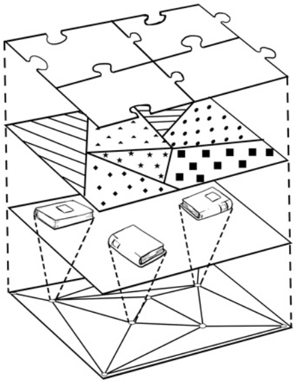
The image depicts a four-tiered, vertically stacked conceptual model presented in an isometric projection. The diagram illustrates a progression from abstract, fragmented concepts at the top to a concrete, foundational network at the bottom. There is no textual information, labels, or numerical data present in the image; the information is conveyed entirely through symbolic representation and structural relationships.
### Components/Axes
The diagram is organized into four distinct horizontal layers, enclosed within a bounding box defined by dashed vertical lines at the four corners.
* **Layer 1 (Top):** A 2x2 grid of interlocking puzzle pieces.
* **Layer 2 (Upper-Middle):** A flat plane divided into four distinct geometric sections, each containing a unique pattern.
* **Layer 3 (Lower-Middle):** A plane containing three book icons, each connected to the bottom layer via dashed projection lines.
* **Layer 4 (Bottom):** A triangular mesh (tessellation) consisting of interconnected nodes (circles) and lines.
### Detailed Analysis
#### Layer 1: The Puzzle (Top)
* **Structure:** Four puzzle pieces arranged in a square.
* **Visual Trend:** The pieces are interlocking, suggesting a whole that is currently fragmented or requires assembly. This represents the most abstract level of the model.
#### Layer 2: The Patterned Plane (Upper-Middle)
* **Structure:** A square plane divided into four quadrants (triangular/quadrilateral shapes).
* **Patterns:**
* **Top-Left:** Diagonal parallel lines.
* **Top-Right:** A field of dots.
* **Bottom-Left:** A field of stars.
* **Bottom-Right:** A field of solid squares.
* **Visual Trend:** This layer represents categorization or classification, where the "puzzle" above is now organized into distinct, identifiable types or data classes.
#### Layer 3: The Knowledge Layer (Lower-Middle)
* **Structure:** Three book icons resting on a plane.
* **Spatial Grounding:**
* **Left Book:** Positioned towards the left, projecting downward to two specific nodes on the bottom mesh.
* **Center Book:** Positioned centrally, projecting downward to two specific nodes on the bottom mesh.
* **Right Book:** Positioned towards the right, projecting downward to two specific nodes on the bottom mesh.
* **Visual Trend:** The books act as "entities" or "sources" that bridge the gap between the upper conceptual layers and the bottom structural layer.
#### Layer 4: The Network Mesh (Bottom)
* **Structure:** A complex, interconnected web of triangles.
* **Components:** Nodes (represented by small circles) are located at the vertices of the triangles.
* **Visual Trend:** This is the most dense and complex layer. It serves as the foundation, suggesting a database, a neural network, or a structural infrastructure that supports the entities (books) above.
### Key Observations
* **Downward Flow:** The diagram implies a top-down process: Fragmentation (Puzzle) $\rightarrow$ Classification (Patterns) $\rightarrow$ Entity/Knowledge (Books) $\rightarrow$ Foundation/Infrastructure (Mesh).
* **Projection Relationships:** The dashed lines connecting the books to the mesh indicate that the "Knowledge" (books) is directly mapped to or derived from specific points within the "Foundation" (mesh).
* **Complexity Gradient:** The diagram moves from low complexity (4 puzzle pieces) to high complexity (a dense mesh of nodes and lines) as one moves down the stack.
### Interpretation
This diagram serves as a visual metaphor for **Knowledge Architecture** or **Data Integration**.
* **Data Transformation:** It demonstrates how raw, fragmented information (the puzzle) is processed through classification (the patterns) to become usable knowledge (the books), which is ultimately grounded in a robust, underlying infrastructure (the mesh).
* **The Role of Entities:** The books represent the "application layer" or "user-facing knowledge." They are not floating; they are anchored to the underlying network. This suggests that for knowledge to be valid or accessible, it must be mapped to the underlying data structure.
* **Peircean/Semiotic Reading:** The transition from the puzzle (iconic representation of a problem) to the mesh (indexical representation of a system) suggests that the "solution" to the puzzle is found by grounding it in the structural network at the base. The diagram argues that knowledge is not just a collection of facts (books), but a structured integration of data points (the mesh).