\n
## Diagram: Knowledge Hierarchy / Data Pyramid
### Overview
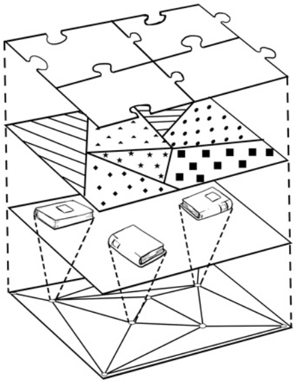
The image depicts a diagram representing a hierarchy of knowledge or data, often referred to as a data pyramid or DIKW pyramid (Data, Information, Knowledge, Wisdom). It's a conceptual illustration showing how raw data transforms into actionable wisdom through successive layers of processing and understanding. The diagram is presented as a series of stacked layers within a dashed rectangular prism.
### Components/Axes
The diagram consists of four distinct layers, from bottom to top:
1. **Data:** Represented by a network of interconnected lines forming a mesh-like structure.
2. **Information:** Represented by three books.
3. **Knowledge:** Represented by three distinct patterned areas: diagonal stripes, small squares, and dots.
4. **Wisdom:** Represented by four puzzle pieces.
Dashed lines connect the books (Information) to the network (Data) and the patterned areas (Knowledge) to the books. The entire structure is contained within a dashed rectangular prism, suggesting a defined scope or system.
### Detailed Analysis or Content Details
* **Data Layer:** The bottom layer is a complex network of interconnected lines. The lines are of varying lengths and intersect at numerous points, creating a dense web. There are approximately 20 visible intersection points.
* **Information Layer:** Three books are positioned above the data layer.
* Book 1 (left): Appears to have a rectangular shape on its cover.
* Book 2 (center): Appears to be a standard book shape.
* Book 3 (right): Appears to have a rectangular shape on its cover.
Dashed lines originate from each book and connect to different points within the data network.
* **Knowledge Layer:** This layer consists of three distinct areas:
* Area 1 (left): Filled with diagonal stripes.
* Area 2 (center): Filled with small squares.
* Area 3 (right): Filled with dots.
A curved line connects the striped area to the book on the left. Dashed lines connect the square area to the center book and the dotted area to the book on the right.
* **Wisdom Layer:** The top layer consists of four puzzle pieces arranged in a 2x2 grid. The pieces are interlocking, suggesting completeness or a holistic understanding.
### Key Observations
The diagram visually represents a progressive refinement of raw data. The complexity decreases as you move up the layers, from the dense network of data to the more organized and abstract representation of wisdom. The connections between layers highlight the dependency of higher-level concepts on lower-level foundations. The use of different visual patterns (stripes, squares, dots) within the knowledge layer suggests different types or categories of knowledge.
### Interpretation
This diagram illustrates the DIKW pyramid, a common model in information science and knowledge management. It demonstrates how data, when processed and contextualized, becomes information. Information, when analyzed and interpreted, becomes knowledge. And knowledge, when applied with judgment and experience, becomes wisdom.
The diagram emphasizes that wisdom is not simply a larger quantity of knowledge, but a qualitatively different state of understanding. The puzzle pieces at the top suggest that wisdom requires integrating different pieces of knowledge into a coherent whole. The dashed lines indicate the process of transformation and the connections between each stage. The diagram is a conceptual model and does not contain specific numerical data, but rather a visual representation of a theoretical framework. The image is a symbolic representation of the process of knowledge creation and the relationship between data, information, knowledge, and wisdom.