## Diagram: 3D Puzzle-Like Layered Structure with Geometric Base
### Overview
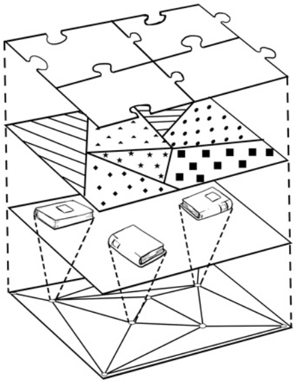
The image depicts a 3D puzzle-like structure composed of interconnected layers. The top layer features four interlocking puzzle pieces with distinct edge patterns. Below, a second layer contains triangular and polygonal shapes with patterned textures (stripes, dots, diamonds). A third layer shows three books with dashed lines connecting them to the geometric base. The base layer is a complex geometric grid with triangular facets and nodes. No textual labels, legends, or axis markers are visible.
### Components/Axes
- **Top Layer**: Four puzzle pieces with interlocking edges (no labels or text).
- **Middle Layer**: Triangular and polygonal shapes with patterned textures (stripes, dots, diamonds).
- **Books Layer**: Three books with dashed lines connecting to the base layer (no titles or annotations).
- **Base Layer**: Geometric grid with triangular facets and nodes (no axis labels or scales).
### Detailed Analysis
- **Puzzle Pieces**: No textual identifiers; edges suggest modular connectivity.
- **Patterns**: Stripes, dots, and diamonds on shapes may indicate categorical distinctions (e.g., data types or classifications).
- **Books**: Positioned centrally in the middle layer, connected via dashed lines to the base, implying a foundational relationship.
- **Geometric Base**: Triangular grid with nodes suggests a network or structural framework (no numerical or categorical labels).
### Key Observations
1. **Modular Design**: The puzzle-like layers emphasize interconnectivity and hierarchical relationships.
2. **Patterned Shapes**: Textures may represent abstract data groupings (e.g., categories, clusters).
3. **Books as Anchors**: Dashed lines from books to the base imply dependency or support structures.
4. **Lack of Labels**: No explicit textual data, axis titles, or legends are present.
### Interpretation
The diagram likely represents a conceptual model of layered systems, where:
- **Top Layer**: Represents high-level components or modules.
- **Middle Layer**: Intermediate structures with distinct characteristics (textures as proxies for attributes).
- **Books**: Symbolize foundational elements (e.g., knowledge, resources) supporting the system.
- **Base Grid**: A structural framework enabling stability and connectivity.
The absence of labels suggests the diagram is abstract, focusing on spatial relationships rather than quantitative data. The use of patterns and geometric shapes may encode categorical or hierarchical information implicitly. Further context is required to map these elements to specific real-world applications (e.g., organizational structures, data architectures).