## Bar Chart: Accuracy (%) vs. Length of paths in SPARQL
### Overview
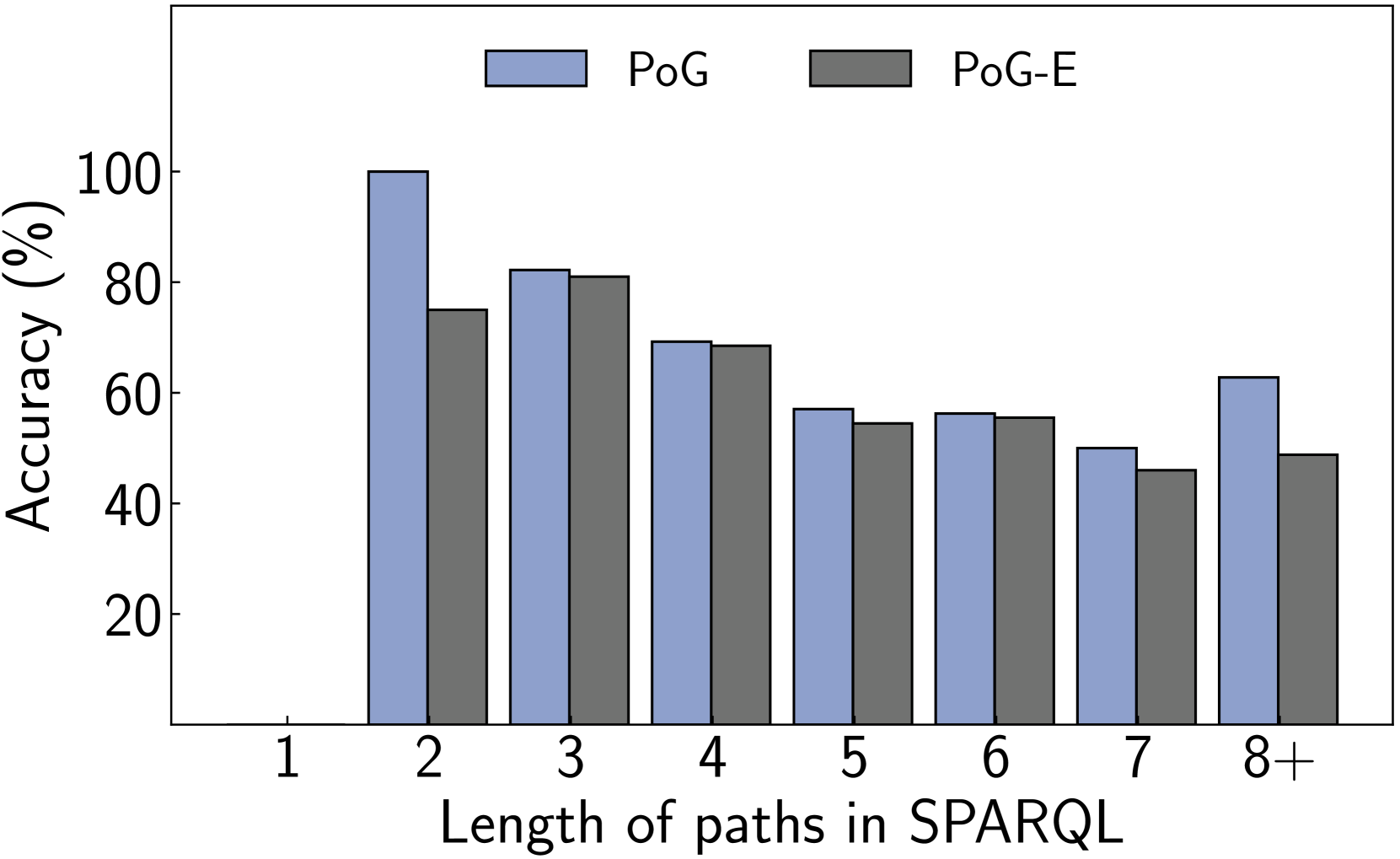
This image is a bar chart comparing the accuracy of two methods, "PoG" and "PoG-E", across different lengths of paths in SPARQL queries. The x-axis represents the length of paths in SPARQL queries, categorized from 1 to 8+. The y-axis represents the accuracy in percentage.
### Components/Axes
* **Title:** Implicitly, the chart title is "Accuracy (%) vs. Length of paths in SPARQL".
* **X-axis Label:** "Length of paths in SPARQL"
* **X-axis Markers:** 1, 2, 3, 4, 5, 6, 7, 8+
* **Y-axis Label:** "Accuracy (%)"
* **Y-axis Markers:** 0, 20, 40, 60, 80, 100
* **Legend:** Located at the top-center of the chart.
* **"PoG"**: Represented by light blue bars.
* **"PoG-E"**: Represented by dark gray bars.
### Detailed Analysis
The chart displays paired bars for each category on the x-axis, representing the accuracy for "PoG" and "PoG-E".
* **Path Length 1:**
* PoG: No bar is visible, suggesting an accuracy of 0% or it's not applicable/measured.
* PoG-E: No bar is visible, suggesting an accuracy of 0% or it's not applicable/measured.
* **Path Length 2:**
* PoG (light blue): Slopes upward to approximately 100%.
* PoG-E (dark gray): Slopes upward to approximately 75%.
* **Path Length 3:**
* PoG (light blue): Slopes upward to approximately 82%.
* PoG-E (dark gray): Slopes upward to approximately 81%.
* **Path Length 4:**
* PoG (light blue): Slopes upward to approximately 68%.
* PoG-E (dark gray): Slopes upward to approximately 69%.
* **Path Length 5:**
* PoG (light blue): Slopes upward to approximately 58%.
* PoG-E (dark gray): Slopes upward to approximately 56%.
* **Path Length 6:**
* PoG (light blue): Slopes upward to approximately 57%.
* PoG-E (dark gray): Slopes upward to approximately 57%.
* **Path Length 7:**
* PoG (light blue): Slopes upward to approximately 50%.
* PoG-E (dark gray): Slopes upward to approximately 46%.
* **Path Length 8+:**
* PoG (light blue): Slopes upward to approximately 63%.
* PoG-E (dark gray): Slopes upward to approximately 50%.
### Key Observations
* **Path Length 2:** "PoG" achieves its highest accuracy at approximately 100%, significantly outperforming "PoG-E" which is around 75%.
* **Path Length 3:** Both "PoG" and "PoG-E" show very similar accuracies, around 82% and 81% respectively.
* **General Trend:** For path lengths 2 through 7, the accuracy for both methods generally decreases as the path length increases, with a slight dip and then a rise for "PoG" at path length 8+.
* **Path Length 8+:** "PoG" shows a notable increase in accuracy to approximately 63%, while "PoG-E" drops to approximately 50%.
* **Comparison:** "PoG" generally performs better or comparably to "PoG-E" across most path lengths, with the exception of path length 4 where "PoG-E" is slightly higher. "PoG" shows a more pronounced peak at path length 2 and a significant recovery at path length 8+.
### Interpretation
This chart demonstrates the performance of two methods, "PoG" and "PoG-E", in terms of accuracy when dealing with SPARQL queries of varying path lengths.
* **Method Performance:** "PoG" appears to be a more robust method, especially for shorter and longer path lengths. Its peak performance at path length 2 (near 100% accuracy) suggests it is highly effective for queries with a single hop or very simple structures. The significant increase in accuracy for path length 8+ compared to path length 7 indicates that "PoG" might be better at handling complex, multi-hop queries than "PoG-E".
* **Impact of Path Length:** The general trend of decreasing accuracy with increasing path length (from 2 to 7) is a common observation in query processing, as longer paths can introduce more complexity, ambiguity, and potential for errors. However, the behavior at path length 8+ for "PoG" suggests that for very complex queries, its architecture might be more adaptable or it might be leveraging different strategies.
* **"PoG-E" Behavior:** "PoG-E" shows a more consistent, albeit lower, performance compared to "PoG" for path lengths 2 through 7. Its accuracy is generally slightly lower than "PoG" in this range, and it does not show the same recovery at path length 8+. This could imply that "PoG-E" is more sensitive to the increasing complexity of longer paths.
* **Relationship between Elements:** The x-axis categories (path lengths) directly influence the y-axis values (accuracy) for each of the two data series ("PoG" and "PoG-E"). The legend clearly distinguishes these two series, allowing for direct comparison at each path length. The visual representation as bars allows for quick identification of relative performance.
* **Underlying Data:** The data suggests that while both methods struggle with increasing path complexity, "PoG" exhibits a more dynamic performance profile, excelling at both very short and very long path lengths, while "PoG-E" offers a more stable but generally lower accuracy across intermediate path lengths. The absence of data for path length 1 for both methods might indicate that such queries are not relevant or not handled by these methods.