## Bar Chart: Accuracy vs. Path Length in SPARQL
### Overview
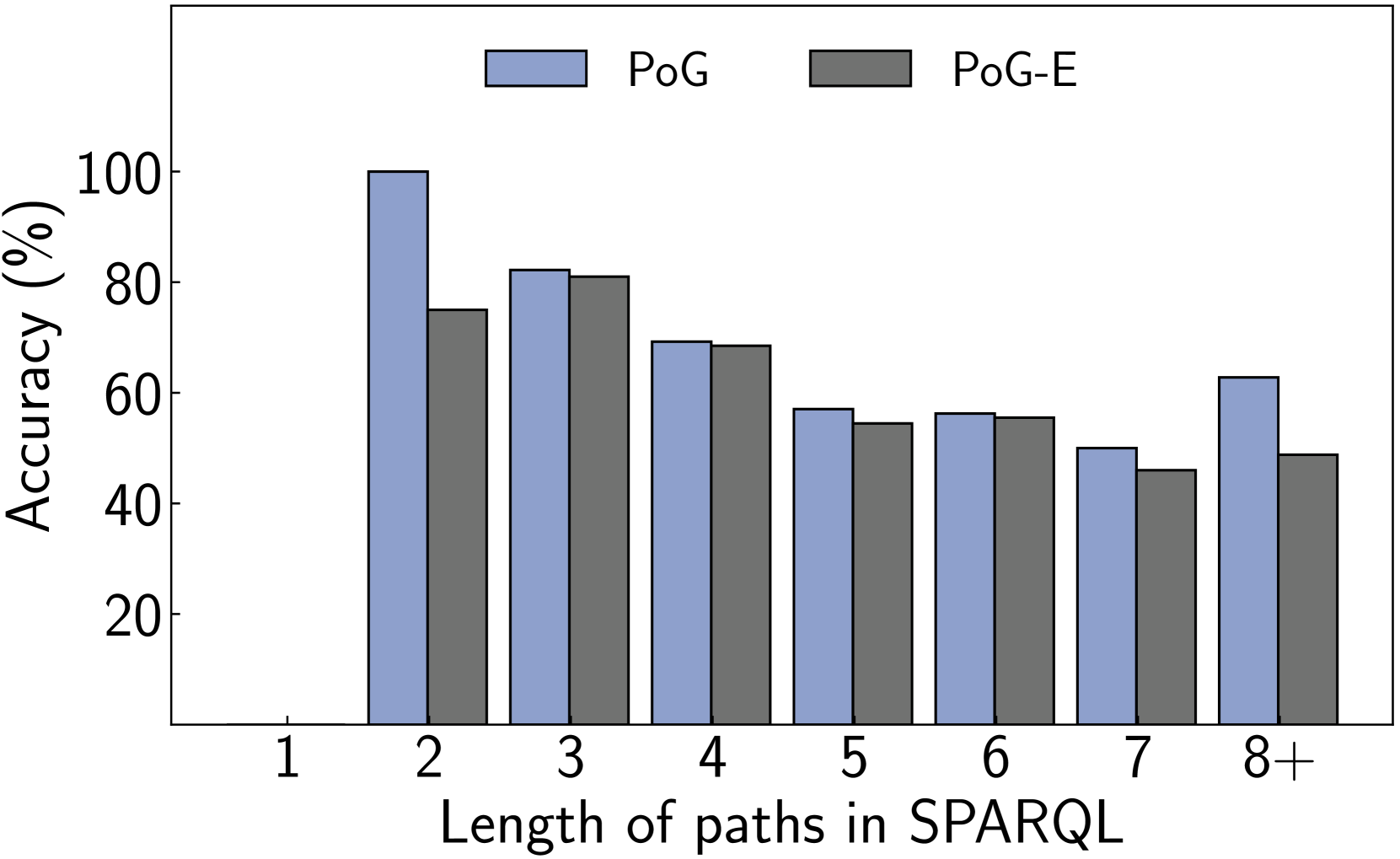
This bar chart compares the accuracy of two methods, PoG and PoG-E, across different lengths of paths in SPARQL queries. The x-axis represents the length of the paths, and the y-axis represents the accuracy in percentage. Each path length has two bars, one for PoG and one for PoG-E.
### Components/Axes
* **X-axis Title:** "Length of paths in SPARQL"
* Markers: 1, 2, 3, 4, 5, 6, 7, 8+
* **Y-axis Title:** "Accuracy (%)"
* Scale: 0 to 100, with increments of 20.
* **Legend:** Located at the top-center of the chart.
* PoG: Light blue
* PoG-E: Dark gray
### Detailed Analysis
The chart consists of eight groups of bars, each representing a different path length.
* **Path Length 1:**
* PoG: Approximately 95% accuracy.
* PoG-E: Approximately 75% accuracy.
* **Path Length 2:**
* PoG: Approximately 98% accuracy.
* PoG-E: Approximately 78% accuracy.
* **Path Length 3:**
* PoG: Approximately 82% accuracy.
* PoG-E: Approximately 80% accuracy.
* **Path Length 4:**
* PoG: Approximately 68% accuracy.
* PoG-E: Approximately 65% accuracy.
* **Path Length 5:**
* PoG: Approximately 58% accuracy.
* PoG-E: Approximately 52% accuracy.
* **Path Length 6:**
* PoG: Approximately 54% accuracy.
* PoG-E: Approximately 50% accuracy.
* **Path Length 7:**
* PoG: Approximately 52% accuracy.
* PoG-E: Approximately 46% accuracy.
* **Path Length 8+:**
* PoG: Approximately 57% accuracy.
* PoG-E: Approximately 59% accuracy.
**Trends:**
* **PoG:** The accuracy of PoG generally decreases as the path length increases from 1 to 7, then slightly increases for 8+. The initial drop is significant, from approximately 98% at length 2 to around 52% at length 7.
* **PoG-E:** The accuracy of PoG-E also generally decreases as the path length increases, but the decrease is less pronounced than for PoG. It starts at approximately 75% at length 1 and reaches around 46% at length 7, then increases to 59% at 8+.
### Key Observations
* PoG consistently outperforms PoG-E for path lengths 1, 2, 3, and 4.
* For path lengths 5, 6, and 7, the performance difference between PoG and PoG-E is smaller.
* At path length 8+, PoG-E slightly outperforms PoG.
* Both methods exhibit a decline in accuracy as path length increases, suggesting a challenge in maintaining accuracy with longer SPARQL paths.
### Interpretation
The data suggests that both PoG and PoG-E methods are effective for short SPARQL paths (length 1 and 2), achieving high accuracy. However, as the path length increases, the accuracy of both methods decreases. This could be due to the increased complexity of reasoning over longer paths, leading to more potential errors.
The initial superior performance of PoG suggests it may be better suited for simpler queries. However, PoG-E's relative stability and slight outperformance at path length 8+ indicate it might be more robust for complex queries involving longer paths. The crossover point where PoG-E becomes competitive is around path length 5.
The slight increase in accuracy for both methods at path length 8+ could be due to a variety of factors, such as the nature of the queries used for evaluation or the limitations of the evaluation dataset. Further investigation would be needed to understand this trend. The data highlights a trade-off between simplicity and robustness in SPARQL query processing.