\n
## Diagram: Semantic Network of "Rob" and "Arrest"
### Overview
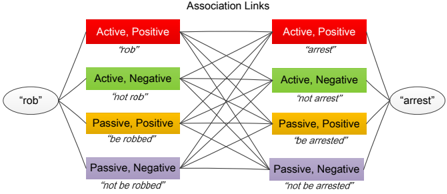
The image depicts a semantic network illustrating the associations between the words "rob" and "arrest". The network categorizes these associations based on valence (Positive/Negative) and voice (Active/Passive). The diagram uses colored rectangles to represent these associations, with lines connecting related concepts.
### Components/Axes
The diagram consists of two main nodes labeled "rob" (left) and "arrest" (right). Between these nodes are four columns of rectangles, each representing a specific combination of valence and voice:
* **Active, Positive:** (Red rectangles)
* **Active, Negative:** (Green rectangles)
* **Passive, Positive:** (Yellow rectangles)
* **Passive, Negative:** (Purple rectangles)
The title "Association Links" is positioned at the top-center of the diagram. Each rectangle contains a phrase related to the concepts of "rob" and "arrest" in the specified valence and voice. Lines connect each phrase in the "rob" column to each phrase in the "arrest" column, indicating an association.
### Detailed Analysis or Content Details
Here's a breakdown of the phrases within each category:
* **Active, Positive (Red):**
* "rob"
* "arrest"
* **Active, Negative (Green):**
* "hot rob"
* "not arrest"
* **Passive, Positive (Yellow):**
* "be robbed"
* "be arrested"
* **Passive, Negative (Purple):**
* "not be robbed"
* "not be arrested"
Each phrase in the "rob" column is connected to each phrase in the "arrest" column via a gray line. This creates a fully connected network between the two main nodes.
### Key Observations
The diagram demonstrates a comprehensive mapping of semantic relationships between "rob" and "arrest", considering both active and passive voice, as well as positive and negative connotations. The complete connectivity suggests that all combinations of valence and voice are considered relevant associations between the two concepts. The use of color-coding clearly distinguishes the different categories of associations.
### Interpretation
This diagram likely represents a model of semantic association used in computational linguistics or cognitive science. It illustrates how the meaning of words can be understood in relation to other words, taking into account grammatical structure (active/passive voice) and emotional tone (positive/negative valence). The complete connectivity suggests that the model aims to capture all possible relationships, even those that might seem counterintuitive (e.g., "hot rob" associated with "not arrest").
The diagram could be used to:
* **Analyze text:** Identify the semantic relationships between words in a given text.
* **Build knowledge graphs:** Create a network of concepts and their relationships.
* **Improve natural language processing:** Enhance the ability of computers to understand and generate human language.
The inclusion of "hot rob" and "not arrest" suggests an attempt to capture nuanced or idiomatic expressions. The diagram is a visual representation of a complex semantic space, highlighting the multifaceted relationships between seemingly simple concepts. It's a theoretical model, not a depiction of empirical data.