## Diagram: Association Links
### Overview
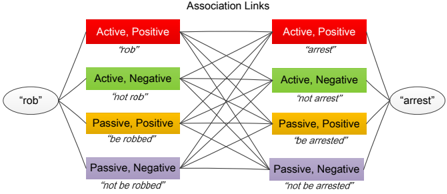
The image is a conceptual diagram titled "Association Links" that illustrates the semantic and grammatical relationships between two core verbs: "rob" and "arrest." It maps out different voice (active/passive) and polarity (positive/negative) variations of these verbs and shows a dense network of potential associations between them.
### Components/Axes
The diagram is structured symmetrically with two primary nodes and two columns of associated concepts.
* **Primary Nodes:**
* **Left Node:** An oval containing the word `"rob"`.
* **Right Node:** An oval containing the word `"arrest"`.
* **Associated Concept Columns:** Each primary node connects to a vertical column of four colored rectangular boxes. Each box contains a label defining a grammatical voice/polarity and a corresponding verb phrase in quotes.
* **Left Column (associated with "rob"):**
1. **Red Box (Top):** Label: `Active, Positive`. Phrase: `"rob"`.
2. **Green Box:** Label: `Active, Negative`. Phrase: `"not rob"`.
3. **Yellow Box:** Label: `Active, Positive`. Phrase: `"be robbed"`.
4. **Purple Box (Bottom):** Label: `Passive, Negative`. Phrase: `"not be robbed"`.
* **Right Column (associated with "arrest"):**
1. **Red Box (Top):** Label: `Active, Positive`. Phrase: `"arrest"`.
2. **Green Box:** Label: `Active, Negative`. Phrase: `"not arrest"`.
3. **Yellow Box:** Label: `Active, Positive`. Phrase: `"be arrested"`.
4. **Purple Box (Bottom):** Label: `Passive, Negative`. Phrase: `"not be arrested"`.
* **Association Lines:** A dense web of straight, black lines connects every box in the left column to every box in the right column, creating a complete bipartite graph. This indicates that any grammatical form of "rob" can be associated with any grammatical form of "arrest."
### Detailed Analysis
The diagram explicitly defines eight distinct verb phrases derived from two root verbs, categorized by two binary features:
1. **Voice/Polarity Label:** Each box has a unique combination of `Active/Passive` and `Positive/Negative`.
2. **Verb Phrase:** The actual linguistic instantiation of that category.
**Spatial Grounding & Color Consistency:**
* The legend (the colored boxes) is positioned in two vertical columns flanking the central network of lines.
* The color coding is consistent between the two columns for corresponding labels:
* **Red** = `Active, Positive`
* **Green** = `Active, Negative`
* **Yellow** = `Active, Positive` (Note: This label is repeated for the "be robbed"/"be arrested" phrases, which are grammatically passive in meaning but labeled as "Active, Positive" in the diagram's schema).
* **Purple** = `Passive, Negative`
**Trend/Flow Verification:**
The diagram does not show a temporal trend but a **relational network**. The visual trend is one of **dense interconnectivity**. The lines form a complex mesh in the center, emphasizing that the semantic relationship between the concepts of "robbing" and "arresting" is multifaceted and not limited to a single direct translation (e.g., "rob" to "arrest").
### Key Observations
1. **Labeling Anomaly:** The yellow boxes for both verbs are labeled `Active, Positive` but contain phrases (`"be robbed"`, `"be arrested"`) that are syntactically passive constructions. This suggests the label may refer to the **polarity of the event** (the robbery/arrest happens) rather than strict grammatical voice.
2. **Symmetrical Structure:** The diagram is perfectly symmetrical, implying the relationship between "rob" and "arrest" is modeled as reciprocal or parallel in its complexity.
3. **Complete Connectivity:** Every possible link between the left-side concepts and right-side concepts is drawn, suggesting a theoretical model where any form of one action can be contextually associated with any form of the other.
### Interpretation
This diagram serves as a **semantic map** for linguistic or cognitive analysis. It deconstructs two related crime/action verbs into their core components of agency (active/passive) and outcome (positive/negative occurrence).
* **What it demonstrates:** It visualizes the hypothesis that the concepts of "robbing" and "arresting" are deeply linked in a network of associations that go beyond simple synonymy. For example, the state of `"not be robbed"` (purple, left) could be associated with the action of `"arrest"` (red, right) as a preventive measure, or with `"not arrest"` (green, right) as a failure of intervention.
* **Underlying Model:** The dense web implies a **connectionist** or **semantic network** model of language, where meaning arises from patterns of connection between nodes. The diagram argues against a one-to-one mapping between the verbs, instead proposing a many-to-many relationship based on grammatical and situational context.
* **Purpose:** It is likely used in fields like computational linguistics, artificial intelligence (for natural language understanding), or cognitive science to model how verbs with related meanings interact in a mental lexicon or to train algorithms to understand nuanced relationships between actions.