## Diagram: Association Links Between "rob" and "arrest"
### Overview
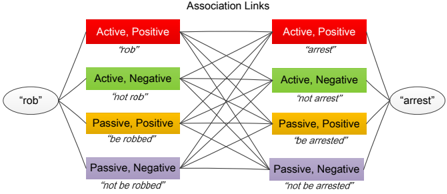
The diagram illustrates bidirectional association links between two core concepts: "rob" and "arrest." Each concept is represented by an oval node, connected to four colored rectangular nodes that encode grammatical (active/passive) and semantic (positive/negative) variations. Black lines represent association links between all nodes, forming a fully connected bipartite graph.
### Components/Axes
- **Legend**: Located at the top center, labeled "Association Links."
- **Nodes**:
- **Left Oval**: Labeled "rob" (black text, white background).
- **Right Oval**: Labeled "arrest" (black text, white background).
- **Colored Rectangles**:
- **Red**: "Active, Positive" (white text).
- **Green**: "Active, Negative" (black text).
- **Yellow**: "Passive, Positive" (black text).
- **Purple**: "Passive, Negative" (black text).
- **Labels**: Each rectangle contains a verb form (e.g., "rob," "not rob," "be robbed," "not be robbed") and its grammatical/semantic classification.
- **Connections**: Black lines link all nodes bidirectionally, creating a dense network.
### Detailed Analysis
- **Left Oval ("rob")**:
- **Active, Positive**: "rob"
- **Active, Negative**: "not rob"
- **Passive, Positive**: "be robbed"
- **Passive, Negative**: "not be robbed"
- **Right Oval ("arrest")**:
- **Active, Positive**: "arrest"
- **Active, Negative**: "not arrest"
- **Passive, Positive**: "be arrested"
- **Passive, Negative**: "not be arrested"
- **Association Links**:
- Every node is connected to every node in the opposite oval (e.g., "rob" connects to "arrest," "not arrest," "be arrested," etc.).
- No self-connections within the same oval.
### Key Observations
1. **Bidirectional Completeness**: All possible combinations of "rob" and "arrest" variations are linked, suggesting a holistic semantic relationship.
2. **Color Coding**: Red (positive) and green (negative) dominate active forms, while yellow (positive) and purple (negative) dominate passive forms.
3. **Semantic Symmetry**: Passive forms ("be robbed," "be arrested") mirror active forms but with inverted agency.
### Interpretation
This diagram models the polysemous relationship between "rob" and "arrest," emphasizing how grammatical transformations (active/passive) and semantic oppositions (positive/negative) create a network of associations. The bidirectional links imply that each variation of "rob" semantically interacts with all variations of "arrest," and vice versa. For example:
- "rob" (active positive) is linked to "arrest" (active positive), suggesting a shared core concept of intentional action.
- "not rob" (active negative) connects to "not be arrested" (passive negative), highlighting inverse relationships.
- Passive forms ("be robbed," "be arrested") retain positive polarity despite inverted agency, indicating focus on the action’s occurrence rather than the agent.
The structure reflects linguistic complexity, where verbs encode both action direction (active/passive) and semantic valence (positive/negative), with associations spanning all combinations. This could inform NLP tasks like semantic role labeling or verb sense disambiguation.