## Diagram: Knowledge Graph Abstraction Hierarchy
### Overview
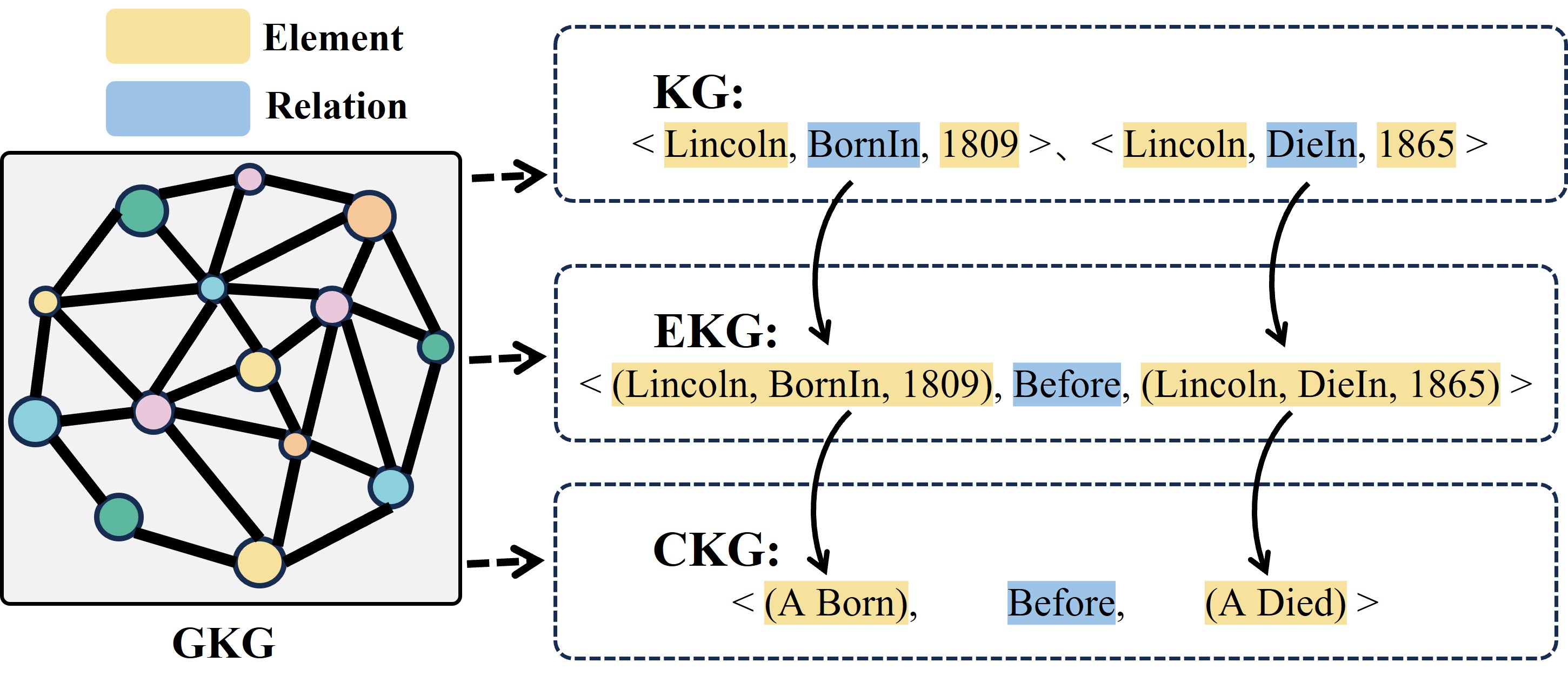
The image is a conceptual diagram illustrating three levels of abstraction for representing knowledge, derived from a base "GKG" (General Knowledge Graph). It demonstrates how specific factual triples can be transformed into higher-order relations and then into generalized conceptual patterns. The diagram uses a color-coding scheme to distinguish between "Elements" (yellow) and "Relations" (blue).
### Components/Axes
* **Legend (Top-Left):**
* **Element:** Represented by a yellow rectangle.
* **Relation:** Represented by a blue rectangle.
* **Main Diagram Structure:**
* **Left Panel:** A box labeled **"GKG"** containing a network graph. This graph consists of multiple nodes (circles) of various colors (yellow, blue, green, pink, orange) connected by black lines, representing a complex knowledge graph.
* **Right Panel:** Three vertically stacked, dashed-line boxes, each representing a different level of knowledge representation. Arrows flow from the GKG to each of these boxes.
* **Flow Arrows:**
* Three straight, dashed arrows point from the GKG box to each of the three right-hand boxes (KG, EKG, CKG).
* Two curved, solid arrows connect the right-hand boxes vertically: one from the KG box to the EKG box, and another from the EKG box to the CKG box, indicating a transformation or abstraction process.
### Detailed Analysis
The diagram explicitly defines three knowledge representation formats, using Abraham Lincoln's lifespan as an example.
1. **KG (Knowledge Graph):**
* **Content:** `<Lincoln, BornIn, 1809>、<Lincoln, DieIn, 1865>`
* **Analysis:** This is the most concrete level, containing specific factual triples. "Lincoln" and the years "1809" and "1865" are highlighted in yellow as **Elements**. "BornIn" and "DieIn" are highlighted in blue as **Relations**. The Chinese punctuation "、" (a comma-like enumeration comma) is used to separate the two triples.
2. **EKG (Event Knowledge Graph):**
* **Content:** `<(Lincoln, BornIn, 1809), Before, (Lincoln, DieIn, 1865)>`
* **Analysis:** This level creates a higher-order relation between two events (the birth event and the death event). The entire first triple `(Lincoln, BornIn, 1809)` and the entire second triple `(Lincoln, DieIn, 1865)` are treated as compound **Elements** (highlighted in yellow). The new **Relation** connecting them is "Before" (highlighted in blue). This represents temporal ordering.
3. **CKG (Conceptual Knowledge Graph):**
* **Content:** `<(A Born), Before, (A Died)>`
* **Analysis:** This is the most abstract, conceptual level. Specific entities and dates are removed. "A Born" and "A Died" are generalized **Elements** (yellow) representing the abstract concepts of "being born" and "dying." The **Relation** "Before" (blue) remains, asserting a universal temporal pattern: the event of being born occurs before the event of dying for any entity 'A'.
### Key Observations
* **Hierarchical Abstraction:** The diagram clearly shows a progression from specific data (KG) to event-based reasoning (EKG) to universal conceptual patterns (CKG).
* **Consistent Color Coding:** The yellow/blue color scheme for Elements/Relations is applied consistently across all three levels, including within the compound elements of the EKG.
* **Transformation Process:** The curved arrows between the right-hand boxes emphasize that EKG is derived from KG, and CKG is derived from EKG, not directly from the GKG.
* **GKG as Source:** The GKG is depicted as a complex, interconnected network, suggesting it is the foundational data source from which these structured representations are extracted or into which they are mapped.
### Interpretation
This diagram illustrates a core methodology in knowledge representation and reasoning within artificial intelligence. It demonstrates how raw, interconnected data (GKG) can be systematically structured and abstracted to support different types of inference.
* **What it suggests:** The data flow implies that complex knowledge systems benefit from multiple representational layers. The KG layer stores verifiable facts. The EKG layer enables temporal and causal reasoning between events. The CKG layer facilitates analogical reasoning and the discovery of universal patterns or schemas.
* **Relationships:** The primary relationship is one of **abstraction and generalization**. Each step to the right (and down via the curved arrows) removes specific instance data while preserving and highlighting the underlying relational structure. The "Before" relation is the invariant core that persists through all levels of abstraction.
* **Notable Insight:** The power of this approach is its ability to connect concrete instances (Lincoln's life) to abstract principles (the life-death sequence). This is fundamental for tasks like question answering, analogical reasoning, and knowledge transfer across domains. The diagram serves as a visual blueprint for building AI systems that can "think" at multiple levels of abstraction.