## Knowledge Graph Diagram: Conceptual Representation of Temporal Relationships
### Overview
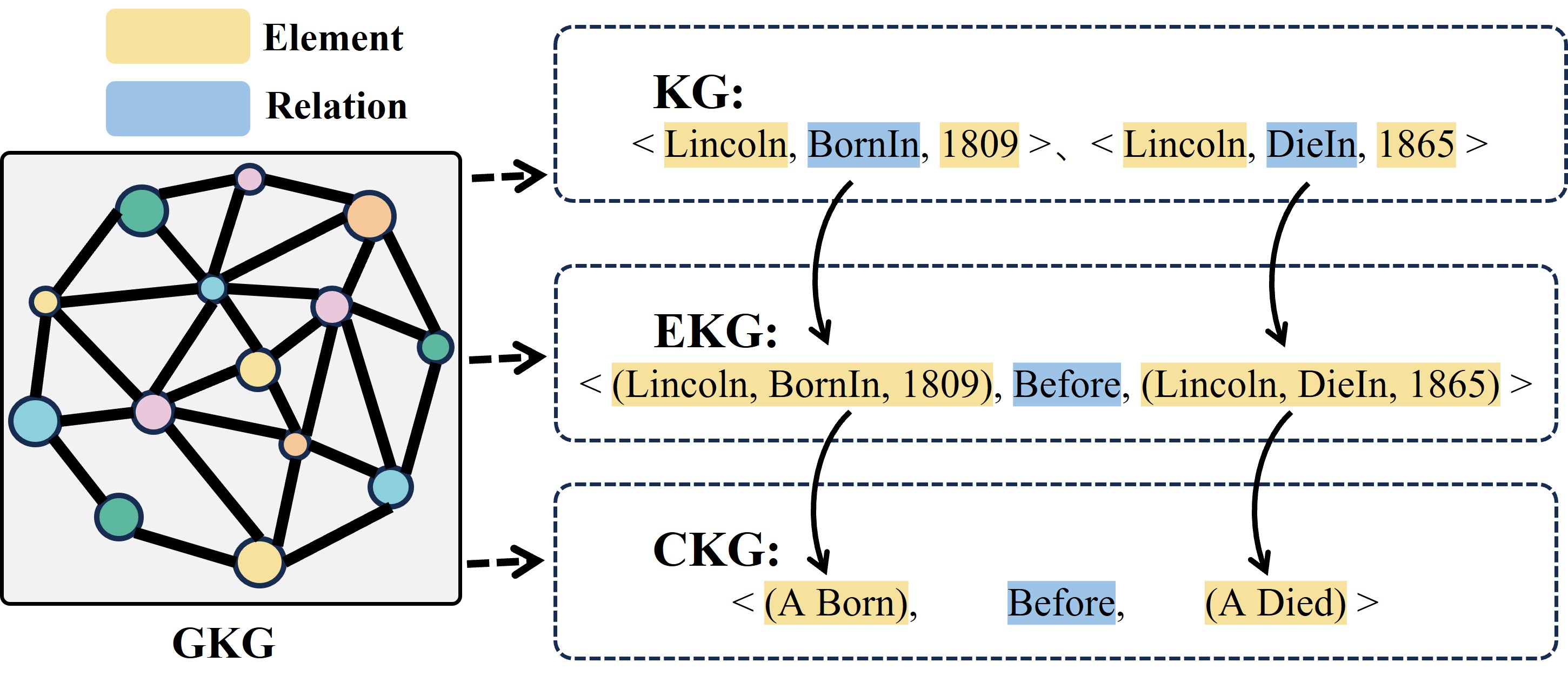
The image presents a hierarchical knowledge graph structure with three interconnected layers:
1. **GKG (Graph Knowledge Graph)**: A network of colored nodes connected by black edges
2. **KG (Knowledge Graph)**: Explicit temporal facts about Abraham Lincoln
3. **EKG (Event Knowledge Graph)**: Temporal relationships between Lincoln's birth and death
4. **CKG (Conceptual Knowledge Graph)**: Abstracted temporal relationship pattern
### Components/Axes
- **Legend**:
- Yellow rectangles = "Element"
- Blue rectangles = "Relation"
- **GKG Layer**:
- Circular nodes in 5 colors (yellow, blue, green, pink, orange)
- Black edges connecting nodes in complex patterns
- Positioned in bottom-left quadrant
- **KG Layer**:
- Nested triple structure:
`<Lincoln, BornIn, 1809>`, `<Lincoln, DieIn, 1865>`
- Positioned in top-right quadrant
- **EKG Layer**:
- Temporal relationship:
`<(Lincoln, BornIn, 1809), Before, (Lincoln, DieIn, 1865)>`
- Positioned in middle-right quadrant
- **CKG Layer**:
- Abstracted pattern:
`<(A Born), Before, (A Died)>`
- Positioned in bottom-right quadrant
### Detailed Analysis
1. **GKG Network**:
- 12 nodes total with varying degrees of connectivity
- Yellow nodes (Elements) appear most frequently (4 instances)
- Blue nodes (Relations) form central connectors
- No numerical values present in this layer
2. **KG Facts**:
- Two explicit temporal facts about Lincoln:
- Birth year: 1809 (yellow element)
- Death year: 1865 (yellow element)
- Blue relations indicate "BornIn" and "DieIn" predicates
3. **EKG Temporal Chain**:
- Establishes chronological relationship between birth and death
- Uses "Before" relation (blue) to connect events
- Maintains original numerical values from KG layer
4. **CKG Abstraction**:
- Generalizes pattern to universal temporal relationship
- Replaces specific entities with variables (A Born/A Died)
- Preserves "Before" relation structure
### Key Observations
- Color coding consistently applies across all layers:
- Yellow = factual elements (entities/years)
- Blue = relational predicates
- Hierarchical progression from concrete facts (KG) to abstract patterns (CKG)
- Temporal relationships maintain chronological integrity through all layers
- No numerical uncertainty present in explicit facts (1809 and 1865 are definitive)
### Interpretation
This diagram demonstrates a knowledge graph's conceptual scaffolding:
1. **GKG** represents raw data connections without temporal context
2. **KG** adds specific historical facts with precise dating
3. **EKG** establishes causal/temporal relationships between events
4. **CKG** abstracts these relationships into universal patterns
The structure reveals how knowledge graphs can:
- Preserve factual accuracy while enabling pattern recognition
- Maintain temporal integrity across abstraction levels
- Connect specific historical data to generalizable concepts
The absence of numerical uncertainty in explicit facts suggests this is a pedagogical example rather than a statistical analysis. The consistent color coding across layers demonstrates effective visual encoding of semantic roles (elements vs relations).