## Contour Plot / Phase Portrait: Nested Polygons within a Bounding Rectangle
### Overview
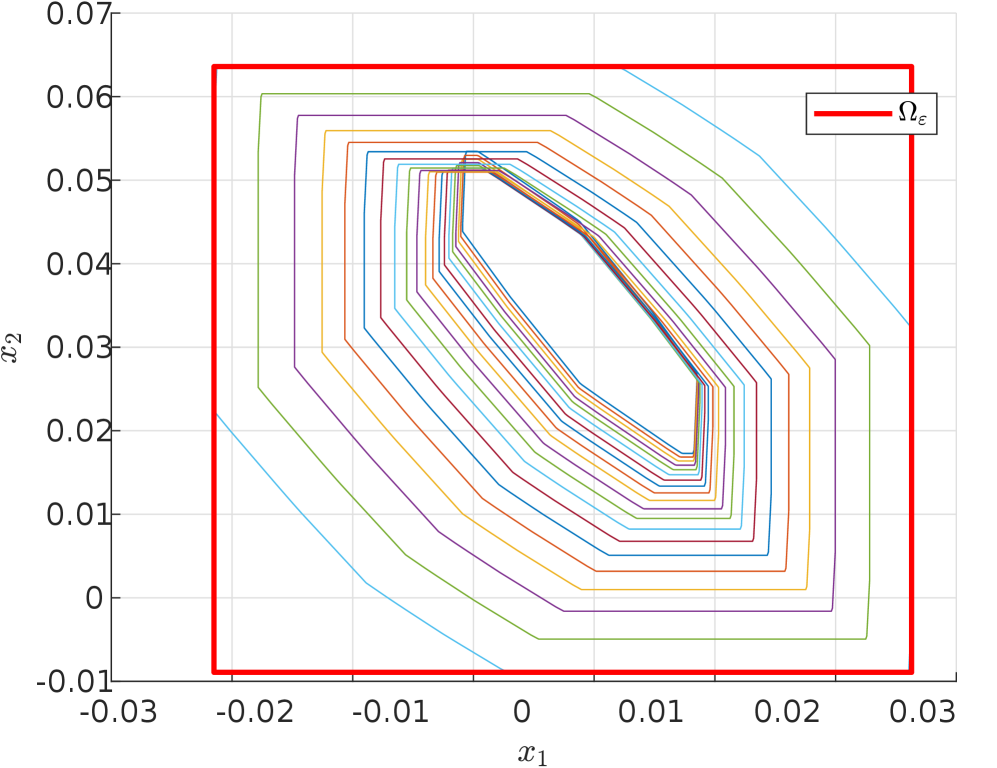
The image is a 2D technical plot displaying a series of nested, closed polygons (likely representing contour lines or level sets) contained within a prominent red rectangular boundary. The plot is set against a light gray grid on a white background. The visualization appears to represent a mathematical or engineering concept, such as a stability region, invariant set, or phase portrait of a dynamical system.
### Components/Axes
* **Plot Type:** 2D contour plot or phase portrait.
* **Axes:**
* **Horizontal Axis (x1):** Labeled `x1`. The scale runs from approximately -0.03 to 0.03. Major tick marks are present at intervals of 0.01 (e.g., -0.03, -0.02, -0.01, 0, 0.01, 0.02, 0.03).
* **Vertical Axis (x2):** Labeled `x2`. The scale runs from approximately -0.01 to 0.07. Major tick marks are present at intervals of 0.01 (e.g., -0.01, 0, 0.01, 0.02, 0.03, 0.04, 0.05, 0.06, 0.07).
* **Legend:** Located in the top-right corner of the plot area. It contains a single entry: a thick red line segment labeled with the mathematical symbol **Ωε** (Omega subscript epsilon).
* **Primary Boundary:** A thick, solid red rectangle, corresponding to the legend entry **Ωε**. Its approximate corners are at coordinates (-0.022, -0.009) and (0.029, 0.064).
* **Data Series (Nested Polygons):** A set of approximately 20-25 concentric, closed polygons. Each polygon is drawn with a thin line of a distinct color. The colors include (from outermost to innermost, approximate sequence): light blue, green, purple, yellow, orange, red, dark blue, and others, repeating in a pattern. The polygons are not perfect circles or ellipses but have a distinct, slightly irregular, multi-faceted shape, suggesting they are defined by a piecewise-linear or polyhedral function.
### Detailed Analysis
* **Spatial Arrangement:** The polygons are nested concentrically. The outermost polygon is the largest, and each subsequent polygon is contained within the previous one, with the innermost polygon being the smallest. They are all centered roughly around the point (0.005, 0.035).
* **Shape & Trend:** All polygons share a similar geometric characteristic: they are elongated along a diagonal axis running from the top-left to the bottom-right of the plot. The shapes are not symmetric about the x1 or x2 axes. The trend is a clear convergence towards a central point or region.
* **Color-Legend Cross-Reference:** The red color is exclusively used for the outer bounding rectangle labeled **Ωε**. None of the inner nested polygons are red. The inner polygons use a palette of other colors (blues, greens, purples, yellows, oranges) which are not individually labeled in a legend.
* **Data Point Approximation (Polygon Vertices):** While exact vertices are not labeled, the polygons' corners can be approximated relative to the grid. For example, the outermost light blue polygon has a vertex near (0.025, 0.030) and another near (-0.020, 0.022). The innermost polygons are tightly clustered around the central point.
### Key Observations
1. **Concentric Nesting:** The most striking feature is the perfect nesting of the polygons, indicating a hierarchical or iterative relationship between them.
2. **Diagonal Orientation:** The consistent diagonal elongation of all shapes suggests an underlying dynamic or constraint that is not aligned with the primary x1 or x2 axes.
3. **Bounding Set:** The red rectangle **Ωε** acts as a strict outer boundary. All other data (the polygons) are fully contained within it.
4. **Lack of Individual Labels:** The inner polygons are not individually identified. Their meaning is derived from their collective pattern and relationship to the bounding set **Ωε**.
### Interpretation
This plot is highly characteristic of visualizations used in **control theory, optimization, or dynamical systems analysis**.
* **What it likely represents:** The nested polygons are almost certainly **level sets** (contours) of a scalar function, such as a **Lyapunov function** or a **cost function**. The function's value decreases as one moves from the outer polygons toward the center. The central point (approx. 0.005, 0.035) is likely an **equilibrium point** or an **optimal solution**.
* **Role of Ωε:** The red rectangle **Ωε** defines a **region of interest, a safe operating set, or an invariant set**. The fact that all level sets are contained within it suggests that trajectories starting inside **Ωε** will remain within it and converge toward the central equilibrium. The subscript ε (epsilon) often denotes a small, positive parameter, implying this set might be defined by a tolerance or a bound.
* **Underlying System:** The diagonal, non-axis-aligned shape of the contours indicates that the system's dynamics or the function's Hessian have coupled terms between the states `x1` and `x2`. The system is not decoupled.
* **Purpose:** The graph demonstrates **stability** or **convergence**. It visually proves that from any point within the bounding set **Ωε**, the system state will evolve (following the gradient of the function) toward the central equilibrium, as shown by the descending sequence of level sets. It is a graphical certificate of performance for a controller or an optimization algorithm.