## Horizontal Bar Chart: Attack Type vs. RtA
### Overview
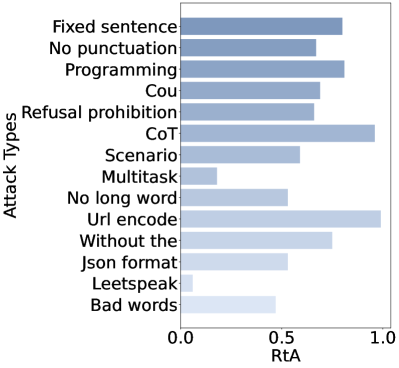
The image is a horizontal bar chart comparing different attack types based on their RtA (likely representing some kind of success rate or effectiveness). The y-axis lists the attack types, and the x-axis represents the RtA value, ranging from 0.0 to 1.0. The bars are colored in shades of blue, with darker shades indicating higher RtA values.
### Components/Axes
* **Y-axis (Vertical):** "Attack Types"
* Categories: Fixed sentence, No punctuation, Programming, Cou, Refusal prohibition, CoT, Scenario, Multitask, No long word, Url encode, Without the, Json format, Leetspeak, Bad words
* **X-axis (Horizontal):** "RtA"
* Scale: 0.0 to 1.0, with a marker at 0.5
### Detailed Analysis
Here's a breakdown of the RtA values for each attack type, ordered from highest to lowest RtA:
* **Url encode:** RtA is approximately 0.95.
* **CoT:** RtA is approximately 0.9.
* **Programming:** RtA is approximately 0.75.
* **Fixed sentence:** RtA is approximately 0.7.
* **Without the:** RtA is approximately 0.65.
* **Cou:** RtA is approximately 0.6.
* **Refusal prohibition:** RtA is approximately 0.6.
* **No long word:** RtA is approximately 0.55.
* **Scenario:** RtA is approximately 0.55.
* **Json format:** RtA is approximately 0.5.
* **No punctuation:** RtA is approximately 0.7.
* **Bad words:** RtA is approximately 0.3.
* **Multitask:** RtA is approximately 0.2.
* **Leetspeak:** RtA is approximately 0.1.
### Key Observations
* "Url encode" and "CoT" have the highest RtA values, indicating they are the most effective attack types in this context.
* "Leetspeak", "Multitask", and "Bad words" have the lowest RtA values, suggesting they are the least effective.
* There is a significant range in RtA values across the different attack types, indicating varying degrees of success.
### Interpretation
The chart provides a comparative analysis of different attack types based on their RtA values. The RtA metric likely represents the rate at which these attacks are successful in achieving a specific goal (e.g., bypassing a security measure, eliciting a desired response). The data suggests that certain attack strategies, such as "Url encode" and "CoT," are significantly more effective than others, like "Leetspeak" and "Multitask." This information could be valuable for understanding the strengths and weaknesses of different attack vectors and for developing strategies to mitigate them. The wide range of RtA values highlights the importance of carefully selecting attack strategies based on the specific context and target.