## Horizontal Bar Chart: Attack Types vs. RtA
### Overview
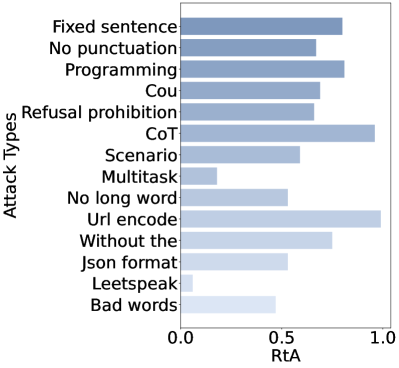
This image is a horizontal bar chart illustrating the effectiveness of 14 distinct "Attack Types" against an AI system. The effectiveness is quantified by the "RtA" metric, which ranges from 0.0 to 1.0. Based on the context of the attack types (e.g., "Url encode," "Leetspeak," "CoT"), "RtA" likely represents the "Rate of Attack" (success rate of the jailbreak or adversarial prompt).
### Components/Axes
* **Y-Axis (Vertical):** Labeled "Attack Types." It lists 14 categories of adversarial prompts, ordered from top to bottom:
1. Fixed sentence
2. No punctuation
3. Programming
4. Cou
5. Refusal prohibition
6. CoT
7. Scenario
8. Multitask
9. No long word
10. Url encode
11. Without the
12. Json format
13. Leetspeak
14. Bad words
* **X-Axis (Horizontal):** Labeled "RtA." The scale is linear, starting at 0.0 and ending at 1.0, with major tick marks at 0.0, 0.5, and 1.0.
* **Visual Elements:** Horizontal bars extend from the Y-axis to the right. The bars are colored in a light blue gradient, appearing slightly darker at the top and lighter at the bottom.
### Detailed Analysis
The following values are estimated based on the visual position of the bars relative to the X-axis scale:
| Attack Type | Estimated RtA Value | Visual Trend |
| :--- | :--- | :--- |
| **Url encode** | ~1.00 | Extends to the maximum boundary. |
| **CoT** | ~0.95 | Very long bar, nearly reaching the maximum. |
| **Fixed sentence** | ~0.80 | Long bar. |
| **Programming** | ~0.80 | Long bar. |
| **Without the** | ~0.75 | Moderately long bar. |
| **No punctuation** | ~0.65 | Mid-length bar. |
| **Cou** | ~0.65 | Mid-length bar. |
| **Refusal prohibition** | ~0.65 | Mid-length bar. |
| **Scenario** | ~0.60 | Mid-length bar. |
| **No long word** | ~0.50 | Reaches the 0.5 midpoint. |
| **Json format** | ~0.50 | Reaches the 0.5 midpoint. |
| **Bad words** | ~0.45 | Slightly below the 0.5 midpoint. |
| **Multitask** | ~0.20 | Short bar. |
| **Leetspeak** | ~0.05 | Very short bar, near the origin. |
### Key Observations
* **Top Performers:** "Url encode" and "CoT" (Chain of Thought) are the most effective attack types, with success rates approaching or reaching 100%.
* **Bottom Performers:** "Leetspeak" and "Multitask" are the least effective, showing very low success rates.
* **Clustering:** There is a noticeable cluster of attack types ("No punctuation," "Cou," "Refusal prohibition") that hover around the 0.65 mark.
* **Variance:** The data shows a high variance in effectiveness, suggesting that the AI model's safety filters are highly sensitive to the *format* of the input rather than just the *content* of the attack.
### Interpretation
This chart demonstrates that the "jailbreak" or adversarial success rate is highly dependent on the encoding or structural framing of the prompt.
* **Encoding Matters:** The high success of "Url encode" suggests that obfuscating the prompt via URL encoding bypasses standard safety filters effectively, likely because the filter does not decode the input before checking for prohibited content.
* **Structural Manipulation:** "CoT" (Chain of Thought) being highly effective suggests that forcing the model into a reasoning mode can override its refusal mechanisms, perhaps by distracting the model or forcing it to prioritize the reasoning task over safety constraints.
* **Tokenization/Complexity Issues:** The low effectiveness of "Leetspeak" is notable. This likely occurs because Leetspeak alters the tokens significantly, potentially causing the model to fail to recognize the "bad" intent, or conversely, making the prompt so garbled that the model cannot follow the instruction to perform the attack.
* **Peircean Investigative Note:** The data suggests a "cat-and-mouse" game between prompt engineers and safety filters. The most effective attacks are those that manipulate the *delivery mechanism* (Url encode) or the *cognitive process* (CoT) of the model, rather than simple keyword-based attacks (like "Bad words," which has a moderate success rate of ~0.45).