## Line Chart: Benchmark: Average
### Overview
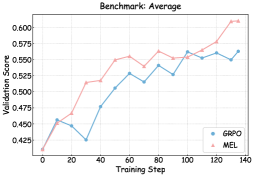
The image displays a line chart comparing the performance of two methods, labeled "GRPO" and "MEL," over the course of training. The chart plots a "Validation Score" against "Training Step," showing how each method's performance evolves. The overall trend for both methods is upward, indicating improvement with more training steps, but their trajectories and final performance levels differ.
### Components/Axes
* **Chart Title:** "Benchmark: Average" (centered at the top).
* **Y-Axis:**
* **Label:** "Validation Score" (rotated vertically on the left).
* **Scale:** Linear scale ranging from approximately 0.425 to 0.600.
* **Major Tick Marks:** Labeled at 0.425, 0.450, 0.475, 0.500, 0.525, 0.550, 0.575, 0.600.
* **X-Axis:**
* **Label:** "Training Step" (centered at the bottom).
* **Scale:** Linear scale from 0 to 140.
* **Major Tick Marks:** Labeled at 0, 20, 40, 60, 80, 100, 120, 140.
* **Legend:**
* **Position:** Bottom-right corner of the chart area.
* **Entries:**
1. **GRPO:** Represented by a blue line with circular markers.
2. **MEL:** Represented by a red line with circular markers.
* **Grid:** Light gray horizontal and vertical grid lines are present, aligning with the major tick marks on both axes.
### Detailed Analysis
**Data Series: GRPO (Blue Line)**
* **Trend:** The line shows an overall upward trend but with notable volatility. It begins with a sharp initial rise, experiences a significant dip, recovers, and then continues a generally increasing but fluctuating path.
* **Approximate Data Points:**
* Step 0: ~0.425
* Step 10: ~0.450
* Step 20: ~0.440 (local dip)
* Step 30: ~0.425 (lowest point after start)
* Step 40: ~0.475
* Step 50: ~0.500
* Step 60: ~0.525
* Step 70: ~0.510 (dip)
* Step 80: ~0.525
* Step 90: ~0.520 (dip)
* Step 100: ~0.550
* Step 110: ~0.560
* Step 120: ~0.550 (dip)
* Step 130: ~0.560
* Step 140: ~0.575
**Data Series: MEL (Red Line)**
* **Trend:** The line shows a strong, consistent upward trend with only minor fluctuations. It starts higher than GRPO and maintains a lead throughout, with the performance gap widening significantly in the later stages of training.
* **Approximate Data Points:**
* Step 0: ~0.450
* Step 10: ~0.450
* Step 20: ~0.475
* Step 30: ~0.510
* Step 40: ~0.525
* Step 50: ~0.550
* Step 60: ~0.550
* Step 70: ~0.560
* Step 80: ~0.550 (minor dip)
* Step 90: ~0.560
* Step 100: ~0.575
* Step 110: ~0.575
* Step 120: ~0.590
* Step 130: ~0.600
* Step 140: ~0.610 (highest point on chart)
### Key Observations
1. **Performance Gap:** The MEL method (red) consistently achieves a higher Validation Score than the GRPO method (blue) after the initial training steps (around step 10).
2. **Volatility vs. Stability:** The GRPO line exhibits more pronounced dips and recoveries (e.g., at steps 20, 70, 90, 120), suggesting less stable training. The MEL line is smoother, indicating more stable and reliable improvement.
3. **Divergence:** The performance gap between the two methods widens considerably after step 80. By step 140, MEL's score (~0.610) is approximately 0.035 points higher than GRPO's (~0.575).
4. **Final Trajectory:** At the final recorded step (140), the MEL line is still on a clear upward trajectory, while the GRPO line appears to be plateauing or rising more slowly.
### Interpretation
This chart demonstrates a comparative benchmark of two training methodologies. The data strongly suggests that the **MEL method is superior to the GRPO method** for this specific task, based on two key metrics:
* **Higher Final Performance:** MEL achieves a significantly higher validation score.
* **More Stable Learning:** MEL's learning curve is smoother and more consistent, which is often desirable in machine learning as it indicates robustness and predictability.
The widening gap in later training stages implies that MEL may have a better capacity for continued learning or generalization as training progresses. The volatility in the GRPO curve could indicate sensitivity to hyperparameters, batch composition, or other training instabilities. For a technical document, this chart provides clear empirical evidence favoring the adoption of the MEL approach over GRPO for the benchmarked task, assuming validation score is the primary success metric.