\n
## Diagram: Causal Diffusion Model Architecture
### Overview
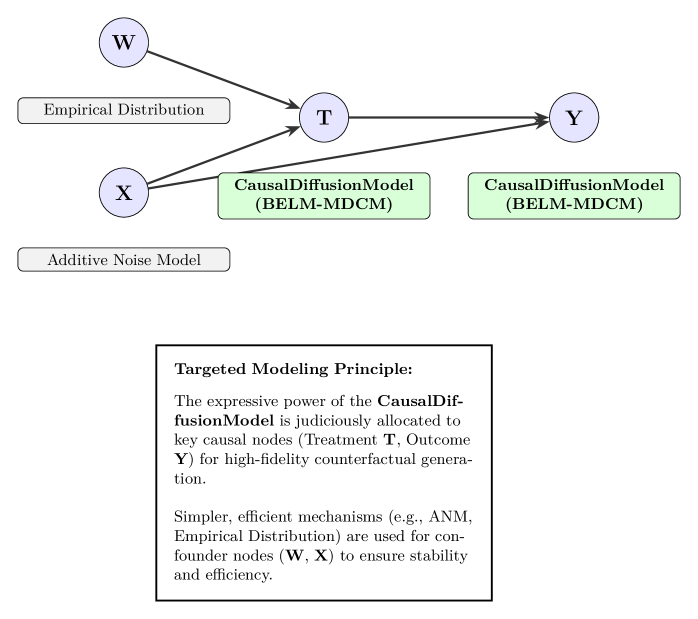
The image presents a diagram illustrating the architecture of a Causal Diffusion Model (specifically, BELM-MDCM). It depicts a causal graph with nodes representing variables and arrows indicating causal relationships. Below the graph is a block of text describing the "Targeted Modeling Principle" behind the model.
### Components/Axes
The diagram consists of the following components:
* **Nodes:** Represented by shapes (circles and rectangles).
* W: Circle, labeled "Empirical Distribution"
* X: Circle, labeled "Additive Noise Model"
* T: Rectangle, labeled "CausalDiffusionModel (BELM-MDCM)"
* Y: Rectangle, labeled "CausalDiffusionModel (BELM-MDCM)"
* **Arrows:** Indicate causal relationships between nodes.
* **Text Block:** A rectangular area containing descriptive text.
### Detailed Analysis or Content Details
The causal graph shows the following relationships:
* W (Empirical Distribution) has a causal influence on T (CausalDiffusionModel).
* X (Additive Noise Model) has a causal influence on T (CausalDiffusionModel).
* T (CausalDiffusionModel) has a causal influence on Y (CausalDiffusionModel).
The text block contains the following content:
"Targeted Modeling Principle:
The expressive power of the CausalDiffusionModel is judiciously allocated to key causal nodes (Treatment T, Outcome Y) for high-fidelity counterfactual generation.
Simpler, efficient mechanisms (e.g., ANM, Empirical Distribution) are used for confounder nodes (W, X) to ensure stability and efficiency."
### Key Observations
* The model architecture emphasizes allocating computational resources to the treatment and outcome variables (T and Y) while using simpler mechanisms for confounders (W and X).
* The diagram clearly illustrates the causal flow from empirical distribution and additive noise to the treatment, and then from the treatment to the outcome.
* The model is identified as "BELM-MDCM".
### Interpretation
The diagram and accompanying text describe a targeted modeling approach for causal diffusion models. The core idea is to focus the model's complexity on the parts of the causal graph that are most critical for generating accurate counterfactuals – the treatment and outcome variables. By using simpler mechanisms for confounders, the model aims to improve stability and efficiency. This suggests a trade-off between model expressiveness and computational cost, prioritizing accuracy in counterfactual generation over precise modeling of confounding factors. The use of "Empirical Distribution" and "Additive Noise Model" suggests a probabilistic approach to modeling the initial conditions and perturbations within the causal system. The acronym "ANM" is used in the text, but is not defined within the image.