## Chart Type: Line Chart: Greedy Accuracy vs. Training Epoch
### Overview
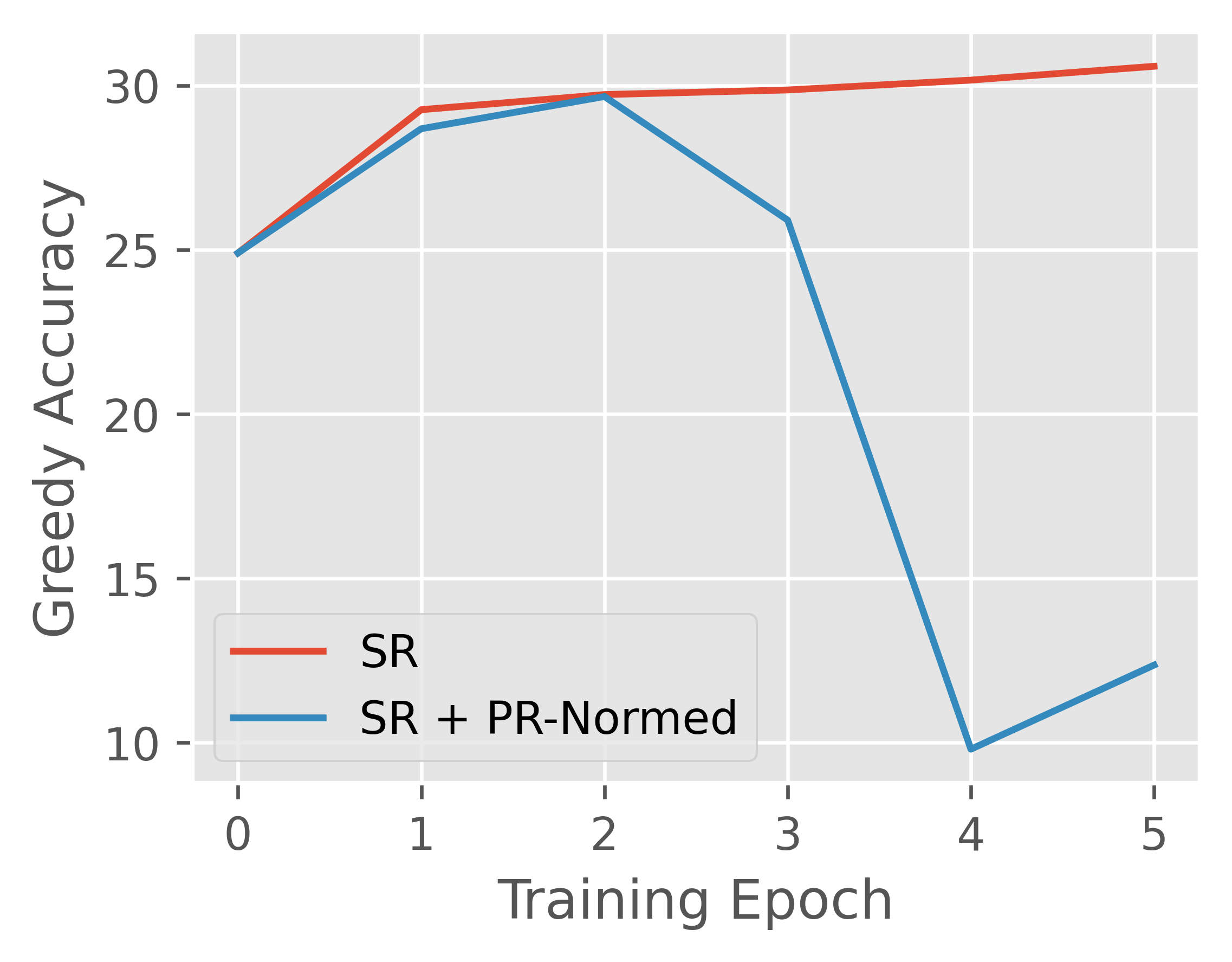
This image displays a 2D line chart comparing the "Greedy Accuracy" of two different methods, "SR" and "SR + PR-Normed", across "Training Epochs" ranging from 0 to 5. The chart illustrates how the accuracy of these methods evolves during a training process.
### Components/Axes
The chart is composed of a main plotting area with a light grey background and a grid.
* **Y-axis:**
* **Title:** "Greedy Accuracy" (oriented vertically on the left side).
* **Scale:** Ranges from approximately 8 to 31.
* **Major Ticks/Markers:** 10, 15, 20, 25, 30.
* **X-axis:**
* **Title:** "Training Epoch" (centered horizontally below the plot area).
* **Scale:** Ranges from 0 to 5.
* **Major Ticks/Markers:** 0, 1, 2, 3, 4, 5.
* **Legend:**
* **Position:** Located in the bottom-left quadrant of the main plot area.
* **Entries:**
* A solid orange-red line segment labeled "SR".
* A solid blue line segment labeled "SR + PR-Normed".
### Detailed Analysis
The chart presents two distinct data series, each represented by a colored line, showing their "Greedy Accuracy" values at different "Training Epochs".
**1. SR (Orange-Red Line):**
* **Visual Trend:** This line generally shows an upward trend from Epoch 0 to Epoch 2, then appears to plateau or show a very slight continued increase from Epoch 2 to Epoch 5.
* **Data Points (Greedy Accuracy):**
* At Training Epoch 0: Approximately 25.0
* At Training Epoch 1: Approximately 29.0
* At Training Epoch 2: Approximately 29.8
* At Training Epoch 3: Approximately 30.0
* At Training Epoch 4: Approximately 30.3
* At Training Epoch 5: Approximately 30.7
**2. SR + PR-Normed (Blue Line):**
* **Visual Trend:** This line initially shows an upward trend from Epoch 0 to Epoch 2, peaking at Epoch 2. Following this peak, there is a sharp downward trend from Epoch 2 to Epoch 4, after which it shows a slight recovery from Epoch 4 to Epoch 5.
* **Data Points (Greedy Accuracy):**
* At Training Epoch 0: Approximately 25.0
* At Training Epoch 1: Approximately 28.5
* At Training Epoch 2: Approximately 29.8
* At Training Epoch 3: Approximately 26.0
* At Training Epoch 4: Approximately 10.0
* At Training Epoch 5: Approximately 12.5
### Key Observations
* **Initial Performance:** Both methods start with the same "Greedy Accuracy" of approximately 25.0 at Training Epoch 0.
* **Early Training (Epoch 0-2):** Both methods show an increase in accuracy. The "SR" method slightly outperforms "SR + PR-Normed" at Epoch 1, but they converge to almost identical peak accuracy (around 29.8) at Epoch 2.
* **Divergence (Epoch 2-4):** After Epoch 2, the performance of the two methods diverges dramatically. The "SR" method continues to maintain or slightly improve its high accuracy, reaching over 30.0. In contrast, the "SR + PR-Normed" method experiences a severe drop in accuracy, falling from its peak of ~29.8 at Epoch 2 to a low of ~10.0 at Epoch 4.
* **Late Training (Epoch 4-5):** The "SR" method shows a continued slight increase in accuracy. The "SR + PR-Normed" method shows a minor recovery from its lowest point, increasing from ~10.0 to ~12.5, but remains significantly below its peak and the "SR" method's performance.
* **Overall Performance:** The "SR" method demonstrates consistent and robust performance, achieving and maintaining high accuracy throughout the training epochs. The "SR + PR-Normed" method, despite an initial promising trend, suffers a catastrophic performance degradation in later epochs.
### Interpretation
The data suggests that the "SR" method is more stable and effective for the task of achieving "Greedy Accuracy" over the observed training epochs. Its accuracy consistently improves or plateaus at a high level, indicating good learning and generalization without significant degradation.
Conversely, the "SR + PR-Normed" method, while initially competitive and reaching a similar peak accuracy to "SR" at Epoch 2, exhibits a critical flaw in its long-term training behavior. The sharp decline in accuracy after Epoch 2, plummeting to roughly one-third of its peak value, strongly suggests issues such as overfitting, instability in the training process, or a detrimental effect of the "PR-Normed" component as training progresses. The slight recovery at Epoch 5 is insufficient to mitigate the severe performance loss.
This comparison highlights that while adding "PR-Normed" might not immediately hinder performance (and even matches "SR" at Epoch 2), it ultimately leads to a less robust and less effective model when trained for more epochs. For practical applications, the "SR" method appears to be the superior choice based on this data, offering reliable and sustained high accuracy. Further investigation into the "PR-Normed" component would be necessary to understand why it causes such a severe performance drop in later training stages.