## Diagram: Cyclical Process
### Overview
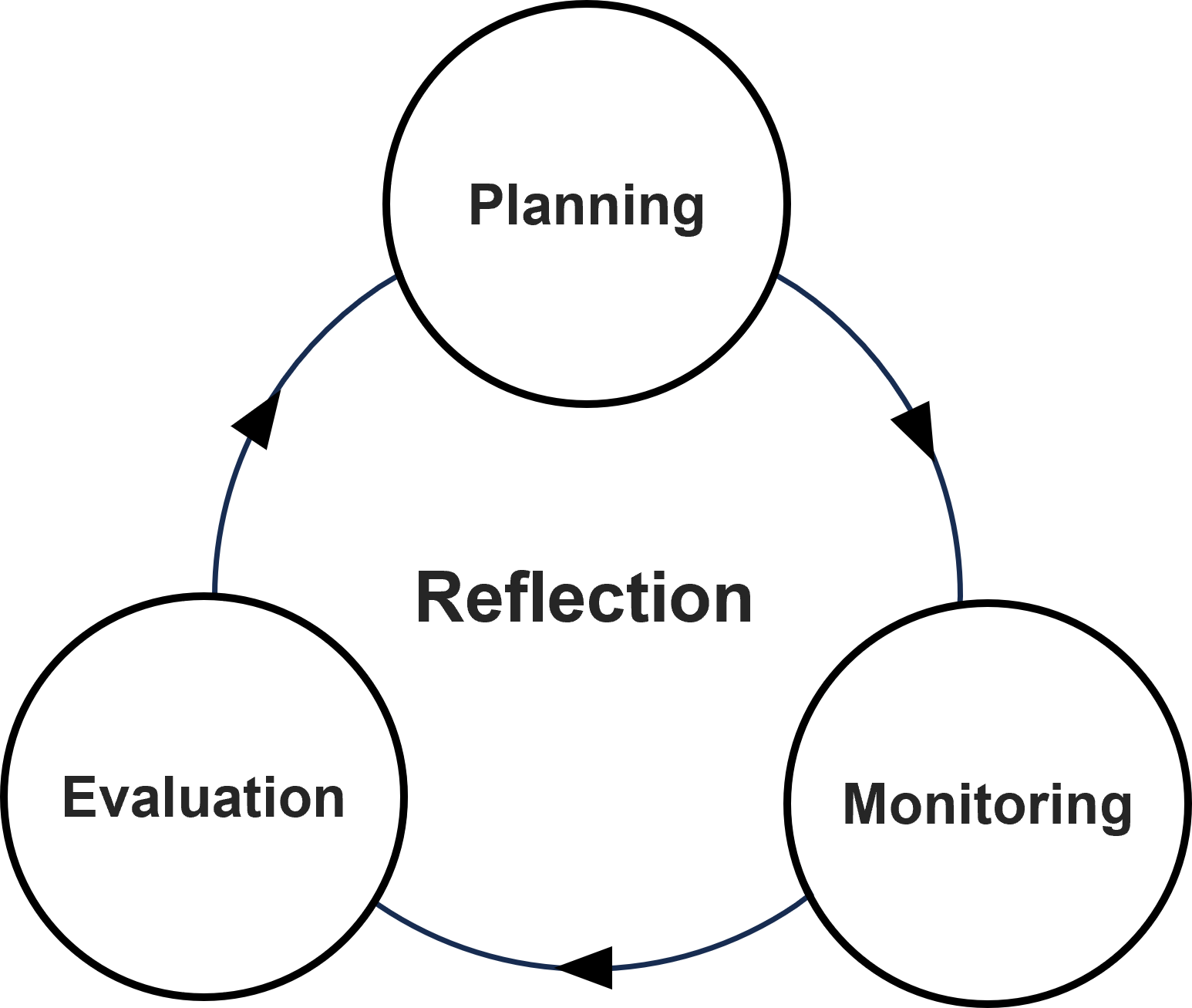
The image depicts a cyclical process diagram with four stages: Planning, Monitoring, Evaluation, and Reflection. The stages are represented by circles, and the flow between them is indicated by dark blue curved arrows.
### Components/Axes
* **Circles:** Represent the stages of the process. Each circle contains a label indicating the stage name.
* **Planning:** Located at the top of the diagram.
* **Monitoring:** Located at the bottom-right of the diagram.
* **Evaluation:** Located at the bottom-left of the diagram.
* **Arrows:** Dark blue curved arrows indicate the direction of the process flow.
* An arrow points from Planning to Monitoring.
* An arrow points from Monitoring to Evaluation.
* An arrow points from Evaluation back to Planning.
* **Reflection:** The word "Reflection" is written in the center of the diagram.
### Detailed Analysis
The diagram illustrates a continuous cycle. The process starts with Planning, moves to Monitoring, then to Evaluation, and finally returns to Planning, with Reflection being a central theme throughout the cycle.
### Key Observations
* The diagram emphasizes the iterative nature of the process.
* The placement of "Reflection" in the center suggests its importance as an overarching element influencing all stages.
### Interpretation
The diagram represents a cyclical process that involves planning, monitoring, evaluation, and reflection. The cycle suggests a continuous improvement loop where the results of evaluation inform future planning. The central placement of "Reflection" implies that it is a critical component that guides and informs each stage of the process. This type of diagram is commonly used to illustrate iterative processes in project management, quality control, and other fields where continuous improvement is desired.