\n
## Diagram: Action Reflection Cycle
### Overview
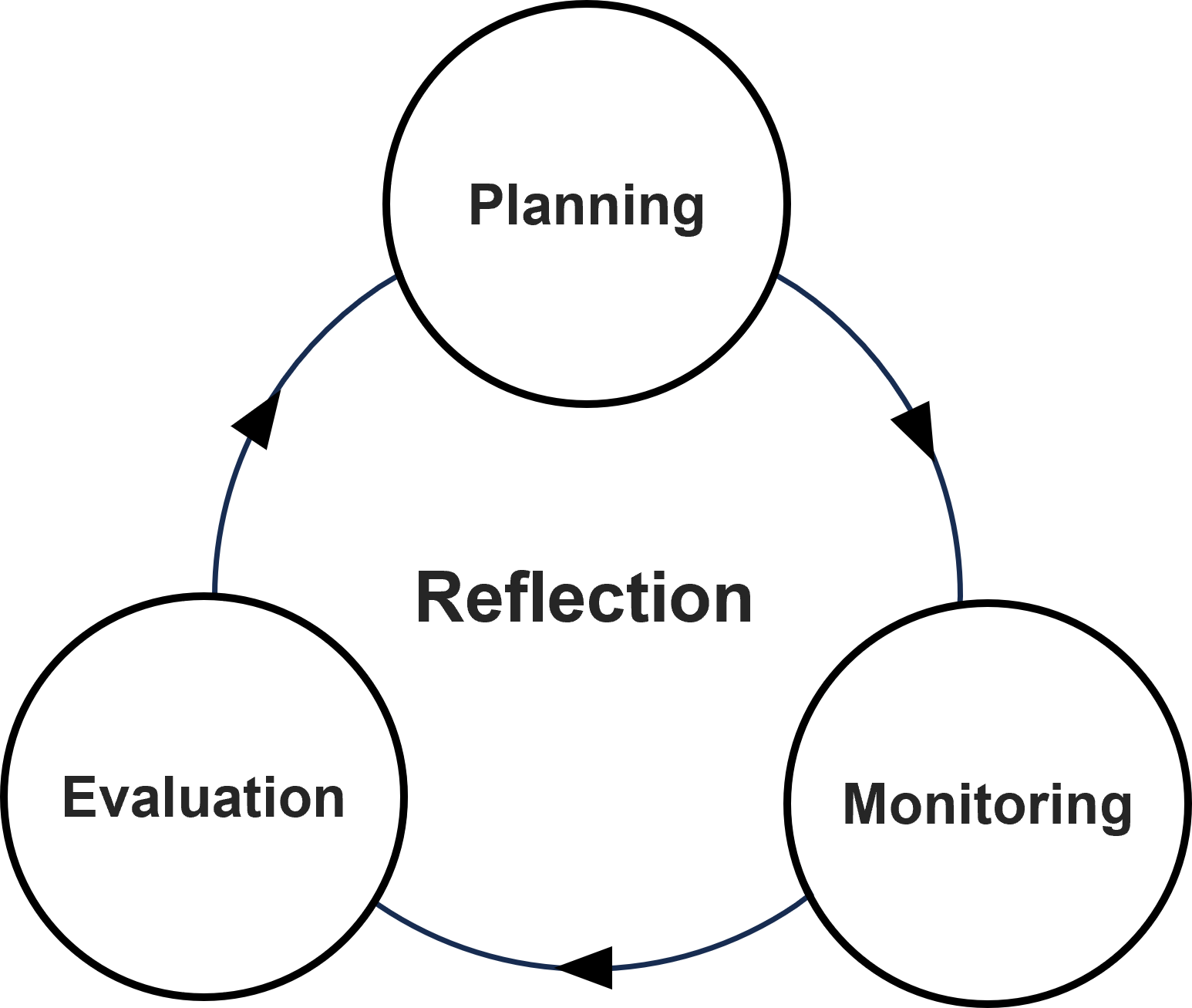
The image depicts a cyclical diagram illustrating an action-reflection cycle. It consists of four interconnected stages: Planning, Monitoring, Evaluation, and Reflection. The cycle is represented by four black-outlined circles arranged in a roughly circular pattern, with arrows indicating the flow between stages.
### Components/Axes
The diagram contains the following components:
* **Circles:** Four circles, each containing a stage of the cycle.
* **Labels:** Each circle is labeled with a stage name: "Planning", "Monitoring", "Evaluation", and "Reflection".
* **Arrows:** Curved arrows connect each stage to the next, indicating the cyclical flow. The arrows have arrowheads pointing in the direction of the cycle.
* **Central Text:** The word "Reflection" is prominently displayed in the center of the diagram.
### Detailed Analysis or Content Details
The diagram illustrates a continuous process. The stages are arranged as follows:
1. **Planning** (top center): This is the starting point of the cycle.
2. **Monitoring** (right center): Follows Planning, suggesting observation and tracking of progress.
3. **Evaluation** (bottom left): Follows Monitoring, indicating assessment of results.
4. **Reflection** (left center): Follows Evaluation, suggesting thoughtful consideration of the process.
The arrows indicate the flow: Planning -> Monitoring -> Evaluation -> Reflection -> Planning (and so on). The central "Reflection" text emphasizes the importance of this stage as a core element of the cycle.
### Key Observations
The diagram highlights the iterative nature of the process. There are no numerical values or specific data points; it's a conceptual model. The equal size and spacing of the circles suggest that each stage is considered equally important. The cyclical nature emphasizes continuous improvement and learning.
### Interpretation
This diagram represents a model for continuous learning and improvement, often used in action research or project management. It suggests that effective action involves not just *doing* (Planning, Monitoring), but also critical *thinking* (Evaluation, Reflection). The central placement of "Reflection" suggests it's the key to driving the cycle forward. The diagram implies that after reflection, the process returns to planning, informed by the insights gained from the previous cycle. This is a qualitative model, and does not contain quantitative data. It is a visual representation of a process, not a presentation of data.