## Flowchart Diagram: Cyclical Process Model with Reflection
### Overview
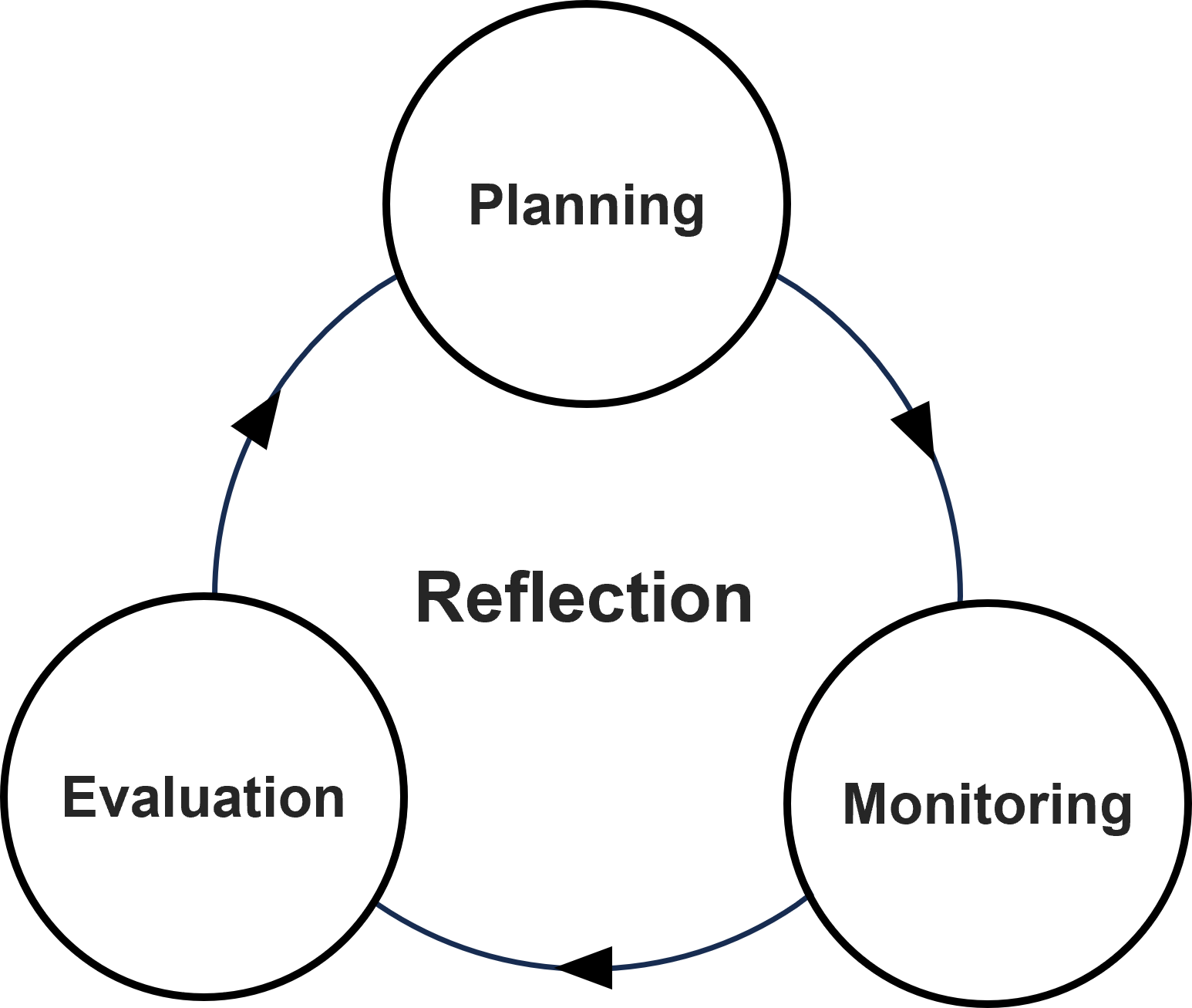
The image depicts a cyclical process model consisting of three interconnected stages (Planning, Monitoring, Evaluation) arranged in a triangular formation. A central node labeled "Reflection" connects all stages through bidirectional arrows, forming a continuous feedback loop. The diagram uses black circular nodes with white backgrounds, connected by blue arrows with black triangular arrowheads.
### Components/Axes
- **Nodes**:
- Top: "Planning" (black text, sans-serif font)
- Bottom-left: "Evaluation" (black text, sans-serif font)
- Bottom-right: "Monitoring" (black text, sans-serif font)
- **Central Element**: "Reflection" (black text, sans-serif font) positioned at the geometric center
- **Connectors**:
- Blue arrows with black triangular arrowheads
- Arrows form a triangular cycle between nodes
- Central "Reflection" node connects to all three stages via bidirectional arrows
### Detailed Analysis
1. **Node Placement**:
- "Planning" occupies the top position
- "Monitoring" and "Evaluation" form the base of the triangle
- "Reflection" is centrally located, equidistant from all three stages
2. **Flow Direction**:
- Primary cycle: Planning → Monitoring → Evaluation → Planning
- Secondary feedback: Each stage connects back to "Reflection" before proceeding to the next phase
- Bidirectional arrows suggest iterative refinement between stages
3. **Visual Hierarchy**:
- Equal-sized nodes emphasize equal importance of all stages
- Central "Reflection" acts as the process's gravitational center
- Blue arrows create visual contrast against black nodes
### Key Observations
- The model emphasizes continuous improvement through cyclical iteration
- "Reflection" serves as both a transitional phase and a quality control checkpoint
- No numerical data or quantitative metrics are present
- The triangular arrangement suggests balanced interdependence between stages
### Interpretation
This diagram represents a systems thinking approach to process management, where each operational phase (Planning, Monitoring, Evaluation) is intrinsically linked to reflective practice. The cyclical nature implies that:
1. Planning informs Monitoring, which informs Evaluation, which in turn refines future Planning
2. Reflection acts as the connective tissue between stages, ensuring lessons learned are integrated
3. The absence of endpoints suggests an infinite loop of continuous improvement
The model aligns with educational and organizational development frameworks that prioritize adaptive learning over linear progression. The equal weighting of all stages indicates that reflection is not an afterthought but a core component of each operational phase.