## Line Charts and Bar Graph: Execution Time and Performance Comparison
### Overview
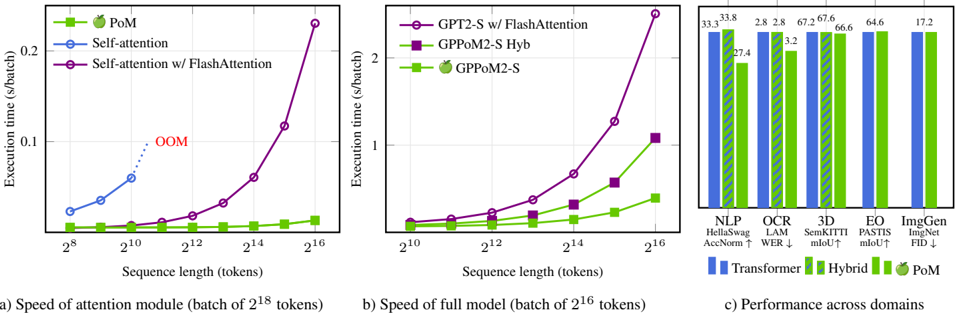
The image contains three visualizations comparing computational efficiency and performance across different attention mechanisms and model architectures. Part (a) analyzes attention module speed, part (b) evaluates full model speed, and part (c) compares domain-specific performance metrics.
---
### Components/Axes
#### Part (a): Speed of Attention Module
- **X-axis**: Sequence length (tokens) from 2⁸ to 2¹⁶ (logarithmic scale)
- **Y-axis**: Execution time (s/batch)
- **Legend**:
- Green squares: PoM
- Blue circles: Self-attention
- Purple circles: Self-attention w/ FlashAttention
- **Annotations**: "OOM" (Out of Memory) marker at 2¹⁶ for Self-attention
#### Part (b): Speed of Full Model
- **X-axis**: Sequence length (tokens) from 2¹⁰ to 2¹⁶ (logarithmic scale)
- **Y-axis**: Execution time (s/batch)
- **Legend**:
- Purple circles: GPT2-S w/ FlashAttention
- Green squares: GPPoM2-S Hyb
- Green diamonds: GPPoM2-S
#### Part (c): Performance Across Domains
- **X-axis**: Domains (NLP, OCR, 3D, EO, ImgGen)
- **Y-axis**: Performance metrics (percentage values)
- **Legend**:
- Blue bars: Transformer
- Green bars: Hybrid
- Green bars with checkmark: PoM
---
### Detailed Analysis
#### Part (a): Speed of Attention Module
- **Trend**:
- PoM (green) remains nearly flat across all sequence lengths.
- Self-attention (blue) increases gradually, with a sharp rise at 2¹⁶.
- Self-attention w/ FlashAttention (purple) follows Self-attention until 2¹⁶, then spikes dramatically.
- **Key Data Points**:
- At 2⁸: PoM ≈ 0.005, Self-attention ≈ 0.01, FlashAttention ≈ 0.01
- At 2¹⁶: PoM ≈ 0.02, Self-attention ≈ 0.15, FlashAttention ≈ 0.25 (OOM noted)
#### Part (b): Speed of Full Model
- **Trend**:
- GPPoM2-S (green diamonds) remains stable across sequence lengths.
- GPPoM2-S Hyb (green squares) increases slightly.
- GPT2-S w/ FlashAttention (purple) follows Hyb until 2¹⁶, then spikes.
- **Key Data Points**:
- At 2¹⁰: GPPoM2-S ≈ 0.05, GPPoM2-S Hyb ≈ 0.06, GPT2-S ≈ 0.07
- At 2¹⁶: GPPoM2-S ≈ 0.1, GPPoM2-S Hyb ≈ 0.15, GPT2-S ≈ 0.3 (OOM implied)
#### Part (c): Performance Across Domains
- **Trend**:
- PoM (green checkmark) outperforms Transformer and Hybrid in most domains.
- Hybrid (green) and Transformer (blue) show mixed performance.
- **Key Data Points**:
- **NLP**: Transformer 33.3%, Hybrid 27.4%, PoM 33.8%
- **OCR**: Transformer 2.8%, Hybrid 2.8%, PoM 3.2%
- **3D**: Transformer 67.2%, Hybrid 67.6%, PoM 64.6%
- **EO**: Transformer 64.6%, Hybrid 66.6%, PoM 64.6%
- **ImgGen**: Transformer 17.2%, Hybrid 17.2%, PoM 17.2%
---
### Key Observations
1. **Memory Constraints**: Self-attention and FlashAttention exhibit OOM at 2¹⁶ tokens, while PoM remains stable.
2. **Efficiency**: PoM maintains consistent execution times across sequence lengths, unlike Self-attention variants.
3. **Domain Performance**: PoM matches or exceeds Transformer/Hybrid in most domains, with notable exceptions in 3D and EO.
---
### Interpretation
- **Attention Mechanisms**: PoM's stability suggests superior scalability for long sequences, while FlashAttention's OOM limitation highlights memory bottlenecks.
- **Model Speed**: GPPoM2-S variants outperform GPT2-S with FlashAttention for shorter sequences but face similar OOM risks at 2¹⁶.
- **Domain Adaptability**: PoM's consistent performance across domains implies robustness, whereas Transformer/Hybrid show domain-specific trade-offs (e.g., 3D/EO performance dips for PoM).
- **Practical Implications**: For applications requiring long-sequence processing (e.g., genomics, long-form text), PoM may be preferable despite slightly higher baseline costs. Hybrid/Transformer combinations offer domain-specific optimizations but require careful memory management.