## Chart Type: Line Chart with Confidence Intervals: Average Correct Flips per Iteration
### Overview
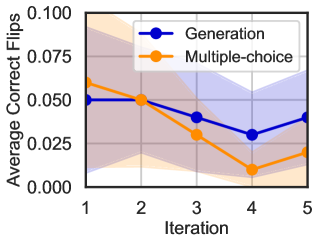
This image displays a 2D line chart comparing the "Average Correct Flips" over five "Iterations" for two distinct methods: "Generation" and "Multiple-choice". Each method is represented by a distinct colored line with circular markers, accompanied by a shaded area indicating variability or uncertainty around the mean.
### Components/Axes
* **X-axis**: Labeled "Iteration".
* Scale: Discrete integer values from 1 to 5.
* Markers: 1, 2, 3, 4, 5.
* **Y-axis**: Labeled "Average Correct Flips".
* Scale: Numeric, ranging from 0.000 to 0.100.
* Markers: 0.000, 0.025, 0.050, 0.075, 0.100.
* **Grid Lines**: Light gray horizontal grid lines are present at each Y-axis marker.
* **Legend**: Located in the top-right quadrant of the plot area.
* **Blue line with solid circle marker**: "Generation"
* **Orange line with solid circle marker**: "Multiple-choice"
* **Confidence Intervals/Shaded Areas**:
* A light blue/purple shaded region surrounds the "Generation" line, indicating its variability.
* A light orange/brown shaded region surrounds the "Multiple-choice" line, indicating its variability.
### Detailed Analysis
The chart presents two data series, each showing a trend across five iterations:
1. **Generation (Blue line with solid circle marker)**:
* **Trend**: The "Generation" line starts at a moderate level, remains stable, then decreases, and finally shows a slight recovery.
* **Data Points (approximate)**:
* Iteration 1: Approximately 0.050 Average Correct Flips. The shaded region extends from roughly 0.020 to 0.080.
* Iteration 2: Approximately 0.050 Average Correct Flips. The shaded region extends from roughly 0.035 to 0.065.
* Iteration 3: Approximately 0.040 Average Correct Flips. The shaded region extends from roughly 0.025 to 0.055.
* Iteration 4: Approximately 0.030 Average Correct Flips. The shaded region extends from roughly 0.015 to 0.045.
* Iteration 5: Approximately 0.040 Average Correct Flips. The shaded region extends from roughly 0.015 to 0.065.
2. **Multiple-choice (Orange line with solid circle marker)**:
* **Trend**: The "Multiple-choice" line starts at a higher level, then experiences a significant and continuous decline, reaching its lowest point, before showing a slight recovery.
* **Data Points (approximate)**:
* Iteration 1: Approximately 0.060 Average Correct Flips. The shaded region extends from roughly 0.030 to 0.090.
* Iteration 2: Approximately 0.050 Average Correct Flips. The shaded region extends from roughly 0.035 to 0.065.
* Iteration 3: Approximately 0.030 Average Correct Flips. The shaded region extends from roughly 0.015 to 0.045.
* Iteration 4: Approximately 0.010 Average Correct Flips. The shaded region extends from roughly 0.000 to 0.020.
* Iteration 5: Approximately 0.020 Average Correct Flips. The shaded region extends from roughly 0.005 to 0.035.
### Key Observations
* At Iteration 1, "Multiple-choice" shows a higher average (approx. 0.060) compared to "Generation" (approx. 0.050).
* At Iteration 2, both methods converge, showing approximately 0.050 Average Correct Flips.
* From Iteration 2 to Iteration 4, "Multiple-choice" experiences a sharp decline in performance, dropping from 0.050 to 0.010. In contrast, "Generation" shows a more gradual decline from 0.050 to 0.030 over the same period.
* At Iteration 4, "Multiple-choice" reaches its lowest point (approx. 0.010), while "Generation" is at a relatively higher level (approx. 0.030).
* Both methods show a slight recovery in performance from Iteration 4 to Iteration 5, with "Generation" recovering to approx. 0.040 and "Multiple-choice" to approx. 0.020.
* The shaded regions, representing variability, show significant overlap between the two methods, particularly at Iteration 1, Iteration 2, and Iteration 5, suggesting that the differences in average performance might not always be statistically significant. The variability for "Multiple-choice" appears narrower at its lowest point (Iteration 4).
### Interpretation
The data suggests that while the "Multiple-choice" method initially outperforms "Generation" in terms of "Average Correct Flips" at Iteration 1, its performance degrades significantly and rapidly over subsequent iterations. The "Generation" method, on the other hand, demonstrates more stable performance, maintaining a higher average number of correct flips from Iteration 3 onwards, despite a dip at Iteration 4.
The convergence at Iteration 2 indicates a point where both methods yield similar results. However, the subsequent divergence highlights a potential weakness in the "Multiple-choice" approach, which struggles to maintain its performance, possibly due to diminishing returns or increased difficulty over iterations. The "Generation" method appears more robust or adaptable, as it does not experience as drastic a decline and shows a stronger recovery towards the end.
The overlapping confidence intervals (shaded regions) are crucial. While the mean lines show clear trends, the overlap implies that, at certain iterations (e.g., Iteration 1, 2, and 5), the difference between the two methods might not be statistically significant, meaning the observed differences could be due to random chance within the variability of the data. However, at Iteration 4, the "Generation" method's mean is clearly outside the upper bound of the "Multiple-choice" method's confidence interval, suggesting a more significant performance advantage for "Generation" at that specific point. This chart could be demonstrating the long-term efficacy or stability of different learning or problem-solving strategies over repeated attempts or stages.