## Chart: Average Correct Flips vs. Iteration
### Overview
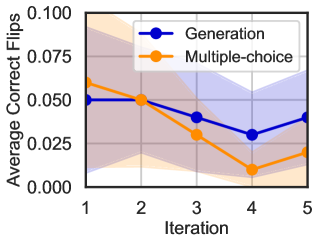
The image is a line graph comparing the average correct flips for two methods, "Generation" and "Multiple-choice," across five iterations. The graph shows the trend of average correct flips over these iterations, with shaded regions indicating variability or confidence intervals.
### Components/Axes
* **Y-axis:** "Average Correct Flips," ranging from 0.000 to 0.100 in increments of 0.025.
* **X-axis:** "Iteration," ranging from 1 to 5 in increments of 1.
* **Legend:** Located in the top-right corner.
* Blue line with circles: "Generation"
* Orange line with circles: "Multiple-choice"
* **Shaded Regions:** Shaded regions around each line indicate variability.
### Detailed Analysis
* **Generation (Blue):**
* Trend: Generally decreasing, then slightly increasing.
* Iteration 1: Approximately 0.050
* Iteration 2: Approximately 0.050
* Iteration 3: Approximately 0.040
* Iteration 4: Approximately 0.030
* Iteration 5: Approximately 0.040
* **Multiple-choice (Orange):**
* Trend: Decreasing more sharply than "Generation," then slightly increasing.
* Iteration 1: Approximately 0.065
* Iteration 2: Approximately 0.050
* Iteration 3: Approximately 0.030
* Iteration 4: Approximately 0.010
* Iteration 5: Approximately 0.020
### Key Observations
* Both methods show a decrease in average correct flips from iteration 1 to iteration 4.
* The "Multiple-choice" method experiences a more significant drop than the "Generation" method.
* Both methods show a slight increase in average correct flips from iteration 4 to iteration 5.
* The shaded regions indicate that the "Generation" method has a wider range of variability than the "Multiple-choice" method, especially in the earlier iterations.
### Interpretation
The data suggests that both "Generation" and "Multiple-choice" methods initially perform well but experience a decline in average correct flips as the iteration number increases, indicating a potential learning or adaptation challenge. The "Multiple-choice" method appears to be more susceptible to this decline. The slight increase in performance at iteration 5 for both methods could indicate a stabilization or slight improvement after the initial decline. The wider variability in the "Generation" method suggests that its performance is less consistent than the "Multiple-choice" method.