## Diagram: Character Generation Process
### Overview
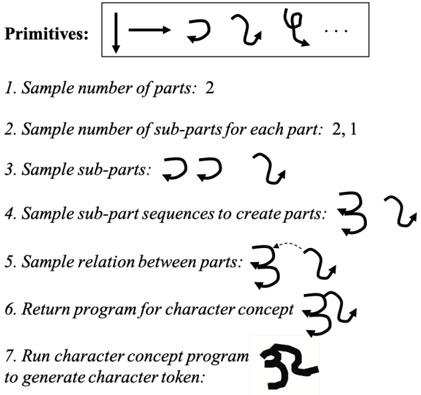
The image illustrates a process for generating character tokens from primitive shapes. It outlines a series of steps involving sampling parts, sub-parts, and their relationships to form a character concept, which is then used to generate a character token.
### Components/Axes
* **Primitives:** A set of basic shapes used as building blocks. The primitives shown are a vertical line with an arrow pointing down, a horizontal line with an arrow pointing right, a curved arrow pointing right, a curved shape resembling a "2", a curved shape resembling a "q", and an ellipsis (...).
* **Steps:** A numbered sequence of operations.
### Detailed Analysis
1. **Sample number of parts:** The number of parts is given as 2.
2. **Sample number of sub-parts for each part:** The number of sub-parts is given as 2 for the first part and 1 for the second part (2, 1).
3. **Sample sub-parts:** The sub-parts are shown as a curved arrow pointing right and a curved shape resembling a "2".
4. **Sample sub-part sequences to create parts:** The sequences are shown as a shape resembling a "3" and a curved shape resembling a "2".
5. **Sample relation between parts:** The relation between parts is illustrated by a shape resembling a "3" connected to a curved shape resembling a "2" with a dotted arrow.
6. **Return program for character concept:** The character concept is represented by a shape resembling a "32".
7. **Run character concept program to generate character token:** The final character token is a stylized shape resembling a "32".
### Key Observations
* The process starts with simple geometric primitives and builds up to a more complex character token.
* The steps involve sampling and combining sub-parts to create larger parts, and then defining relationships between these parts.
* The final character token is a result of running a program based on the character concept.
### Interpretation
The diagram demonstrates a generative approach to character design, where complex shapes are constructed from simpler primitives through a series of sampling and combination steps. This process could be used in computer graphics or handwriting recognition to generate or interpret characters. The use of sampling suggests a stochastic element, where different combinations of sub-parts could lead to variations in the final character token.