\n
## Diagram: Character Concept Generation Process
### Overview
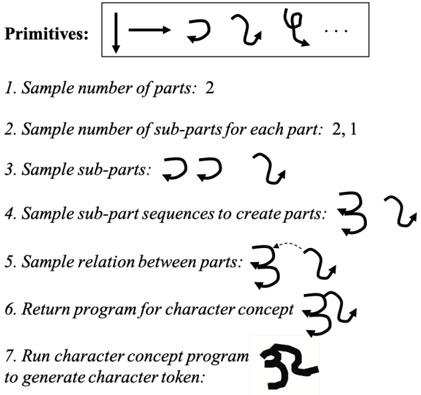
The image depicts a diagram illustrating a process for generating a character concept, starting from primitive shapes and culminating in a character token. The process involves sampling parts, sub-parts, sequences, and relations, then using a program to generate the final token.
### Components/Axes
The diagram is structured as a sequential process, numbered 1 through 7. At the top, a box labeled "Primitives:" displays a set of basic shapes: a downward arrow, a rightward arrow, a clockwise curved arrow, a wavy line, and a spiral. The diagram proceeds downwards, showing the evolution of the character concept through each step.
### Detailed Analysis or Content Details
1. **Primitives:** The initial set of primitives includes:
* Downward arrow (↓)
* Rightward arrow (→)
* Clockwise curved arrow (↻)
* Wavy line (~)
* Spiral (⦇)
* "... " indicating more primitives exist.
2. **Sample number of parts: 2** - This step indicates that the character concept will be composed of two parts.
3. **Sample number of sub-parts for each part: 2, 1** - The first part will have 2 sub-parts, and the second part will have 1 sub-part.
4. **Sample sub-parts:**
* Two clockwise curved arrows (↻↻) represent the sub-parts for the first part.
* A wavy line (~) represents the sub-part for the second part.
5. **Sample sub-part sequences to create parts:**
* The first part is created by combining the two clockwise curved arrows into a shape resembling a "3".
* The second part is the wavy line (~).
6. **Sample relation between parts:** The "3" shape and the wavy line are connected by a dotted line, indicating a relationship between the two parts.
7. **Return program for character concept:** The combined shape of the "3" and the wavy line is used as input to a program.
8. **Run character concept program to generate character token:** The program outputs a final character token, which is a more complex, filled-in shape derived from the previous steps. The final token is a dark, stylized shape combining elements of the "3" and the wavy line.
### Key Observations
The process demonstrates a compositional approach to character design, starting with simple primitives and building up complexity through sampling and combination. The use of a program in step 6 suggests an automated or algorithmic aspect to the character generation process. The final character token is significantly more detailed than the initial primitives, indicating that the program performs some form of refinement or rendering.
### Interpretation
This diagram illustrates a procedural method for character concept generation. It suggests a system where characters are not designed directly, but rather *grown* from a set of fundamental building blocks. The process is akin to a generative art system, where rules and algorithms determine the final output. The use of "sampling" implies a degree of randomness or variation in the generated characters. The final step, generating a "character token," suggests this process is intended for use in a digital environment, potentially for games or animation, where the token could represent a unique character asset. The diagram highlights a shift from manual character design to a more automated, data-driven approach. The dotted line in step 5 is important, as it shows the relationship between the parts is also a key component of the process.